
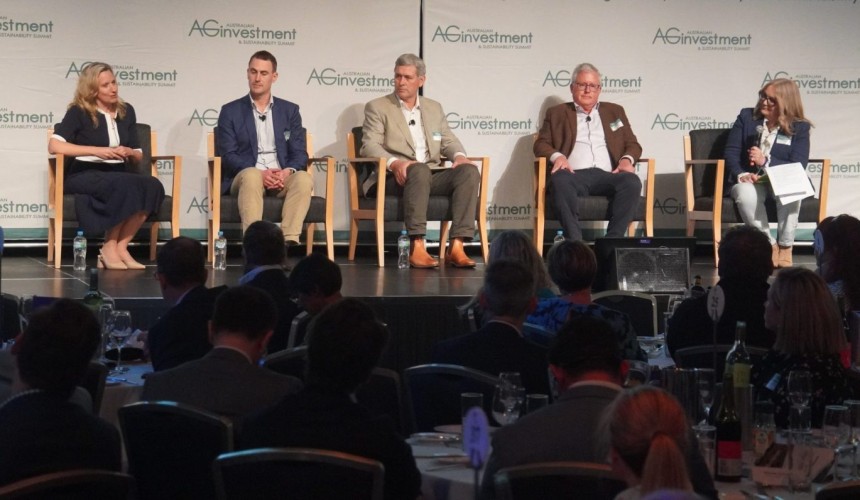
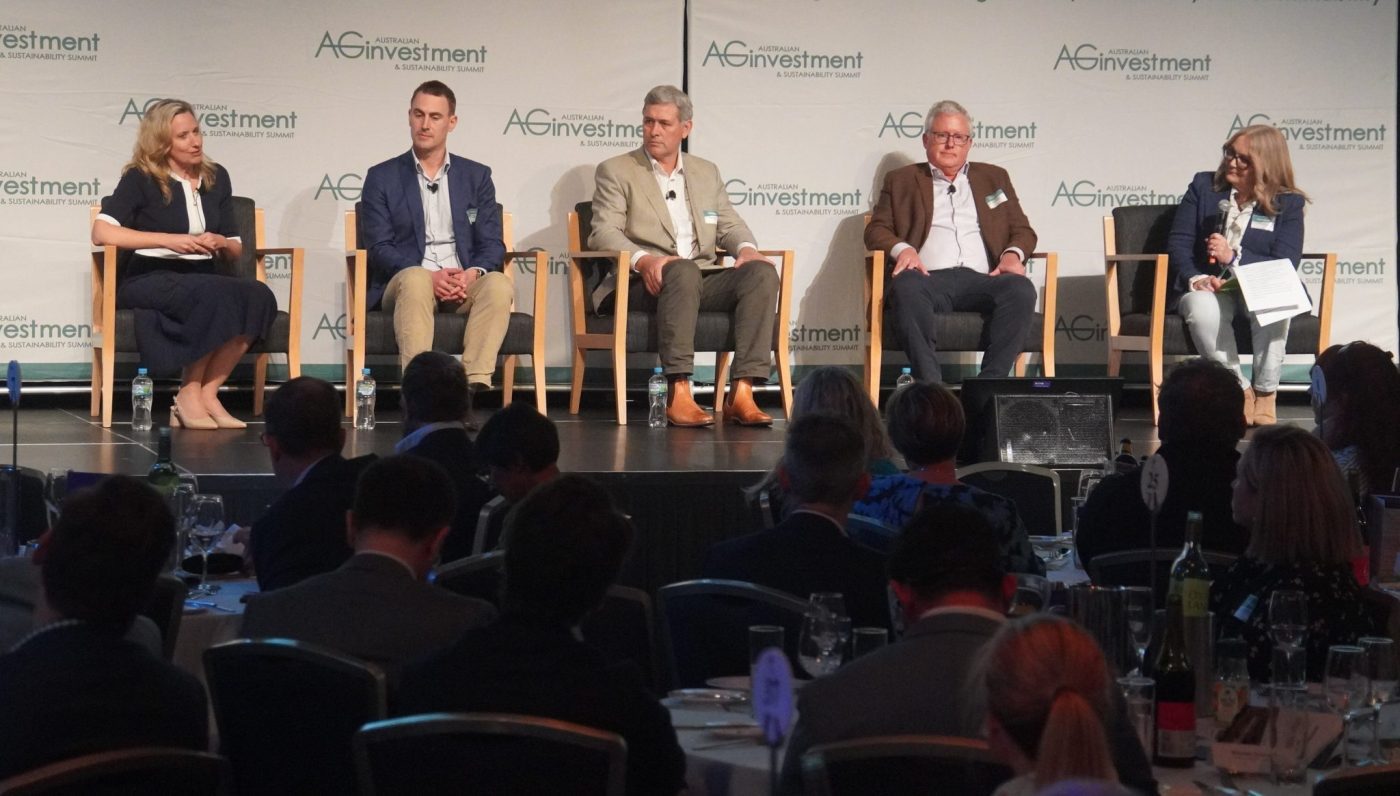
PROSPECTS for greater investment in agriculture from large Australian super funds came up during a seminar in Brisbane on Friday.
The Australian Ag Investment and sustainability summit staged by rural accountants Bentleys heard that Australia super funds had $4 trillion dollars at their disposal, with ‘much, much less than one percent’ of those funds currently allocated to agriculture.
The investment summit attracted about 500 people from across the investor, funds management, regulatory, advisory and production spaces.
Kristina Hermanson from Nuveen Natural Capital, a global ag investor with a presence in 11 countries, told the audience that while there had been some agriculture investment engagement from Australian super funds, there were also a couple of ongoing exits by super investors.
“Probably the most important thing you can do for an asset class besides really good research and education backed by data, is a good experience. We probably all hold each others hands in ensuring we get that for our investors,” she said.
“Even my parent company, which has been at the frontier of investment in ag, has just a couple of percent allocated to the ag sector. Imagine what we could do with that,” she said.
“I think your future is in super benchmarks that need to be held in the regulatory framework. They create opportunities in some spaces, but they do hold back from the fundamental farmland.
“As an Australian, I would really like some of my super fund money invested in Australian farmland,” she said, attracting applause from the audience.
 Brad Wheaton from Gunn Agri and Cunningham Cattle Co, said it was unfair to say that the Australia super industry was not engaged in agriculture.
“There are some great and successful examples over time of super funds investing in ag,” he said.
“As an investment manager, we don’t lose hope that more of that may happen. We engage and discuss, and I believe that over time that flow (from super funds) will increase, because their competitors, globally, have certainly identified the opportunity,” he said.
Asked whether super-fund contributors, themselves, should be able to ‘tick a box’ indicating they would like some of their money to go into ag, Mr Wheaton said citizens could always use a self-managed super-fund to achieve that if they wished, but said super funds were ‘democratic institutions’.
“There are certain industry super funds that harness that democracy, and direct their investments into industries that relate to their members, and have had great efficacy doing so,” he said.
“But perhaps if members want it, and have a voice, they can over time convince super investment directors to start listening.”
So does Australian ag need to tell a better story to attract super fund investors?
Bentleys Ben Cameron said the growing momentum behind natural capital in agriculture would help achieve that.
“But where I would like to see it go is that rather than super fund members ‘ticking a box,’ indicating support for ag investment, is having a requirement – regardless of which super fund you are in – to have say, 5pc of capital allocated to regional Australia.”
“There’s towns out there that need infrastructure and investment,” he said.
“We need some big projects to keep those regional centres going. Dare I say it, we need to build dams – dams bring water, water brings life, which brings a reason for people to go and live and work in those areas. Surely most Australians would not worry too much if 5pc of their super was invested in regional Australia, building infrastructure to give everyone a job.”
Carbon footprint measurement
Asked whether Bentleys was now helping its clients measure their carbon footprint, Mr Cameron said it was already happening.
“It stems from the ESG standards placed on the big end of town,” he said.
“We don’t have a lot of clients (at the scale where) they have to do the ESG reporting in their own financial reports, but what’s happening is that through the supply chain they are involved in, they have to know what their scope 3 emissions are.”
“For example, if you are selling cattle to Woolworths on a weekly basis, you’re getting tapped to say, ‘hey, we have to fill out this ESG reporting, can you give my your footprint, because I need that to fill out my Woolworths report.’
“Out of necessity, we’re doing it with our clients, and are trying to design a cost-efficient and effective way to calculate those emissions,” Mr Cameron said.
“Everyone started off years ago saying you will get a premium if you do it (ESG calculation). But you’re not going to get a premium – you’re just going to save yourself getting hit with a discount or not being able to supply by not doing it.
“If you are growing a commodity to sell to supermarkets or processors, it will probably become mainstream within four or five years.”
Food and fibre versus ‘growing trees’
Nuveen Natural Capital’s Kristina Hermanson was asked whether overseas investors in Australian ag wanted to grow feed and fibre, or ‘grow trees for carbon.’
“The investors we talk to on a broad natural capital perspective want to see the highest return from the land they invest in,” she said.
“In some instances that may require land use change, and some investors have more focus on a net zero carbon status, or a low carbon intensity model for their portfolio. But at the same time every investor knows that to drive returns, they have to develop within the community in which they operate. That will always be a mindful and careful approach.”
But is it a bad look if a local community does not want an investor intent on a carbon model? the panel was asked.
Brad Wheaton from Gunn Agri suggested it was part of a transition.
“We’re talking a lot today about the opportunity to participate in natural capital markets. But if we had had this investment gathering ten years ago, we probably would not be even mentioning the phrase, natural capital. It’s still new, and what that means is that like most new industries – take crypto-currency for example – there are charlatans, who come in, get involved, and look for opportunities, and cause damage.
“There has been a transition of natural capital servicing which has produced mixed experiences. But what we are seeing now is maturing of those markets, and in the space of service providers.
“Not only is it becoming more reliable, but the cost is also coming down. That means that not just institutional investors like ourselves, but more and more farmers of different scales are now willing to participate in those markets – whether that be a 500ha farm, 50ha of environmentally-managed trees, or operating a soil carbon project.”
Macquarie Asset Management’s head of agriculture and natural assets, Colin Rigg, said it was healthy to have debate about on topics (like landuse), and whether there were better ideas or different ways to evolve, over time.
“It might not be simply planting trees or growing crops, but also there’s the discussion around where all the renewable energy infrastructure goes. That has implications for the people whose land it is placed on, but also for the surrounding communities. And then there is the bigger national question around its contribution to our emissions as a country,” Mr Rigg said.
“All those things are very topical, and agriculture is at the forefront of a lot of that, because we are so attached to the physical asset (land).”
“But the use of our assets has always changed. There has always been questions about what we do with our land, and what we do now may be different to what we do in the future, but being open to ideas and discussion is important.”
Queensland foreign land owners tax
The inevitable questions arose around Queensland’s tax on foreign-owned land, and whether it weas impacting investment in the state.
“It is holding foreign capital back – there’s no double about it,” Bentleys’ Ben Cameron said.
“Talking about the asset growth piece and the cash yield side, which now has to stand up. I heard a story earlier in the week about a (foreign owned) farm business being taxed at 4.75pc of the unimproved value. If your asset is only generating 1pc to 1.5pc cash yield, that whole 1.5pc is going to the Queensland Government,” he said.
“It just doesn’t work. The majority of foreign capital is very good capital – they have pushed to get returns, so they invest, they spend, building infrastructure, and yes, they sell it out. But that’s good – they can’t take it with them, so what they have left is better for the next guy.
“Australia needs foreign capital, full stop, and this tax needs to be looked at.”
“Some offshore investors who would prefer to buy in Queensland are now going to new South Wales or other states, because of the tax – they just can’t make the numbers work in Queensland.”
foreign companies or foreign slush funds should pay a higher tax. it all sounds good in theory but if foreign companies can come here and get prioritised over locals to purchase our land then they are clearly benefiting in a way that's outside the profitable ability of local farming and potentially our country's tax system. also I think it would be good to remind all of the readers of the ability of these foreign and some local companies to capture government handouts. I can think of multiple situations where these monstrous companies benefit from tax funded handout schemes, that are borderline dubious. i can't afford nor would I want an office full of people to come up paiges of rubbish to fish for state and federal handouts. this is another reason why your family farm big or small is frustrated.
cheers Matthew Della Gola
I wonder if anyone at the Australian Ag Investment and sustainability summit thought to ask Macquarie Asset Management’s head of agriculture and natural assets, Colin Rigg why Macquarie are selling Paraway Pastoral?