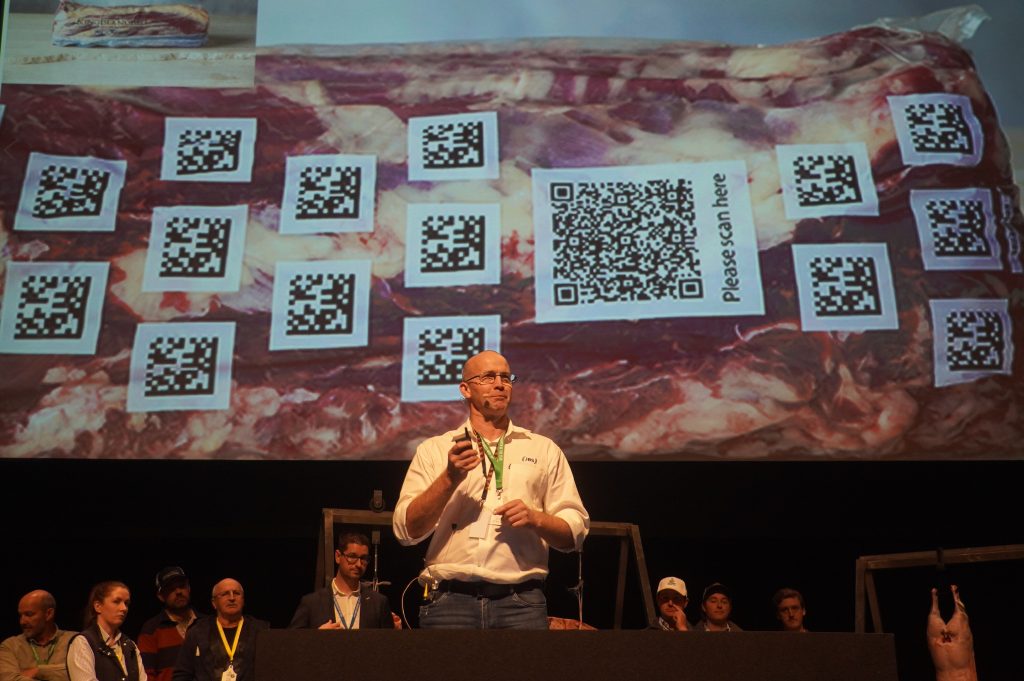
JBS Southern’s head of innovation and industrial engineering Sean Starling leads a session during the Melbourne Great Southern conference
TECHNOLOGY, automation and artificial intelligence are playing increasingly important roles right across the JBS beef and lamb businesses, stakeholders attending the company’s recent Great Southern supplier network gathering in Melbourne heard.
From feedlots to retail shelves, tech is driving elevated levels of traceability, production and labour efficiency across the JBS Southern business.
JBS Southern’s head of innovation and industrial engineering Sean Starling showcased a bunch of technologies making an impact across the company’s red meat supply chain, including some novel ‘hands on’ demonstrations using selected folk from the audience.
JBS Southern was making a big investment in innovation, in various forms, Mr Starling said.
Reflecting the ‘frontier’ nature of the tech space, he said most of the company personnel working in innovation were relatively young in age, often fresh graduates. He acknowledged contributions in the tech space from the Australian Meat Processor Corporation and Meat & Livestock Australia.
Here’s a quick sample of some of the tech on show:
Autonomous drones
JBS’s Yambinya Station and Beef City feedlots are part of a trial using remote sensing autonomous drones for novel purposes, developed by tech company Sensorem.
Sensorem’s managing director Ed Boxall explained that early sensing drone deployments had been with ‘tier one’ companies like Telstra, BHP, and Rio Tinto. Agriculture was the latest segment. Currently the company has 23 systems in operation in large and complex sites in WA, Queensland and NSW, with another 20 systems soon to start.
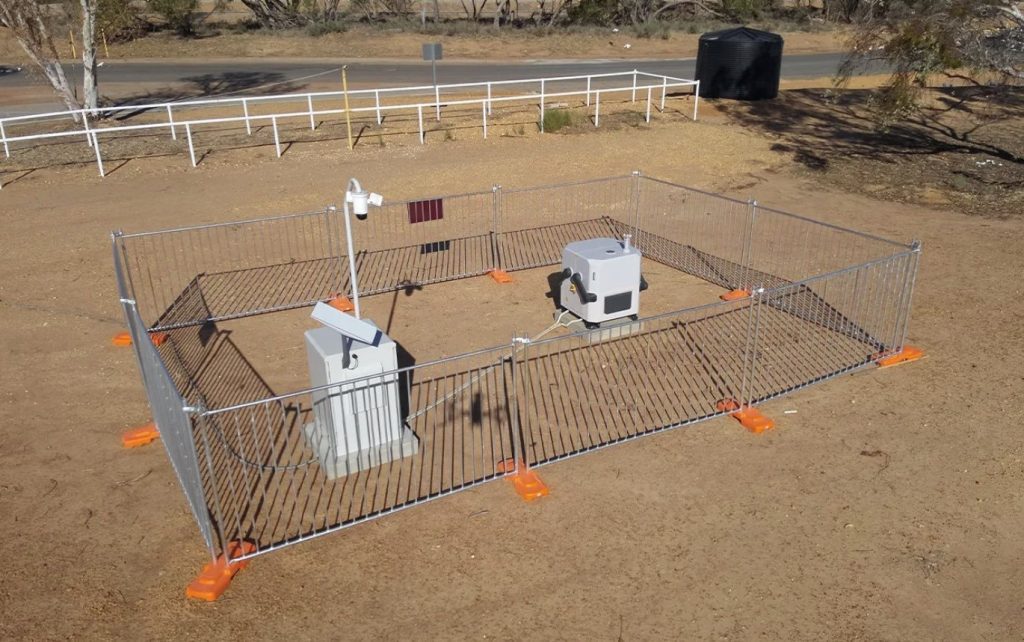
Autonomous drone in its docking station and hangar
For the JBS feedlot sites, Sensorem uses its ‘Drone in a box’ system – designed to operate completely autonomously, rather than being controlled by a ‘pilot’ on site. Each drone launches and lands from a ‘dock’, where it is automatically re-charged before its next use. Each drone can be used day or night, under remote control and monitoring from Sensorem’s pilots based in Perth, managing multiple drones in use across Australia simultaneously.
The drones are connected and operate via satellite, and can be fitted with speaker systems, spotlights, and thermal or visual cameras (still or live video). Each drone can be launched within a couple of minutes, when required.
JBS feedlot management teams can view the video footage live, allowing them to make decisions in real time, Mr Boxall said.
“Whether it is cattle monitoring or site security, the live stream is available to anyone with a user log-in and internet access, via mobile phone,” he said.
Mr Boxall suggested there were literally hundreds of use-cases for the autonomous drones, with 90 already suggested for the JBS Yambinya site alone:
 Bird management or bird scaring, around bulk grain storages. This was the ag application where ‘drone in a box’ technology had started, and was now one of the most proven use cases, pioneered by grain handling company CBH in Western Australia. CBH had deployed six units at its grain receival sites, already completing 4000 autonomous missions. “It protects the grain, but also protects that tarps that cover them,” Mr Boxall said. Pre-programmed bird-of-prey sounds and flashing lights are used as bird deterrents.
- At Beef City, the autonomous drones are now used 24/7 for site security, detecting any unauthorised activity across sites. In one recent episode in WA, a detection was made of someone stealing copper wire from a grain site, at 2.15am.
- Visual images of loading and unloading of cattle to ensure welfare standards and operating procedures are maintained
- The thermal cameras and high-resolution imaging on the drones holds possibilities for livestock health monitoring, looking for elevated body temperatures, signs of distress or any unusual behaviour – even at night. Using inbuilt or purpose-built AI, the detection of the issue can be fully automated, Mr Boxall said.
- Temperature monitoring of hay storages, using thermal sensors on drones to prevent haystack fires and protect feed supplies. Alarms can be used when trigger levels are reached. In this case we let the drone and the software do all of the work,” Mr Boxall said.
- Measuring manure stockpile volumes to improve planning as well as inspecting site infrastructure. In an example at Yambinya feedlot, the drone took 18 minutes to collect manure stockpile data, processed in the cloud, and delivering a report within two hours.
- Inspecting yards, feedlots, water systems, all without the need to put staff or contractors back out into the field.
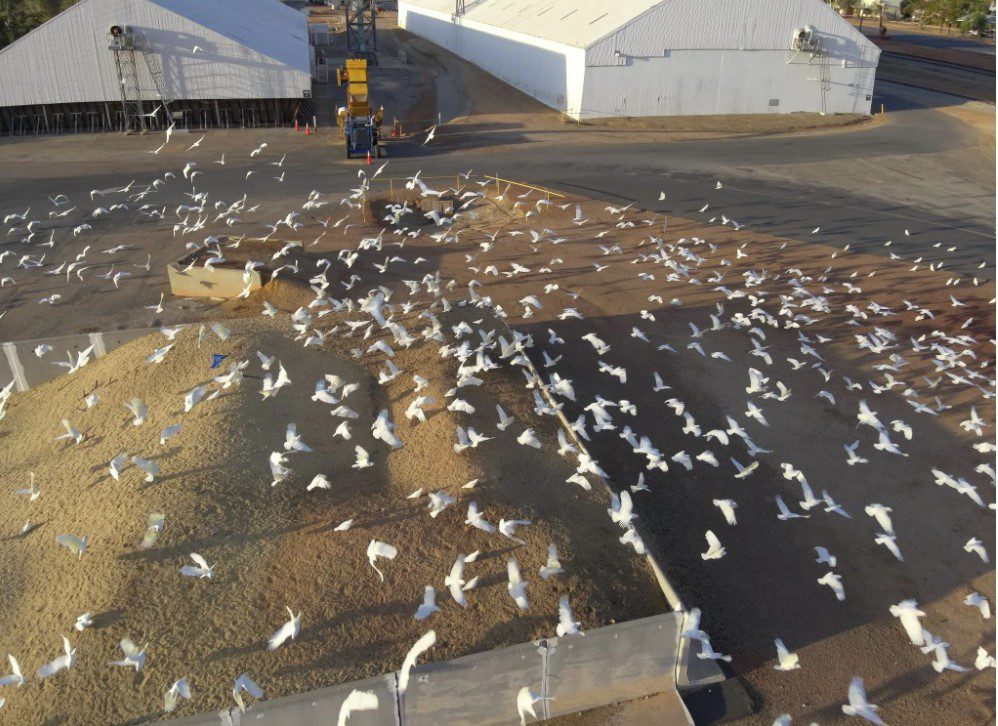
Autonomous drones are being used to manage bird problems around bulk grain storages at feedlots
The drone-in-a-box system needs only a simple power connection, and the inbuilt drone ‘hangar’ means it is designed for all weather events.
Shadow robotics:
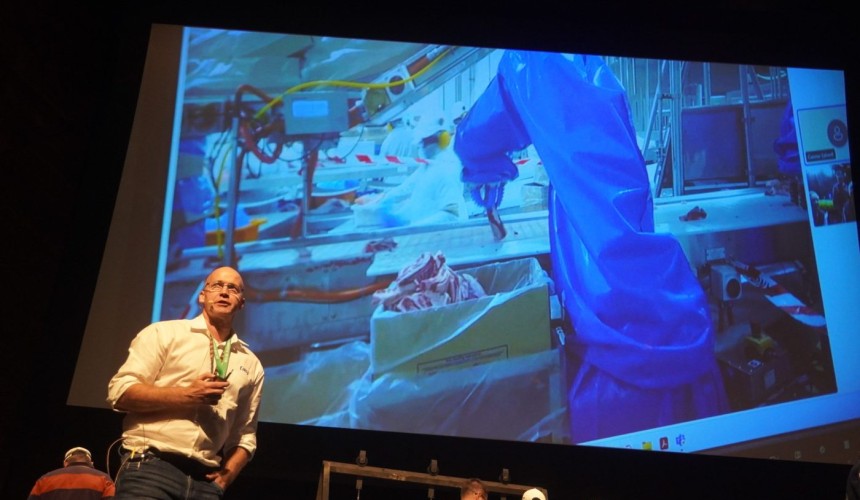
The Great Southern event audience in Melbourne saw a live demonstration of shadow robotics in use, where a person at the event was able to manipulate a robotic arm located some 15 km away along a processing line in JBS’s Brooklyn facility – picking up and relocating pieces of red meat on a conveyor belt.
“That’s taking working-from-home to the next level,” one commentator said.
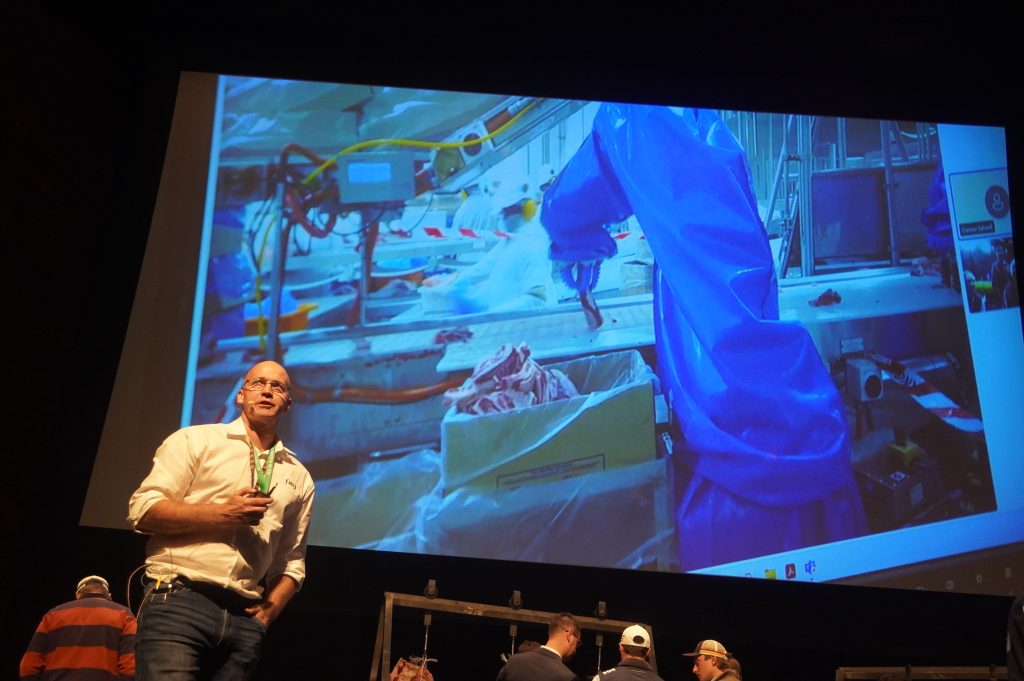
A member of the audience was controlling the shadow robot arm pictured on the screen behind Sean Starling, picking and packing pieces of red meat on a conveyor belt 15km away at the JBS Brooklyn processing facility
“Picture a uni student: rather than working in pub, could they be working remotely for us at Brooklyn, helping pack meat using a shadow robot connection. Could it be used by a retiree, at home? – it’s the first in the world that we’re aware of,” Mr Starling said.
“We’ve been trialling this technology for two years now, and it could take another 12 months before we are ready to use this every day – and then we will see how far we can take it.”
Another possibility was to use camera-based AI to ‘recognise’ certain muscle shapes travelling along a conveyor belt to do its own ‘picking and packing.’
“Where we can fully automate such tasks, we will – but we just know that the variability in our industry is a challenge. This will allow us to learn some more information about those cuts. It could go in lots of different directions.”
MEQ Probe grading
Objective measurement is a very busy space in the red meat processing field at present, with lots of industry collaboration amongst processors and producers.
At the JBS Bordertown plant, the company is in the process of setting up every piece of objective carcase measurement technology it can get its hands on. That includes RAMP technologies to try to improve RFID reading systems (hook tracking etc), readers for QR codes, Murdoch University’s lamb system hot GR measurement and IMF measurement devices, MEQ mini-probes and DEXA X-ray technology.
“By Christmas, that will all be running – providing feedback for us first, so we can understand whether we trust it, and if so, what we can do with it,” Mr Starling said.
The MEQ beef grading camera was demonstrated on stage at the Melbourne event, now being rolled-out into three southern and three northern JBS beef sites. JBS Brooklyn is expected to go live over the next month, with Longford in Tasmania and Scone (NSW) to follow after that.
Grading camera technology results are being cross referenced with JBS manual graders, so long-term, what does carcase feedback look like? Mr Starling was asked.
He showed high-resolution eye-muscle images scanned using MEQ only a few days earlier.
“Potentially, that’s the sort of feedback a producer could get. It may not be necessary or even wanted on everything we grade, but the portal will give access to it, at the sites when it is implemented,” Mr Starling said.
A prototype MEQ device for on-farm live animal decision-making use was also discussed, but is still some way off commercial reality. MEQ also recently announced that it has become the first company in the world to receive USDA certification for its video-based beef grading technology.
All of the tech featured in the presentation was already AusMeat approved, or at least going through AusMeat approval, Mr Starling said.
Automation
JBS has been a pioneer in in-plant processing robotics, especially in lamb scribing, instructed by scanning.
One of the many attractions with robot cutting was the yield cost in lamb carcases.
 “We have found that every millimetre you can get right in accurate cutting lines in lamb can be worth $1 million to the supply chain,” Mr Starling said.
“That’s why we are chasing so hard in some of these automation activities – it’s not only about replacing labour, but in making sure those saw cuts are in exactly the right spot, every time.”
So where is the process up to in beef, which by nature of its sheer mass is more challenging than a lamb carcase.
A protype robotic saw currently housed at JBS Brooklyn takes the chine bone out of a bone-in beef striploin. Once again, a world first, JBS claims. A second, very similar robot will take the chine bone out of a cube roll, and a third will cut up forequarters. All are under different levels of development.
Robots were an important part of improving consistency of product flow around a fabrication or boning room.
“One of the things we didn’t understand before we started putting robotics into lamb is that because they are at the start of the fabrication room, they set the speed of the room,” Mr Starling said. “Think of dragon boat racing, where the guy beating the drum sets the pace for everybody else in the crew. It delivers nice, consistent product flow for processing staff further downstream.”
“Consistency of product flow in the fabrication room is good for food safety, but also for our operational staff.”
Hook tracking
The use of hook tracking technology allows the tracking of every individual carcase on every chain, linked back to weigh tickets and electronic grading. JBS stressed that this was still ‘work in progress’, and was some way from commercial reality. The company is still etching a large number of rail hooks and installing readers to send data to the IT system to allow delivery of feedback.
“We would anticipate that by Christmas this year, at JBS Bordertown where we are getting all of that measurement technology in place, we will be able to link back through hook traceability,” Mr Starling said.
Beyond the processing plant, JBS is also moving towards automation of other tasks that are either ‘ugly or less desirable.’ An example was an automated manure collector designed to operate under slatted sheep pens, replacing a bobcat and driver.
Artificial intelligence
Mr Starling said AI was currently a little like blockchain a decade ago, when there were lots of consultants running around trying to sell it, but very few who actually knew how to do it.
“We’re working with some of those few who we believe can actually do it quite well.”
An example application was in counting livestock, off truck.
“We are using (an AI version of) this to validate our eNVD documentation on sheep arrivals,” he said.
“We have learned a lot with (tech partner) Lumichain since 2022. Even the location of the sun at different times of year can affect the performance. We’ve had to recalibrate the technology for all these things, over two or three years of continuous evolution, and it’s at a point now where it works.”
The technology is now so good that if a lamb turns around and goes the other way, it knows that it has already been counted. Another one is working dogs in the image – there were some really funny-looking lambs being counted in the early stages.”
AI is also being used in-plant, to reduce the amount of plastic packaging material used in the manufacturing process.
“We are stating to use AI to understand how to run our plants more efficiently,” Mr Starling said.