
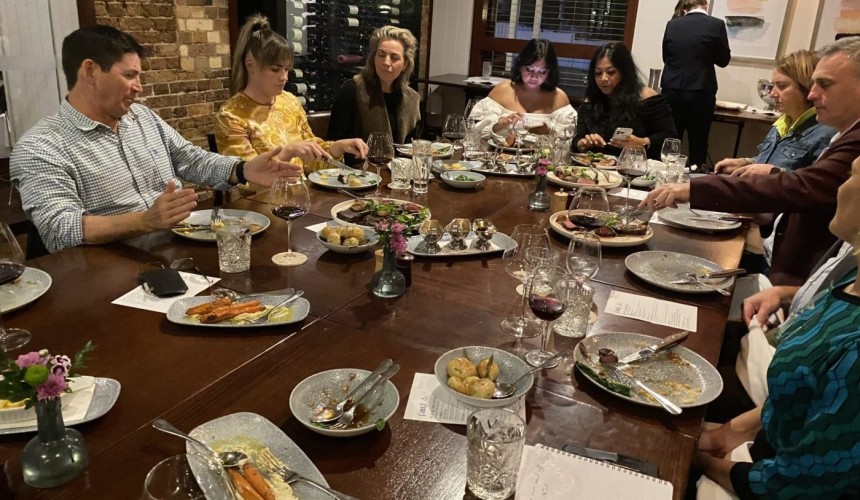
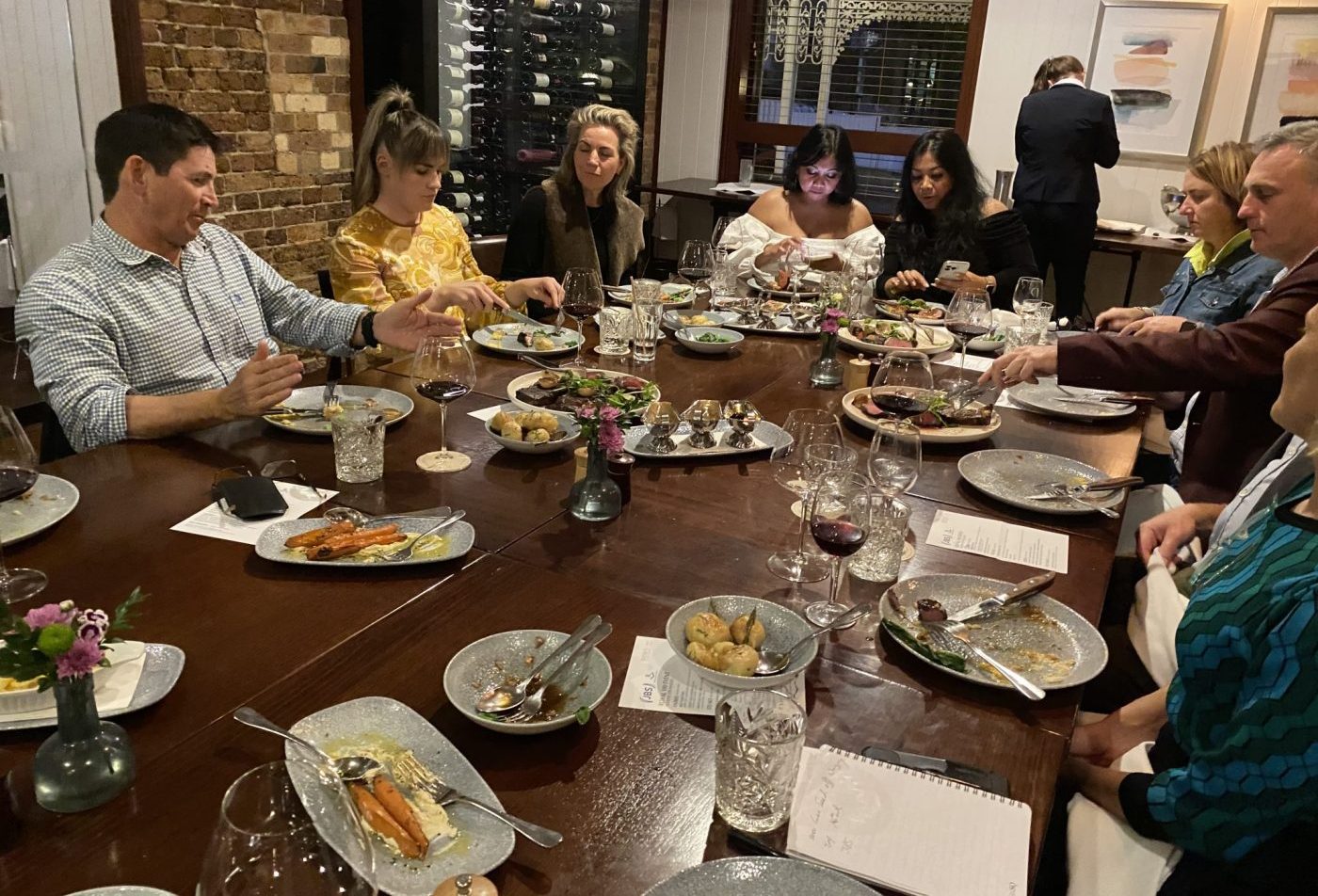
Russell Pastoral Co’s Adam Armstrong, left explains the production history behind this year’s RNA paddock-to-palate weightgain winners during the JBS dinner at Brisbane’s Storey Bridge Hotel on Tuesday night. Click on image for a larger view
HETEROSIS (or hybrid vigour) is an under-utilised resource in the Australian beef industry, the winner of the 2025 RNA 100-day grainfed carcase competition weightgain results says.
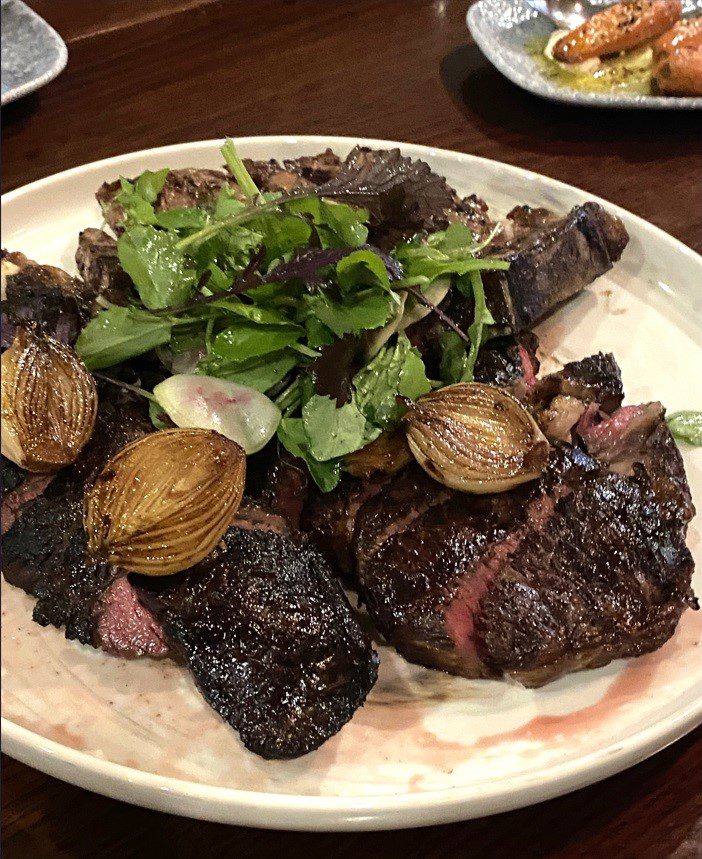
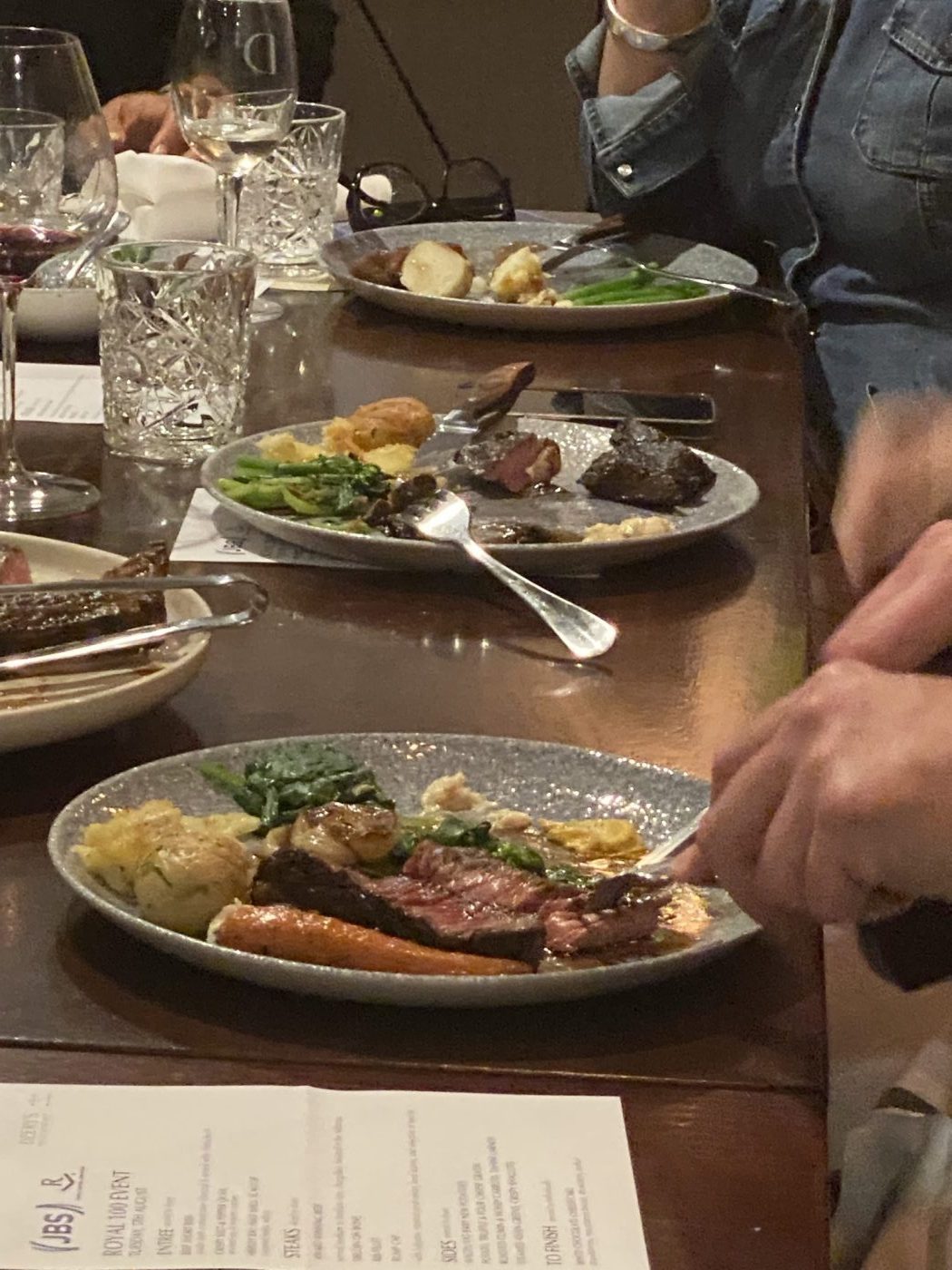
As part of the lead-up to this week’s Brisbane Royal Show, JBS Australia hosted a dinner at Brisbane’s popular Story Bridge hotel steak restaurant on Tuesday featuring product from the weightgain division winners in this year’s 100-day Paddock-to-Palate performance classes.
Russell Pastoral Co’s has been a consistent performer in the competition over the past decade, topping this year’s weightgain entries with teams displaying ADGs of 2.797kg, along with the highest individual weight gain in that class of 2.87kg. And it was no fluke, with same winners last year averaged 2.75kg and 2.71kg/day.
JBS Australia fed and processed both 100-day RNA classes (open and HGP-free) at the company’s Beef City feedlot and processing plant near Toowoomba. The feedlot weightgain component was announced earlier, with overall results being announced at the annual carcase competition dinner at the showgrounds tomorrow night.
Russell Pastoral Co’s managing director Adam Armstrong was on hand at Tuesday night’s tasting dinner to provide some background on the production origins of the beef.
His entries this year were similar to earlier years: true crossbreds produced from a combination of Angus, Charolais and composite genetics over an original Braford and Shorthorn herd base, produced on Mitchell/Flinders grass country on the company’s extensive Champion Station near Blackall in Central Western Queensland.
Covering some 55,000ha, Champion runs around 5000 breeding cows, and produces around 2000 conventional feeder steers each year – virtually all of which go through JBS programs like Yardstick at Beef City or Mungindi feedlots.
Young cattle are transported south for growing out and backgrounding on Russell Pastoral’s Jimbour Station near Dalby, and a second property across the border in northern NSW.
Witches brew of genetics
“The reason, I believe why we have been successful in the competition is hybrid vigour,” Adam Armstrong told this week’s dinner audience.
“Ours is an Angus-based herd these days, but the genetics is a real witches’ brew,” he said. “One day we may get it spectacularly wrong, but at the moment it is going well.”
 Adam’s late father, John Armstrong, was well known across the northern beef industry as company cattle vet with Stanbroke Pastoral Co for 22 years (click here to read Beef Central’s earlier tribute).
At the time Stanbroke was the largest cattle operation in the world, running 600,000 head at one point. John played a key role in the development of the Stanbroke composite genetics program, and much of that philosophy was imprinted on his son, Adam.
The art was in balancing genetics required for adaptation in Stanbroke’s far northern breeding country, with meat quality and feedlot performance.
Asked whether the beef industry today was putting enough emphasis on the ‘free kick’ provided by heterosis, Mr Armstrong said he believed it was not.
“There’s a lot of weightgain advantage which is being overlooked – 100 percent,” he said.
Russell Pastoral is buying Charolais bulls again this year to keep the rotation and the heterific effect going – despite the premiums that are available for Angus program-eligible feeder cattle.
Performing of the breeder, lotfeeder and processor
“Our aim is to produce cattle that equally, perform for us, in terms of fertility and growth on the station, but also perform in the feedlot and in the chillers,” Adam Armstrong told this week’s dinner audience.
“We remain very focussed on the end-market – and the end market to us is not the retailer or restaurant, but JBS, which is a very good customer of ours. We want them to make as much money as they can out of our cattle in the meatworks and feedlot, as well as ourselves.”
“Through genetic selection and management, we are very focussed on making sure the eating quality remains high.”
As an example of that, Russell Pastoral is currently putting particular selection emphasis on intra-muscular fat (marbling).
“Trying to breed a very high-value animal in our environment is not easy,” Mr Armstrong said, “but they have to make money for us, and our customers – the lotfeeder, the processor and the wholesaler selling it to end-customers here or overseas.”
 He said he saw the RNA paddock to palate competition as a very good way to benchmark where Russell Pastoral’s cattle sat in the industry.
“Some of the best cattle studs in Australia put entries into the RNA performance classes, and they are trying to win this to promote their bull breeding businesses.”
Asked what the ‘formula was’ to win a performance class like this (some in the room were not beef industry people) , Mr Armstrong said there was science behind the genetic selection decisions, but equally, some of it was subjective.
“I will look at what the market is telling us they want – and the way they do that is through price signals – and we’ll try to anticipate what the future market will be looking for,” he said.
“When I started with RPC in 2007, there was a market signal in terms of small premiums for black cattle, which were foreign to our northern environment at the time. We introduced some Angus cattle, looking at specific bloodlines that had growth and survivability for a tough environment.
“But we had started with late-maturing Braford cattle, which were great for lotfeeders, but not so good for us. We were selling them just as they were about to bloom.
“We had to work out a way to produce earlier-maturing cattle so we could share the bounty more, rather than just handing that to the lotfeeder.”
Objective measurement
Paddock performance measurement is now a big part of the Champion Station management approach.
“We have gone from highly subjective measurement to a point where Champion Station has just signed a contract with MLA for an innovation project around the use of Vence (Merck) virtual fencing using collars, used at scale, with around 1150 cows involved.
That project will become a Producer Demonstration Site.
Carbon, methane, sustainability
Soil carbon assessment has also become another key focus.
“We’re looking at what the world is saying – and they want lower emissions cattle, carbon sequestration and environment.
 “We’re working on a project with JBS, with data currently being collected in the feedlot, while working on our own emissions factors. Feed conversion efficiency has a 95pc correlation with methane emissions, meaning if I can make my cattle more productive (in terms of NFE) I can also lower my methane emissions at the same time. That’s a win-win.”
Russell Pastoral Co is already actively selecting cattle for net feed efficiency, started through sire lines, especially in the company’s second Wagyu production stream, where every bull and female in the stud is measured using the Vytelle Growsafe feed testing units. At the same time cattle are tested using GreenFeed methane emissions testing units, which is proving-up the correlations between feed efficiency and methane output.
“There are markets in carbon at the moment, and there’s about to be markets in the whole natural capital space – and we’re working with companies at present working with the federal government in this space. We have to benchmark our natural capital, at Blackall,” Mr Armstrong said.
“Just on our woody biomass alone, right now, we have 30,000ac of timbered country that sequesters more carbon than our total emissions – and that does not account for the other 100,000ac of grassland country.
“Champion Station, alone, has the potential to sequester carbon at rates equivalent to (the output of) a medium-sized coalmine. We can sequester more carbon than they can emit,” he said.
“We’re working with third-party auditors (who are in turn working with the Federal Government) at the moment on exactly that – measuring every aspect.”
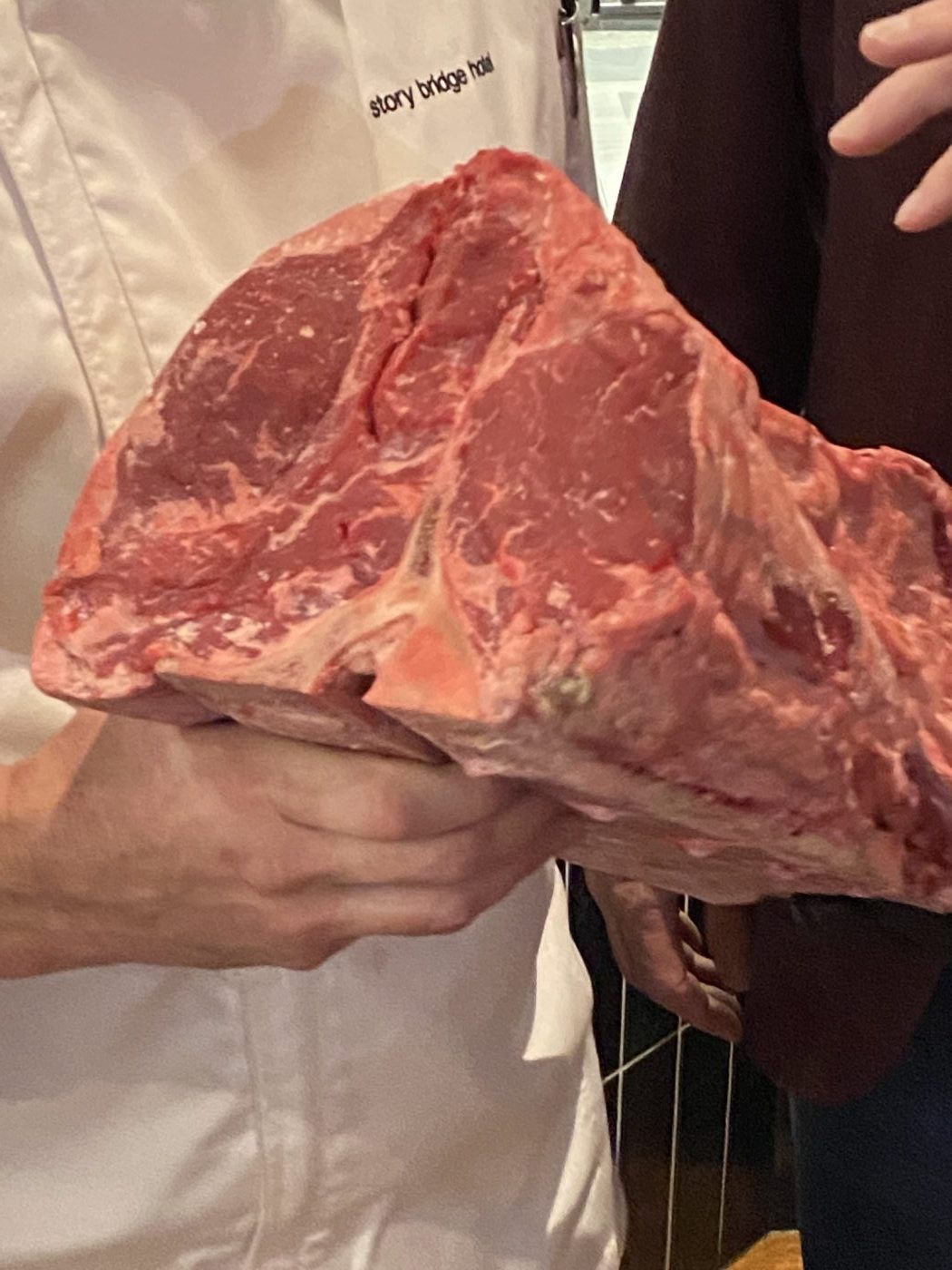
Full T-bones produced from Russell Pastoral’s Paddock-to-Palate competition winners
“This is a brave new world for the grazing industry – some of it may not happen, but some of it will.”
“I will be able to go to JBS (cattle buyers) and say, here are my emissions, here is my sequestration, and here is my overall natural capital map. We’re very excited about it, because our ecological score-card is off the charts.”
“And we are no different than any of our neighbours – Champion Station is not doing anything special – but the ecologists are stunned at the ecological work that’s going on and the results coming back.”
Mr Armstrong said the biggest enemy to the environment and the biggest contributors to global warming were vegans, because they wanted to “lock land up, and put trees on it.”
“But grass has a carbon sequestration capacity three times that of trees,” he said.
“The way to maximise that is through consumption of that grass to exaggerate photo-synthesis. And the best tool to do that is a cow.”
“So if you want to save the planet, eat a steak.”
Brilliant article
I'm 71 and breed cattle for many years
I tell my son that if we don't adapt and focus on what the market wants in terms of feeder type we will vanish
Wet run commercial DMaster breeders with PB DMaster bulls from Valera Vale
But we are about to introduce Angus bulls this season
Totally agree with most of Adams comments except where he intends to put a European breed back in the programme but hopes to lift IMF . The more muscle the less IMF as a rule. I think the Hereford or Shorthorn would be better options.
I really liked the last two paragraph's which need to be shouted out loud and clear, to the World.
Great story.
Great article, Adam. You covered most of the significant issues in the beef industry. You have built on your father's excepptional capabilities, speaking from someone who worked for & with your father, and a great friend of your family with enormous respect for your achievements
Congratulations, and well said Adam, you have made very poignant points around use of genetics for our individual production environments and an eye to the future around what is the future landscape of sustainable beef production. Something we can all learn from.