

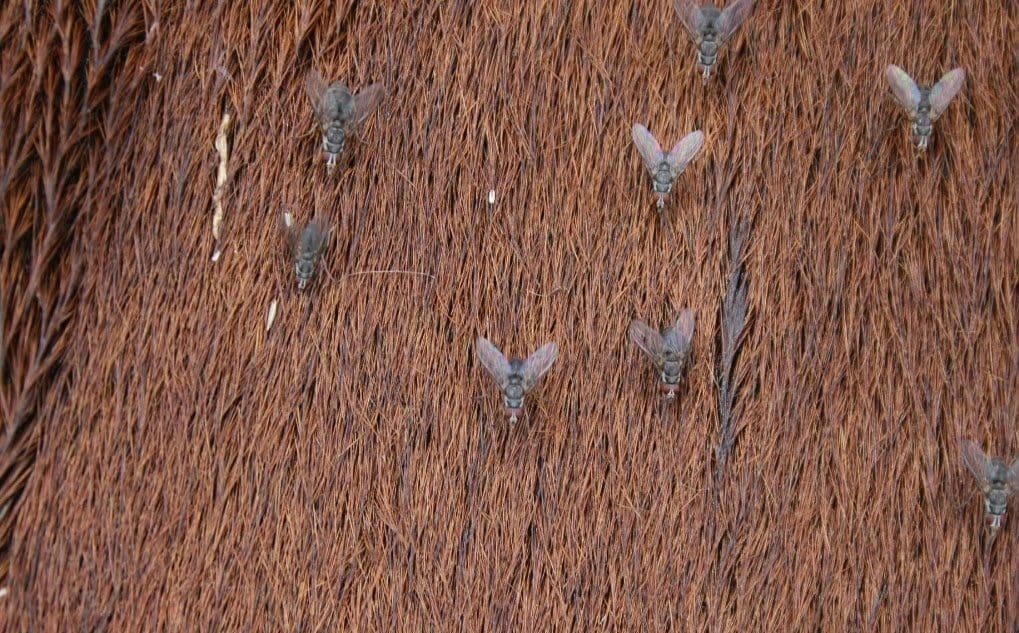
QUEENSLAND researchers armed with a new ‘stealth-gene’ technique are pitching to eradicate ticks and buffalo fly from Australian cattle herds.
University of Queensland scientists have recorded recent success with a gene-specific delivery system fighting flystrike in sheep, and now have major cattle pests in their sights.
MLA estimates that ticks and buffalo fly cost Australia’s cattle industry at least$330 million annually.

Tim Mahoney
UQ research leader Prof Tim Mahony believes Australia’s cattle industry will benefit from the double-stranded RNA (dsRNA) delivery technology ‘within our lifetime’.
The researchers have found a stable way of delivering controlled amounts of dsRNA into blowfly larvae, slowing their growth and eventually killing them.
The technology adsorbs dsRNAs into polymers and encapsulates them in a fine clay called bentonite, so the material platform is called BenPol.
Queensland Alliance for Agriculture and Food Innovation senior research fellow Dr Karishma Mody said: “The challenge is that the dsRNA breaks down very quickly in biological fluids, preventing it from reaching the target gene.
“Our laboratory tests have confirmed that BenPol acts as a tiny protective capsule for dsRNA, keeping it intact long enough for the larvae to ingest it so it can reach the gut and switch off the target gene.”
The research demonstrated efficient dsRNA uptake by the cells of the blowflies and more than 24 hours protection in the larvae guts. In feeding assays, BenPol formulations significantly enhanced RNA efficacy for up to seven days post-treatment.
Prof Mahony said the current research involved micro-injecting dsRNA into larvae – a laboratory technique used to check the efficacy of the dosage.
While this technique would be unworkable in the cattle crush, it is a precursor to effective treatment via a dietary feed, he explained.
“The technique allowed us to measure the controlled amount of RNA going into the larvae.” he said. “And when we’ve identified the key targets, that’s when we investigated them into a feeding assay, an artificial diet where the larvae eats the dsRNA-adsorbed BenPol. This then breaks down in the gut and releases the dsRNA.”
Asked about the risk of transference to other species, even human handlers, he explained that the RNA breaks down rapidly and is closely targeted at the livestock pests. “With dsRNA, we can look at that at a molecular level; we can ensure the genetic sequence is specific to, say, blowflies.
“The RNA is specifically focussed on the target pest species. We are looking only at the specific genes of the pest species. It gives us the extra level of specificity,” he said
“In the case of sheep – if we are targeting blowflies we don’t want to target, say, bees.”
And, with the RNA’s fast rate of decay, he said: “We would anticipate it is not going to persist in the environment.”

Dr Karishma Mody and PhD candidate Yakun Yan in the laboratory at St Lucia. Image: Megan Pope, UQ.
No GMO modification
While the technology would need to go through some approval processes, it would not be classified as a GMO because it does not modify any genome, he said.
Generational attrition of livestock pests is the aim, he added. “And we expect the risk of them developing resistance is low.”
The research is planning to target multiple genetic pathways simultaneously. “That would make the likelihood very remote of them having mutations all at once,” he said.
Buffalo flies are one of the most costly endemic parasite for the Australian beef industry, draining an estimated $170.3 million in annual losses due to production reductions and control measures. The parasite significantly impacts northern Australia, causing painful bites, severe irritation, and up to 16% lower liveweight gains. Tick-related costs are also estimated at around $160 million annually.
Currently, both infestations are normally treated with chemicals, but there is evidence of increasing chemical resistance.
QAAFI PhD candidate Yakun Yan said combining dsRNA with BenPol provided an effective platform to protect and enhance uptake.
“The findings represent a major step forward for RNA-based livestock protection,” she said. The research team now plans to take this technology dsRNA+BenPol into field testing.
Dr Mody said QAAFI researchers successfully tested the dsRNA+BenPol platform through collaboration with the Department of Primary Industries and an Advance Queensland Industry Research Fellowship.
Read more about the research here.
Now this could well be some of the best research that MLA have spent our producer dollars on.
I think I am happy that dsRNA significantly differs from mRNA!
To quote an article I read recently,
Double-stranded RNA (dsRNA) and messenger RNA (mRNA) differ fundamentally in their structure, function, and interaction with the cellular immune system. While mRNA is a single-stranded molecule used to translate genetic information into proteins, dsRNA consists of two complementary strands, usually acting as a trigger for gene silencing (RNA interference) or an activator of innate immune responses.