
IN this week’s property review, two major reports examine the performance of the rural property market, which is currently experiencing a nationwide plateauing in prices following years of rapid growth.
Ray White chief economist Nerida Conisbee and Herron Todd White’s Frank Peacocke have found significant regional differences driven by factors including commodity prices, asset quality, seasonal conditions and vendor expectations.
Ray White’s latest regional report highlights a significant surge in property values across Australia’s key cattle-producing regions, driven by a decade-long rise in beef prices and shifting rural lifestyle preferences.
The report compared median house prices across five major cattle regions.
Beef region 1Y and 10Y price growth
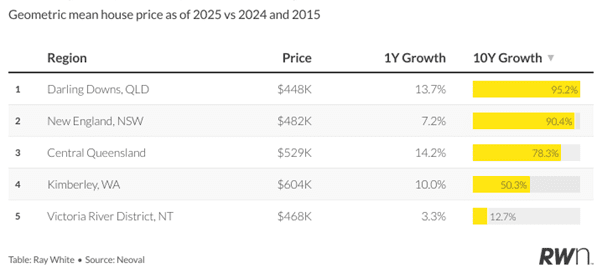
Ray White Rural examined median house price data from 2015 to 2025 across these five key cattle regions, cross-referenced with Eastern States Young Cattle Indicator prices from Meat & Livestock Australia. Regional house price trends were analysed alongside quarterly cattle price movements to identify correlations and divergences, with particular attention to periods of significant commodity price volatility and broader economic shifts affecting rural property markets.

Nerida Conisbee
Chief economist Nerida Conisbee said collectively, the New England (NSW), Central Queensland, the Darling Downs, the Victoria River District and the Kimberley rose by an average 65 percent from 2015 to 2025.
“The Darling Downs leads with a 95pc increase, followed by New England at 90pc and Central Queensland at 78pc. Even remote areas like the Kimberley and Victoria River District saw gains of 50pc and 13pc respectively.”
“This property boom correlates with a 39.5pc increase in the Eastern States Young Cattle Indicator, which rose from 510c/kg in 2015 to 712c/kg by the end of June in 2025. (Editor’s note: Since then the EYCI has pushed as high as 900c in September, before easing to 825c this week).
However, the stronger growth in property prices suggested that broader economic and demographic factors were amplifying the impact of agricultural prosperity, she said.
Ms Conisbee said each region’s role in the beef supply chain influenced how quickly cattle price increases translate into local economic benefits.
“The Darling Downs, as Australia’s feedlot capital, benefits most directly due to its high-margin finishing operations. The New England’s proximity to major cities and its suitability for premium breeding also attract lifestyle buyers.”
In contrast, she said, the Kimberley and Victoria River District, while benefiting from economies of scale, experience slower economic flow-through due to their remoteness.
“Central Queensland’s mix of breeding and finishing, along with access to export ports, supports more stable long-term growth,” Ms Conisbee said.
Cattle boom amplifies regional property price growth
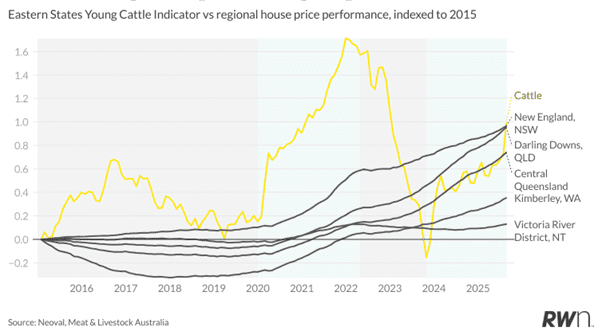
Ray White Rural found strengthening cattle prices driven by herd rebuilding, stable feed costs, favourable seasonal conditions and rising global protein demand are supporting rural property values, particularly in grazing regions. It said these factors are improving producer margins, boosting confidence and underpinning long-term investment appeal.
Herron Todd White director Frank Peacocke
According to Herron Todd White’s latest Month in Review, the rural property market across Australia remains complex, with varied conditions depending on region and asset quality.
In northern grazing areas such as northern New South Wales, Queensland, the Northern Territory and Kimberley, the market is steady with reasonable liquidity, especially when vendor expectations align with market realities.
Southern regions like Victoria, Tasmania, and South Australia, however, continue to experience subdued transaction volumes as buyers and sellers remain cautious.

Frank Peacocke HTW
Darwin-based valuer Frank Peacocke, makes the point that livestock markets have rebounded strongly, particularly due to the US herd rebuild, boosting profitability and confidence among producers.
“In northern regions, strong cattle prices, amplified by favourable seasonal conditions, have bolstered the balance books of landowners (typically institutional-grade or large family enterprises) enabling them to actively pursue high-quality assets to expand their existing operations and benefit from economies of scale.”
Conversely, Mr Peacocke said high land prices and interest rates had segmented the market, pricing out debt-reliant newcomers and non-institutional buyers.
“This segmentation has led to concentrated demand for premium assets and generally low transaction volumes, although regions with good rainfall and strong livestock values have seen land values supported,” he said.
Despite recent rainfall in Victoria and parts of southern South Australia, Mr Peacocke said these areas have not yet seen a rebound in land market activity, even though the outlook for livestock prices remains strong.
“The recovery in livestock markets, particularly cattle, from the late 2023 trough has helped restore trust needed for both land buyers and sellers to consider a transaction, but it has not been enough to trigger a more widespread increase in market activity.”
He said nevertheless, the past couple of months had shown how a resilient and recovering livestock market has served as the main driver for sentiment in the grazing land market.
“Indicators like the Eastern Young Cattle Indicator (EYCI) and National Young Cattle Indicator (NYCI) have risen significantly year-on-year, driven by strong demand. Australia’s beef exports to the US remain robust, with record output and slaughter figures in the June quarter contributing to improved producer sentiment and helping to underpin the grazing property market.”
“The sheep and wool markets have also shown firm conditions, with the National Trade Lamb Indicator (NTLI) rising notably,” he said.
NSW, QLD
In northern New South Wales, Mr Peacocke said the property market remained sound, with strategic and neighbouring buyers more active than out-of-region purchasers.
“Premium assets continue to attract strong interest from larger family enterprises and corporate operations, although increased supply in some areas is leading to longer selling periods and more selective purchase decisions.”
He said Queensland’s market shows mixed results, with strong values for quality properties with scale and limited interest in less desirable ones where vendor expectations remain too high for buyers.
“There is no region which stands out as more active, however it appears that there is higher demand in the north and west for properties with scale and beast area value rates below $10,000/AE.”
The report noted the season in the Central Tablelands and Central West New South Wales is improving with recent rains and the prospect of good pasture growth. Despite this optimism, buyer caution remains evident and sale volumes appear to be slowing.
In the lower Western Division of New South Wales, grazing levels remain firm, with several significant transactions and listings suggesting continued interest in quality grazing properties.
- 72,000ha Tasman and Corinya Stations, north of Ivanhoe, sold to the NSW government for around $12m bare ($166/ha).
- 24,423ha Waiko Station, east of Ivanhoe, sold prior to auction to a Booligal district producer with family ties to Ivanhoe. The price was undisclosed, however, the asking price was around $12m ($495/ha). Mr Peacocke said if it proves to have sold at this level, it will set a new benchmark for the area.
A significant holding currently being marketed in the Balranald area is the 51,000ha Magenta Aggregation near Hatfield.
Mr Peacocke said if it sells, the property will provide further confirmation of the current firm market for good grazing properties.
Victoria
He noted the Western Victoria property market has softened over the past year, with limited supply and cautious buyers.
“Financially secure farmers still seek land to improve economies of scale, but isolated properties, marginal country and less regarded areas face extended market times.”
In some instances, Mr Peacocke anticipates a drop of 40pc from the peak of the market.
“Over the past several years, most farmers have maintained strong balance sheets, buoyed by elevated commodity prices, low input costs and historically low interest rates.”
“However, recent increases in interest rates, coupled with persistently high production costs, have led to a more price-conscious buyer. As a result, vendors are increasingly having to recalibrate their expectations to align with current market realities,” he said.
Northern Territory & Kimberley
When it comes to the Northern Territory and Kimberley, Mr Peacocke said reliance on live cattle exports had generally been factored into the investment profile of these two property markets.
“While long-standing ties with Indonesia support confidence, there appears to be more doubt playing out in investment decisions for northern pastoral leases, with several stations remaining unsold (for an extended period) possibly due to high asking prices.”
Mr Peacocke noted properties further south (below Daly Waters to Central Australia) that are less dependent on live export, are attracting more interest.
“Only two pastoral leases, Dorisvale and Hodgson River Stations have sold this year, indicating a cautious but selectively active market.”
Meantime, Benmara on the Barkly Tablelands which sold for $40 million (bare) in April 2023 in a sale negotiated by LAWD to Sydney-based Wealthcheck Funds Management, is the first cattle station (in the past decade at least) where the asking price has been reduced.
Mr Peacocke said the asking price at $35 million bare is not reflective of the state of the NT pastoral property market, however the result will be fascinating.