
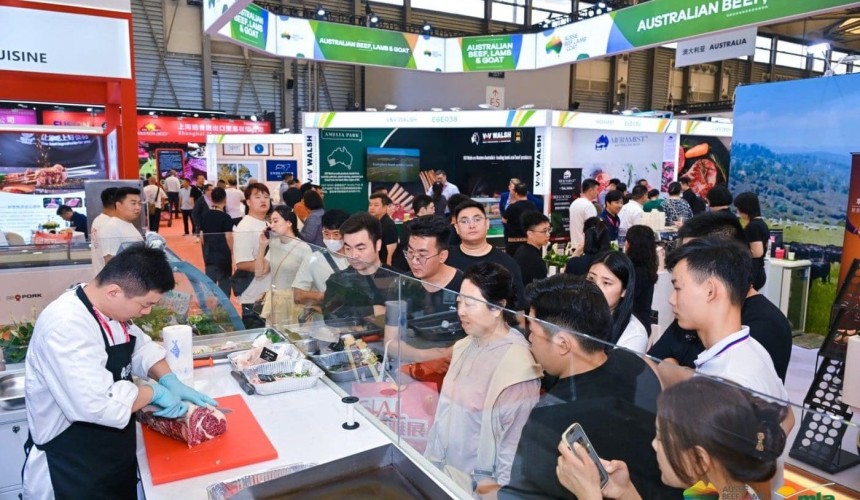
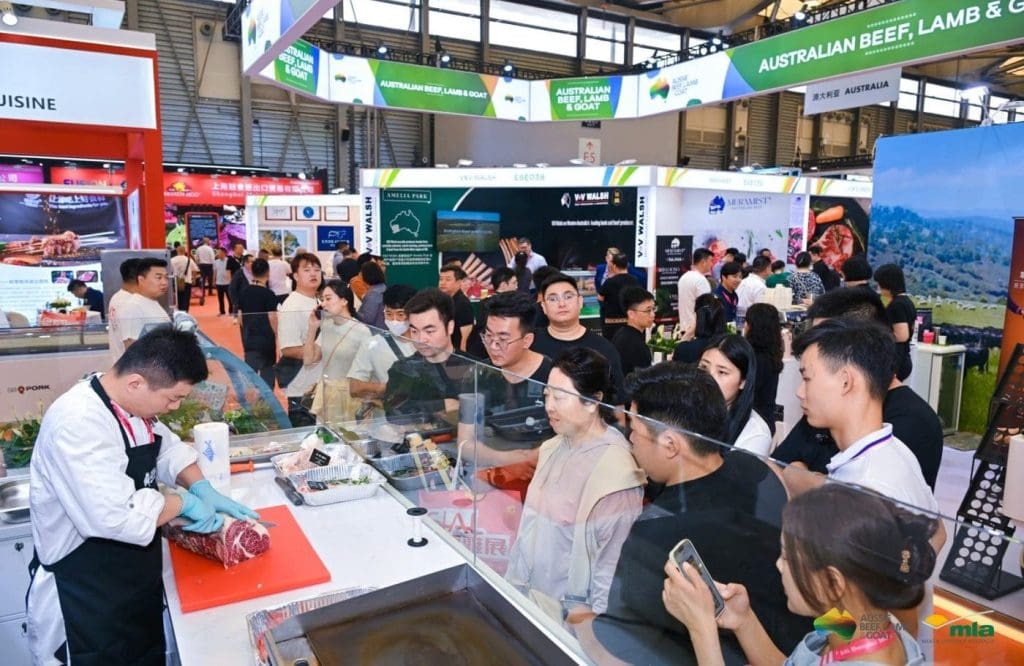
Visitors checking a cutting demonstration and tasting on Australia’s stand at Shanghai’s SIAL food trade show in May
AUSTRALIAN beef exports to China will face a larger tariff obstacle for the remainder of the calendar year, after triggering the Special Agricultural Safeguard market protection mechanism on beef imports overnight.
Vigorous beef export sales into China in recent months has seen the Safeguard mechanism triggered earlier this year than many had anticipated.
Safeguard mechanisms, sometimes called ‘Snapbacks’, are included in most of Australia’s bilateral free-trade agreements with customer countries including Korea, the United States and China. They are designed to protect local livestock industries from unusually large increases in shipment volume, from one year to another.
Australian beef entering China will now face an additional 12pc tariff for the remainder of the 2025 year.
 The triggering has been anticipated for some months, as described in this earlier Beef Central article.
In May, China’s General Administration of Customs (GACC) announced the country’s 2025 Safeguard tariff level for Australian beef, setting the volume at 208,300 tonnes. However the actual trigger level amount available this year was slightly less than 191,000t, once carry-over product from 2024 is included.
Now that the threshold has been reached, a Most-Favored Nation tariff of 12pc will be imposed on Australian beef imports (some items higher, depending on the product’s Harmonised System code).
Last year, the carry-over safeguard figure was lower, at 178,000t, but the Safeguard trigger was reached much later in the year during October, leaving only a shorter period exposed to the 12pc tariff for the remainder of 2024.
China’s total beef imports in the first half of 2025 were down 9.5 percent to 1.32 million tonnes, however Australia was the only large supplier to see an increase in volume (up 35pc compared with the same six-month period last year, to 129,259t). Australian grainfed beef is the primary alternative for Chinese customers that no longer have access US beef.
Part of the recent surge in Australian sales has been caused by Chinese importers anticipating the triggering of the Safeguard, lifting the tempo of sales during June and July.
Regular triggering
The Safeguard mechanism was negotiated back in 2015 as part of the China Australia Free Trade Agreement, and has triggered at least five previous times since then, as exports have dramatically expanded.
A decade ago when the FTA agreement was struck, it was never foreseen that Australia’s beef exports into China would take off as they have. Australia first triggered the limit in 2018, again in 2019 and 2020, and most recently in late 2023 and 2024.
The absence of US beef entering the Chinese market this year (as a consequence of the current 45pc reciprocal tariff, the increasingly smaller rates of US beef production and the current stand-off by the Chinese in re-licensing almost 400 US beef plants) has pressured export volumes out of Australia, Brazil and other global suppliers.
Pressure to source more grainfed from Australia
A summary written by market reporting service Expana (many in Australia will be familiar with Expana’s previous name, Urner Barry) said despite the higher annual quota volume for Australia this year, the safeguard quota was exhausted in 205 days – 75 days earlier than last year.
Initially set at 170,000t in 2017, the China-Australia Free Trade Agreement volume has risen every year and is scheduled to increase incrementally to 249,000 mt by 2031.
Yesterday’s triggering underscored the recurring pressure to source more beef from Australia as US supply fell sharply, Expana said.
“Since April, Australia’s grainfed beef has gained significant ground in China’s premium market. This shift follows China’s non-renewal of import permits for more than 400 US beef processing plants and the imposition of punitive tariffs following escalating trade tensions between the world’s two largest economies,” it said.
Australia’s shipments to China almost doubled in June ahead of potential safeguard tariffs, supporting record-high overall Australia’s beef exports of 134,596t in June, up by 26.8pc on the year. The volume topped the previous monthly record set in October 2024.
The zero-tariff quota for Australian beef to China resets on January 1, 2026.
What is wrong with superior Grass fed beef from Australia. Is it because the Chinese market is not aware of better quality pasture raised beef?
<strong>Safeguard mechanisms are commonly used in Free Trade Agreements - similar clauses appear in our FTAs with Korea, the US and Japan. They are designed to protect the local beef industries from unusually large rises in imports from year to year. Editor </strong>
Surely our prime minister can easily show that our threshold has been reached because their other main supplier has higher tariffs or a ban on. in any other business this would be negotiated and sorted before it even stopped. Quite simply why didnt that add the quota from America into Australia seeing they are not bringing in America's beef.
OR Alternatively if they make that rule do the same with the imported Chinese cars.
Any cars coming in this year over the amount from China last year have a 15% tariff placed on them to protect our local car dealers that have supported us for the last 50 years.
playing by the same rules aren't we, then no one will be upset.