
AFTER being limited to secondary markets for decades over FMD/BSE disease concerns, Brazil has in recent years gained access to primary, lucrative markets like the US and China, where it has now established a substantial foothold in the imported beef market.
Indeed for several months earlier this year before Trump imposed his 50pc (later 40pc) tariff, Brazil for the first time in history exported greater volume to the US than Australia did.
 Similarly, since gaining access to the China beef market in 2015, Brazil has gradually grown into an export powerhouse, consigning an incredible 1.3 million tonnes to the market in 2024, seven times Australia’s volume of 193,000t.
Now Japan is in Brazil’s sights as a beef customer, and going on past market access history, by extension, it’s possible Korea may follow.
If successful, the decades-long food safety and disease-risk ‘protection’ from Brazilian competition that Australia has enjoyed in its four largest export markets – Japan, Korea, China and the US – will no longer exist.
Brazil’s OIE approval mid-year as being free of FMD, without vaccination (see references below), has been a key catalyst in recent developments. Japan had maintained a cautious stance regarding lifting the ban on imports of Brazilian beef due to disease reasons, including FMD, but also phyto-sanitary food safety standards.
Recent international trade and finance media reports suggest the ban on Brazilian exports to Japan over disease risk is now ‘close to being lifted.’ High tariffs on Brazilian beef into the US for most of this year have evidently energised discussions with Japan.
However local Australian sources believe nothing will happen in terms of market access until at least April next year, the start of the new Japanese financial year.
Here’s a quick timeline of Brazil’s progress towards Japan beef access:
 March 2025: During a Japanese visit, Brazilian President Lula urged Japan to lift its ban on beef imports and to conclude an Economic Partnership Agreement with Mercosur countries. Japan maintained a cautious stance, casting a shadow over bilateral relations. Lula pressed for an EPA, stating Brazil, as the current Mercosur chair, “wants to start negotiations toward realisation in the latter half of 2025.”
May 2025: Japan dispatches technical food safety and sanitation experts to Brazil in consideration of beef exports.
June 2025: The Brazilian government confirmed that it had received certification from the World Health Organisation as a country free of FMD without requiring vaccination.
September 2025: a Japanese technical inspection team completed its visit to Brazilian meat processing facilities, and concrete steps were underway to obtain certification from Japan, which has strict hygiene standards. Brazilian authorities suggested that diplomatic momentum could lead to Japan approving Brazilian beef imports as early as this year.
September 2025: With rising populations and incomes, Asia had established itself as a top priority market for Brazil’s beef industry, Roberto Pelosa, president of the Brazilian Meat Exporters Association said. Offal, in particular, offered high added value due to regional cultural and religious demand, making it a product category that Brazilian exporters were actively seeking to expand. “In Japanese yakiniku restaurants, sliced beef tongue is considered a gourmet dish, however, beef tongue consumption is limited in Brazil. These differences in consumption trends are impacting the export strategy of Brazil’s beef industry,” Pelosa said.
October 2025: Brazil’s Agriculture Minister Favaro said Japan was “close to” lifting its ban on Brazilian beef imports.” “The progress is fast.” He said. “Something that has been on the shelf for more than 25 years is now on the brink of becoming a reality, with only a few details remaining to be worked out,” Favaro told media. He said the Japanese market was lucrative, but also had very strict standards. He said the discussion was in the final stages of sanitary procedures, and that “once the procedures are completed, the market will open,” hoping for this to happen by the end of the year.
Global head of JBS, Gilberty Tomazoni, said from the sidelines of a trade conference in Sao Paulo in October, “Japan is a premium market, and being able to export selected cuts will be a major boost for Brazil.” However he added that Japanese consumers demanded high quality and that building a commercial relationship would take time.
Japanese meat industry associations have not issued any statements regarding the mooted lifting of the ban on Brazilian beef imports. However since Japanese-produced Wagyu beef is already differentiated from most imported beef, the industry remained quiet when imports from Argentina and Uruguay were lifted in recent years.
What might Brazilian exports to Japan look like?
So what might Brazilian beef exports to Japan look like, and would they compete directly with Australia’s?
Australian meat traders with solid Japan market history have identified a few key areas.
Apart from edible offals, described above, Brazil could play a substantial role in commodity manufacturing meat for use in the lower-level food service industry.
Stagflation sees price pressure
Despite its level of affluence, a ‘stagflation’ cycle persists in Japan, and food service operators – especially those operating at the lower level – were stubbornly reluctant to increase prices, an Australian export trade contract said.
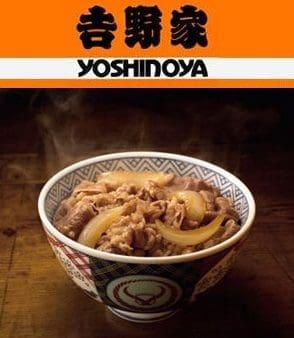
A beef bowl from the popular Japanese food chain Yoshinoya.
That was evident not only in western style burger chains using ground beef, but in Japan’s incredibly popular ‘beef bowl’ restaurant chains like Yoshinoya and Matsuya, serving marinated sliced grilled beef on top of a bed of rice.
Many Japanese fast food and quick service operators at this level are locked in a competitive battle, and are extremely reluctant to lift menu prices. For example a beef bowl meal from a major chain can be had in Tokyo or Osaka this week for as little as A$5.50, and prices haven’t changed for years.
It’s similar for Japan’s hamburg steak, a puffy equivalent of the hamburger served with rice instead of a bun, in tens of thousands of budget-conscious Japanese family restaurants.
The prospect of blending cheaper Brazilian beef trimmings with a better grainfed-type material could prove highly attractive to Japanese customers in price-competitive segments like this, Beef Central was told.
“Brazil may play a big part in Japan during this period of wages stagflation,” one contact said.
“But it’s not really a space that Australian beef wants to play in. Our profile has shifted somewhat towards grainfed – particularly in our chilled beef profiling,” he said.
“But somewhere between 15pc and 25pc of sales in that ground beef area is where Brazil could really exert some influence.”
“But the rest of it, grainfed, will likely remain immune.”
Price distinctions
Over many years, Japan has always exhibited clear price distinctions on imported beef, based on perceptions of quality and safety.
Brazil does not have the world’s best reputation on food safety, and the reason why relatively inexpensive Argentinean and Uruguayan beef has not gained significant traction in the Japanese marketplace is because of Japan’s high quality expectations.
“Even if Brazilian beef were to be permitted, it would be difficult for it to immediately dominate the Japanese market, based on these consumer perceptions and reputation,” a trade source said.
“However it may create a floor price, against which other imported product price is based.”
“An example is Mexican beef tongues, which got access to Japan some time back. Did it drag the price of Australian beef tongues down? Not necessarily, but it added another, cheaper option.”
“But even if the early Brazil trade into Japan is based only on offals, it potentially runs the risk of eroding the revenue tree for Australia – one dollar at a time.”
“However I don’t see Brazil as an immediate threat to Australia’s premium beef products in Japan, because we have been able to boutique our products and get price recognition on quality, food safety performance and provenance in Japan, as we have all around the world.”
“It’s at the commodity end where the risk from Brazil to our exports to Japan lies. They certainly set a floor, and volume-wise, Brazil has proven it can ‘turn-it on,’ very quickly, when a market like China needs it.”
However it was in export markets like Indonesia where there was potentially a more direct conflict between Brazilian and Australian beef: “It’s lean, its frozen, its offal – exactly what Indo is looking for,” the trade source said.
“But Brazil’s appetite to put its meat into the best export markets like Japan and Korea has clearly grown – albeit from last Friday week when Trump removed the 40pc tariff, it now has the US firmly back in its sights.”
“The aggressiveness of Brazil trying to gain access into Japan, and a lesser extent Indonesia this year, has been all around trying to escape the 76.4pc tariff it faced for most of this year for trade into the US.”
“An on top of that, China is yet to complete its imported beef anti-dumping investigation. But at the end of the day, China needs that Brazilian product, and it does not have a local herd of sufficient size or productivity to produce that beef itself.” https://dev.beefcentral.com/trade/chinas-imported-beef-anti-dumping-investigation-delayed-again/
“Just like America, the Chinese have been eating their own beef herd faster than they can grow it.”