
Source: Expana. Click on image for a larger view
BOOMING beef exports to the United States this year driven by short domestic supply and a US beef herd at 70-year lows has sparked speculation that Australia may face a tariff hike in coming months under trade agreement provisions.
Comments published in an ABARES outlook summary in The Australian newspaper and website on Friday incorrectly suggested that Safeguard tariffs on Australian beef heading to the US could be triggered “as soon as next month,” pushing our tariff rate higher.
In fact, despite the recent rapid pace of Australian exports to the US, there is little chance of Safeguard or additional similar tariffs being triggered on Australian beef to the US this year.
Firstly, some background.
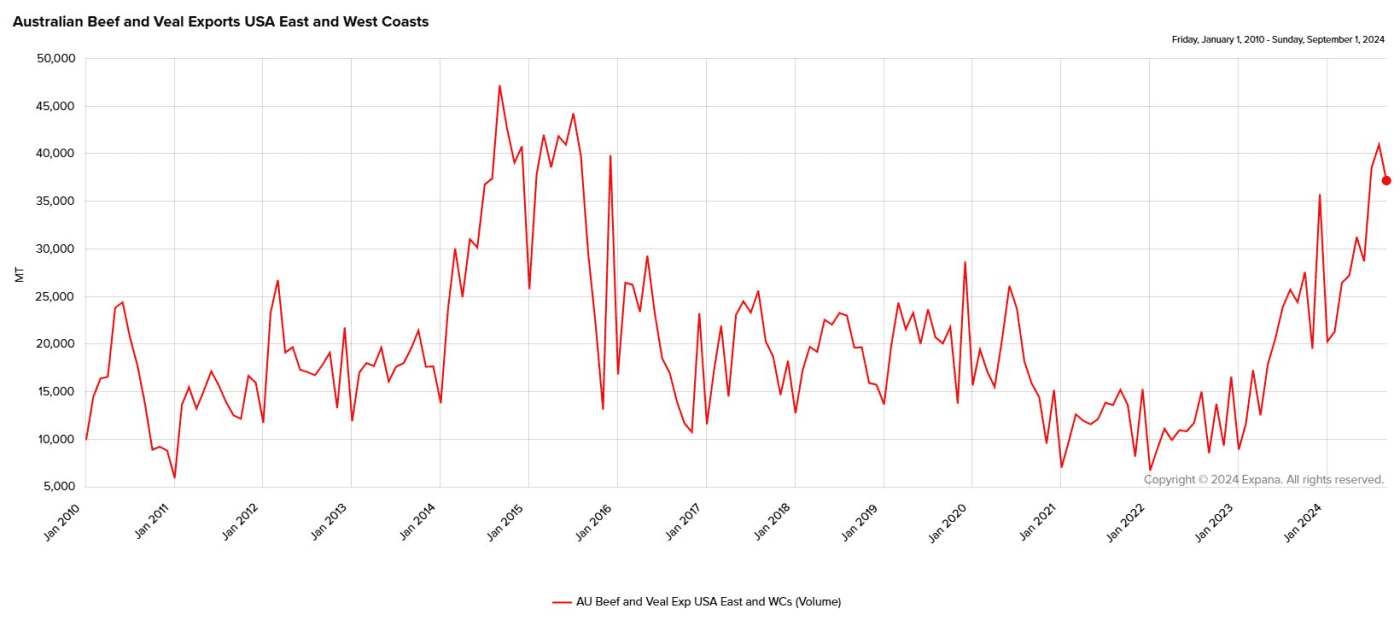
Exports to US for the calendar year to the end of August have reached 286,876 tonnes, up 52,000t or 27pc on the same eight-month period last year, DAFF statistics show. September shipments are already shaping up to be close to record high, at around 45,000t. Refer to the graph above, showing this year’s surge, equalled only by the 2015-16 period when the US was in beef deficit after its previous drought cycle.
However, as detailed on DAFF’s recently updated website page, under the AUSFTA, there is a discretionary safeguard – effective from 2023 onwards. Under this arrangement, Australia can export up to 449,482t of beef (representing the combination of WTO 378,214t and AUSFTA 71,268t entitlements) to the US at zero tariff for calendar year 2025. Australian beef exports exceeding this combined amount can be subject to a safeguard provision if both price and quantity conditions stipulated in AUSFTA are met.
 That means Australia still has 162,606t of zero tariff entitlement (excluding Trump’s 10pc retaliatory measures) left for the last four months of 2025, or an average of 40,650t per month.
December is inevitably one of the slowest months of the year, as most large Australian export processors will conduct their last kill for the year on Thursday, 18 December (final boning shift Friday, 19 December), before they close for traditional Christmas/New Year holidays.
On top of that, rates of Australian slaughter over the last month have softened, from seasonal highs recorded in late July and early August (see Beef Central home page industry dashboard graphs).
That suggests that if the 2025 trigger level is reached at all, it will happen deep in the year – likely during December, leaving only a matter of days or weeks where the higher tariff could be applied – but only if the meat price conditions (see below) are met.
However that looks highly unlikely. Exporters and importers in all markets have in the past proven to be adept at managing shipments, holding over late season shipments in bond, to count against the following year’s tariff-free entitlement, when the ‘clock goes back to zero’ from 1 January.
US-based analysts and commodity reporting service Expana told Beef Central that if the current pace of Australian shipments into the US continues, Australia may reach its full entitlement by the end of the year – but not until late in the year.
“With the potential for this to happen so late into the year, and now more available bonded cold storage space due to limited Brazilian shipments into the US, it would make sense that most of the late Australian product is put into bond and then taken out in 2026 when the entitlement resets,” Expana said.
“That means that hitting the volume entitlement and facing an extra tariff would be a minimal concern,” it said.
Background on US tariff and access entitlements
The old Australia-US Free Trade Agreement volume safeguard is now null and void, as the FTA implementation period over the past 18 years has now run its course.
All Australian beef exports to the US will continue to enter under Trump’s baseline ‘Liberation day’ 10pc tariff – contrary to the 0pc preferential tariff agreed-to as part of the FTA.
There is no additional automatic 26.4pc tariff hike looming for Australian beef into the US – this is the Most Favoured Nations out-of-quota tariff which other suppliers face.
Under the AUSFTA, there is a discretionary safeguard clause. If Australian beef exports exceed 449,482t, a beef price safeguard provision may kick in – but that is only if the beef price conditions, under a complicated index formula as assessed by the US, and as stipulated under AUSFTA – are also met.
Given all-time record wholesale and retail prices for beef in the US at present, that looks extremely unlikely.
The US Trade Representative also has the right to waive the application of the safeguard if it so chooses, given unusual market movements like those currently being experienced in the US.
In the remote possibility that the price index component is met, however, Australian beef exports would then be subject to a tariff equal to 65pc of the prevailing MFN tariff on beef (that is, 65pc of 26.4pc – effectively 17.1pc), for the remainder of the year.
This would likely not include the 10pc baseline tariff currently being applied under Trump’s measures since August.
Bonded storage
Reflecting on the evidence that September Australian beef exports to the US could exceed 45,000t, a contact at Expana told Beef Central that it seemed that buyers in the US and sellers (from all origins) were now more seriously negotiating significant packages of imported boneless beef for delivery next year.
“Typically, when we get close to filling the quota, meat moves into bond,” the contact said.
Normally, product would be premium for late-year delivery, then discounted once bonded meat is released, he said.
That trend was significant enough that Expana’s Yellow Sheet (a widely used beef price reporting tool in the US market) has established a January delivery quote in the sheet.
Measured in A$ terms (taking currency into account), Australian lean 90CL cow beef into the US has surged to new record highs since late August, hitting a new record high of A$11.23c/kg CIF on 22 August.
On Monday, the spread between imported and fresh US domestic 90s was wider than in the recent past, Expana said, “but it’s still too narrow for Australian product to absorb the 26.4pc duty. That makes a reasonable case for moving it into bond later in the year, to avoid any threshold risk,” it said.