
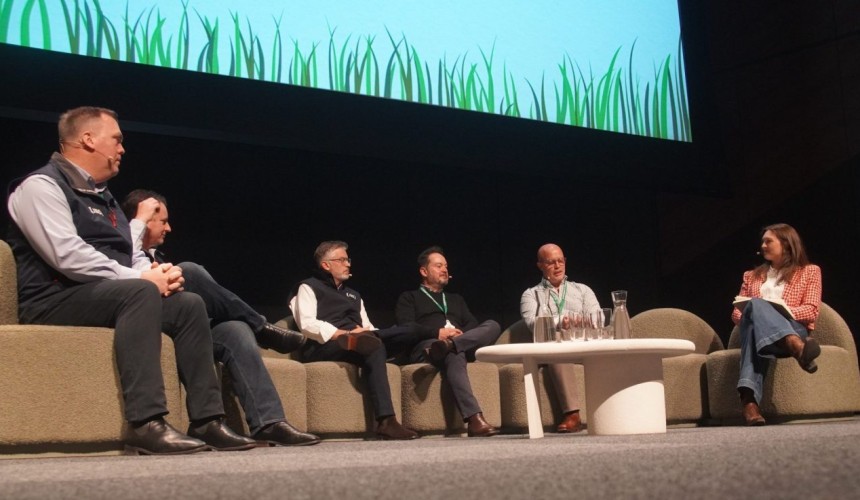
CATTLE and sheep price volatility and its impacts on all sectors of the supply chain came into sharp focus at two large red meat industry gatherings held in different parts of Australia on Friday.
The topic came up during question time at a large gathering of 650 grassfed beef and lamb suppliers attending the JBS Great Southern event in Melbourne, and again later the same day at an industry briefing during Brisbane’s Ekka gathering (see references below).
While price volatility has been discussed for a century or more across the red meat sector, its during times like the past two or three years, with drought impacts afflicting the production sector in some regions, and demand distortions being seen worldwide, that it comes into sharper focus.
Several speakers at Friday’s JBS Great Southern event touched on the challenges associated with delivering a certified grassfed beef and lamb program at scale, given the seasonal volatility experienced over much of the program’s supply region in the last two years.
While the attributes of certified grassfed had attracted greater demand at both retail and food service level overseas, challenges existed in meeting demand – declining supply out of New Zealand, red meat production challenges in other parts of the world and global population growth among them.
During a panel session, a Victorian beef and lamb producer expressed frustration in producers who had worked hard to produce a consistent premium product underpinned by farm assurance, only to have just gone through two years of drought and “very, very ordinary livestock prices” despite solid export demand.
“What’s happened is this new method of buying slaughter stock, called space booking,” he said, referring to the process of committing to a kill-slot forward, and negotiating the price closer to slaughter.
“We can book stock in for the next month or two months, and we don’t get a price. When the time comes, it’s take it or leave it,” he said. “And normally (in the seasonal cycle we have been in) that means the price has become cheaper, closer to slaughter date.”
He stressed he was not having a go at JBS in particular, claiming that ‘all the other processors and supermarkets did it as well.’
“Now, there are so many sheep being killed – beautiful ewes full of lamb – and there has been so many lambs not produced. And this happens in cattle as well, in the feedlots, and with cows.”
“Now we are seeing less sheep and the prices going up, with processors squealing because there aren’t enough sheep and lambs. But they have killed the goose that lays the golden egg.”
“Everyone is just so sick of not getting properly rewarded for the work being put in to produce a premium product,” he said, “despite all this high worldwide demand for protein.”
“The word trust has been used a lot today, and I just wonder how we continue that mutual trust, if we don’t get paid properly.”
Multiple sides to price volatility
JBS Southern’s head of lamb sales, Warren Swanson, was the first to respond, saying that there were multiple sides to the price volatility story.
“There’s been a lot of volatility in lamb, with highs and lows, and I agree that that erodes trust,” Mr Swanson said.
“The lows are no good for farmers, and we don’t want to see that. But right now, obviously livestock prices in this region are at record highs. That’s not good, either, from a retail or a food service perspective,” he said.
 “I’d love to have lambs at, say, $8/kg or $9/kg every day of the week, and just have consistency. But there’s too many knee jerk reactions and problems all over the world, to the point where lamb at the price where it sits today is being taken off menus, and retail shelves.”
“For our (JBS’s) largest lamb customer in the world, I’m fighting to keep lamb on-shelf at the moment in the US, because right now their message is based on the latest price we’re providing, and it’s just not stacking up for them,” Mr Swanson said.
“On top of the 10pc tariff impact imposed by the US this month, that has led to a 30pc drop in lamb volume to that particular customer. They have had similar quantities coming in, but they are now pricing Australian lamb at a level that means they are losing money on it.”
“Now that prices on lambs have lifted probably 50pc on where it was eight weeks ago, you can imagine the conversations we are having in trying to pass on the 10pc tariff, on top of the 50pc rise in stock price that’s occurred. You can imagine the US retailers’ reception to these significantly higher prices.”
High meat prices = lower demand
Mr Swanson said like all supply and demand cycles, things always adjusted up and down.
“High prices inevitably leads to lower demand, and consequently then the livestock prices will drop off. Even here in Australia, a couple of retailers have now taken lamb off-shelf, or are reducing their range, because they are losing money in-store. And it’s the same in the food service sector,” he said.
“That drop in demand then means livestock prices will retract, because we will have to cut back even further in our processing. So volatility is a much larger picture than just livestock price.”
“I’d love to remove the volatility and pay $8.50/kg every day of the week, and the end customers would much rather see that consistency as well,” he said.
Food service struggling
Head of JBS’s value-adding and portioning business Andrews Meats, Peter Andrews, said the food service industry, both in Australia and overseas, was struggling at the moment.
“As much as they want to buy premium beef and lamb, price gets to a certain level where the squeeze comes on,” Mr Andrews said.
“Nobody is really making money out of it, at current levels – we’re not, and they’re (food service outlets) not.
He highlighted this by talking about what had happened in the food service sector, post-COVID, with rising labour costs, and rents, insurances and utilities all increasing sharply.
“It’s important to look at the whole chain. At the moment we’re in a space where its very hard to pass all this added cost on, and they (restaurants, hotels, pubs, clubs and cafes) are struggling.”
“The whole of food service is in a challenging place at the moment, and obviously the first place they look at is, “Can we afford Wagyu or these premium red meat products in general?”
“That means we have to be more considered in how we sell these products. We understand the venues’ menu costing pressures, and they can’t make the sums add up at present. So we all have to look at the whole chain – just at the moment, we’re all feeling the effect of that squeeze.”
JBS UK meat sales manager Nick Sherwood told the Great Southern gathering that despite the price challenges, the underlying demand for Australian lamb in the UK was ‘still there’.
“Yes its price sensitive, and questions remain around how much consumers will pay, and whether there will be a knock-on effect on demand. But the reality is that our biggest export competitor in the UK – New Zealand – has reduced its sheep flock and continues to do so. The British and Irish lamb numbers are dropping also, so the outlook generally for Australian lamb is pretty positive, in the broader context – despite the humps in the road right now.
“Demand for Australian lamb is improving, year-on-year.”
Mr Sherwood suggested beef was facing similar supply-demand issues in the UK.
Solutions?
Another stakeholder asked the panel whether there was any way the industry could get away from the price volatility that impacted all parts of the supply chain.
“Or is it something that we just need to live with forever?” he asked.
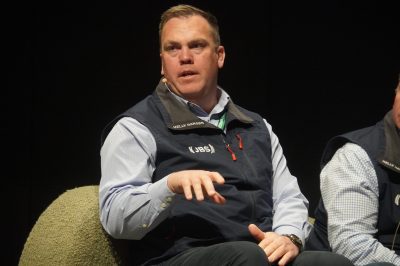
JBS Southern beef marketing manager Rob Ryan
JBS Southern’s beef sales manager Rob Ryan said evolution was inevitable, whether it is in beef or lamb, following each supply event like drought.
“As a company, we are thinking very hard about how we can change and evolve (in both beef and lamb) to insulate more against that volatility,” he said.
“Something is going to inevitably change, based on this current cycle – whether it be producer behaviour, processor behaviour or customer behaviour – to get some more consistency in the chain.”
“It will be gradual – we know there can’t be a huge shift in one step, but it is a given, and it is on our agenda,” he said.
Hedging solution?
An East Gippsland Great Southern producer asked whether some form of physical or monetary hedging might be considered as a tool to avoid price volatility.
JBS Southern chief operating officer Sam McConnell responded, saying one of the biggest challenges in this area was the absence of a futures market in Australia.
“In the JBS US business, we hedge our corn, our grain, our chicken, beef and pork. But we are working very hard as a company, both livestock and meat sales teams, as well as some of our larger international customers who buy 12 months at a time, to price every quarter. But it’s a real challenge for us in Australia.
Mr McConnell said another factor in the cost burden side of the equation was the fact that freight rates had doubled, with some product now taking more circuitous routes (avoiding the Suez Canal, for example) to markets like the UK.
“There’s a lot of additional cost like this being added to the business that is impacting price, as well as demand,” he said.
Another Great Southern supplier said production costs to produce good quality animal protein had been rising for decades, and customers around the world needed to take account of that. Can that be better accounted-for over the next decade, or is it just going to be more of the same in terms of volatility? he asked.
JBS UK’s Nick Sherwood said costs had risen right across the supply chain – including labour costs, and freight rates.
“But the western world, including Australia, North America and Western Europe has always had a very protein-rich diet. We’ve probably been a bit spoiled, to be honest.
“But as costs rise, we can see that western animal protein-heavy diet shrinking a little, while developing regions in the east will likely increase their protein intake. Even moving from 50g/day to 100g/day would be a big shift in Asia. That may be different sorts of protein to the wealthier western hemisphere, but we’re already seeing consumers in the UK and western Europe reducing their animal protein intake,” Mr Sherwood said.
“But the protein that they do buy must be of a high quality, with better provenance, or with better messaging. That’s where we see the benefits of the Great Southern program, and that dynamic will continue to evolve over the next ten years.”
- Stand by for an announcement next week about a new platform trading prime sheep and lambs, which promises to take some of the volatility out of the market.
- See today’s separate report on cattle price volatility, from comments made by Rabobank economist Angus Gidley-Baird at last week’s Brisbane Ekka.
Perhaps full supply chain price transparency is the answer to obtaining that word 'trust'? Certainly not a new or impossible concept, we only have to look at the US beef industry for a template.
it's just remarkable that as soon as prices go above the processing sectors comfort zone we start having these kumbaya articles. when lamb and mutton sellers were receiving a bill from the saleyards did we have crisis meetings? all I see from these cycles is inflation. by that i mean the consumer price keeps creeping up during these times. as soon as the cycle shifts (ie consumer push back blah blah blah excuses) that price for the farmer crashes (sometimes drought is an unlucky remedy) and there is a mild adjustment to the consumer with the same rhetoric and then the cycle starts again. remember we need to account for the inflation of our money ontop of the inflation in our industry. if you consider what we are being paid today compared to 25 years ago we aren't seeing much of an improvement. throw the mega inflationary event of the covid experiment and its possibly even worse. cheers Matthew Della Gola