
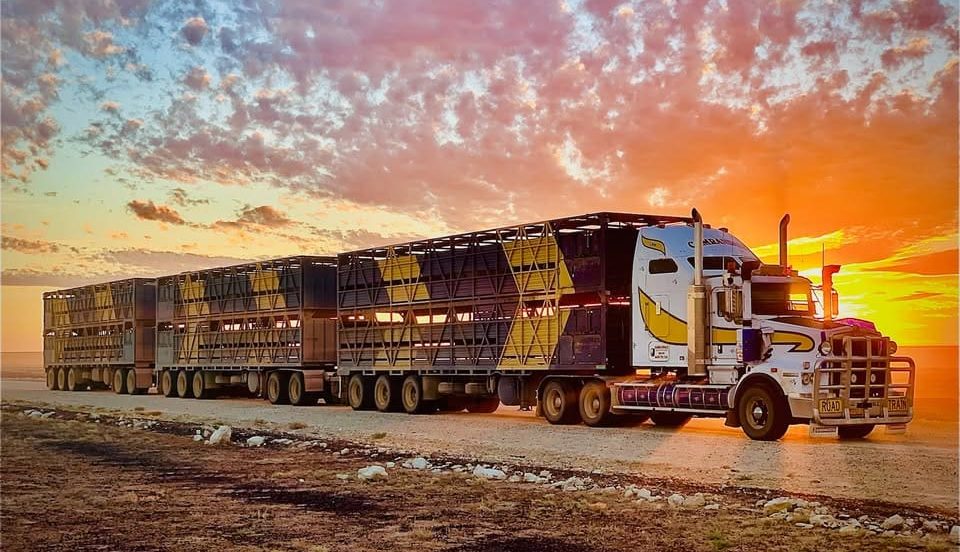
Road train operated by Camrandale Transport, Quilpie QLD
HAVING done a long road-trip from Brisbane to Longreach via Roma on Friday, one thing was clearly evident. There was a non-stop procession of road-trains heading south and east, as the onset of hot summer conditions arrives and second-round musters start to wind-up.
With modern enclosed trailers it was hard to tell from a distance exactly what type of cattle were involved, but judging by the carriers’ names, many had come long distances, and still had a way to go to get to feedlots or processors.
Good luck in securing a transport booking to shift cattle any distance this week – as conversations clearly indicated that large transport operators servicing the northern industry are running at, and beyond, capacity – especially for one-off jobs.
 “It’s virtually impossible to secure a truck heading into October – especially if you are out of shape and need to get rid of a load or two in a shipment in a hurry,” one large pastoral operator told us during the Longreach Cup races on Saturday.
Rail line access problems over the past ten days in some parts of Queensland has not helped the stock transport situation.
Weather is again starting to come into the play-book in parts of northern Australia’s cattle country, with plenty of dry feed in some roadside paddocks, while others were looking light-on, and in urgent need of rain. Oats crops in some regions are now on the cusp, with some oats finishers asking processors to bring forward kill dates because of the haggard state of the crop.
Nobody we spoke to is panicking yet, but with three months still until the end of the year, weather and feed are coming into calculations.
In comparison, BOM’s three-month outlook for October-December looks reasonably optimistic (click here to view article and map). If that does not deliver in the next six to eight weeks, however, there could well be a run of cattle by November.
Over-the-hooks pricing
Some northern direct consignment offers have moved upwards this week, but most of it appears to be about aligning with competitors’ offers which lifted earlier.
Best offers we’ve seen this morning for southern Queensland kills delivery second or third week of October are 690-700c/kg on heavy cows +300kg, and four-tooth grass ox 770-780c/kg (some grids only offering 780c for no HGP). Some of those offers are up 20c, but only to keep in touch with others. Central Queensland sheds are generally 20c/kg behind those rates.
Some northern processors are remarking that plenty of cows un the chain this week are lacking finish – suggesting vendors are sensing current pries are about as good as they are going to get, and are electing to offload now rather than wait a month or two and add a few extra kilos or a mm or two of fat cover.
In some cases it’s left consignment numbers after northern musters a bit lighter than what was committed, because they’ve missed minimum liveweight limits in agreements.
For the timebeing at least, some Queensland processors’ phones have evidently ‘gone a bit quiet’, as producers weigh up the prospects for the months ahead.
Further south, there’s little change evident on grids, with offers out of eastern regions of South Australia and southern NSW at 780c/kg on good cows and 850c/kg on four-tooth ox.
A few more locally-sourced slaughter cattle are starting to appear in eastern regions of SA and western Victoria, one processor said.
“We’re getting some – but certainly not enough to survive on without bringing other cattle in,” one local export processor said.
Other plants in the region, especially those operating as part of larger integrated multi-region processing/lotfeeding businesses, continue to ‘fill the void’ with grainfed shipped out of yards further north.
Others (both north and south) have ‘salted’ a few lighter conditioned cattle away on self-feeders in the paddock for use over coming months – in one example, Brahmany-type steers and heifers being topped-up far west as St George in western Queensland. Most of that activity appears to be an insurance play.
Slaughter numbers
As discussed in a separate story today, JBS Dinmore will add an additional 1700 a week capacity from Friday this week, with an additional (ninth) weekly kill and bone shift.
Despite coming under a strong southern processor competition for livestock for the past six months, Queensland slaughter numbers have been fairly stable since May, in a weekly range between 78,000 and 81,000. For long periods since Easter, Queensland has accounted for well over half of the national adult cattle kill each week – and especially since Victorian and NSW kills have started to slip away in volume since late July.
Saleyards trading
Saleyards trading early this week also reflects the drying conditions in some areas of the north.
Warwick sale this morning yarded 1252, with quality described as ‘very mixed’ for yearlings and cows. Well finished bullocks sold to dearer prices with cows back by 15-30c/kg. Grown steers in the 500-600kg range to processors sold to 488c with those over 600kg at 447c to average 434c/kg. Good heavy score 3 cows to processors made 373c with the best heavy cows at 410c to average 383c/kg.
Wodonga yarded 1235 this morning, up 700, following steady continuous light rain since the last sale. There were very few steers and bullocks with much quality and the majority comprised large runs of plain steers mostly suited to the manufacturing trade. Steers and bullocks were dearer for the few that were finished suitably for the export trade, while the large numbers of mostly manufacturing types sold cheaper for the majority.
Naracoorte yarded only 1023 head this morning, following last week’s cheaper market and more rainfall across the region. About half of the yarding were beef cows. Export slaughter cows and bulls were dearer again to reclaim most of the previous week’s cheaper rates, the best beef cows to 450c against a top of 444c a week ago. The market strength in this sale was export cows. The majority of Angus and Hereford cows offering reasonable fat cover and weight from 400-440c/kg. Leaner and lighter conditioned cows had support which kept the better lines above 380c to a top of 406c/kg. There was a consistent rate of 440c to 460c/kg for bulls regardless of weight and finish.
While the sale was still in progress as this interim report was filed, Roma Store Sale yarded 9028 this morning, up 7pc in volume on last week. Grown steers 400-500kg made to 490c/kg to processors, while steers 500-600kg sold to 428c/kg, and those 600kg to 438c/kg. Cows were yet to sell, but we’ll publish a full report tomorrow.