
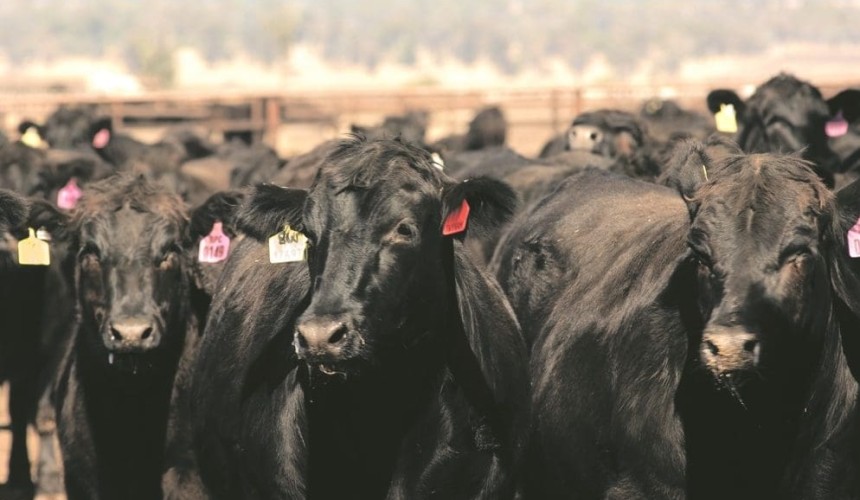
PROMINENT Queensland grainfed beef producer Stanbroke is proposing to expand its Bottletree feedlot near Chinchilla, taking capacity to 65,250 Standard Cattle Units.
If successful, the expansion would represent an increase of 20,250 head, or 45 percent. The move comes after a series of large feedlot expansions across Queensland, NSW and South Australia last year, outlined in this Beef Central report.
Stanbroke lodged its proposal late last month with the Western Downs Regional Council.
The application comes just four months after the company in October last year spent close to $400 million buying the 40,000 head Rangers Valley feedlot near Glen Innes (including cattle on feed).
If successful in its application to expand the Chinchilla site, it would give Stanbroke total feeding footprint of 105,000 head – mostly Wagyu and Angus.
The proposed staged expansion would add nine new rows of pens, each holding around 250 head.
- The first phase covering four new rows of pens to the west of the existing feedlot, would include the southern-most row fully covered under open-sided permanent shedding, covering some 320m x 40m wide. Initially, the remaining rows will be designed and operated as conventional, uncovered pens with a stocking density of 12 m2/SCU, however the expansion application is seeking the flexibility to convert these pens to fully covered housing at a higher stocking density (6 m2/SCU) if required.
- Stage two, covering a further 9050 SCU, would include a further five rows of new pens, built under conventional lines with no provision for shedding. Pens would be constructed in a back-to-back configuration with each row sharing a cattle lane/drain and a feed road.
“The covered row is intended to allow Stanbroke to trial covered housing to determine the cost-benefit of these systems,” the application says. “Depending on the outcome of these trials, the covering of the remaining three rows in stage one may occur before or after the construction of stage two.”
 The proposed expansion will require about 20 additional full-time equivalent staff on top of the 58 FTEs currently employed, the WDRC was told.
The proposed expansion will also result in other indirect jobs including contractors, drivers and tradespeople. The majority of staff working at the feedlot live at the on-site workers accommodation, with some living in other houses in the area or commuting from Miles and/or Chinchilla.
With the expansion, the feedlot will generate an average of 52 heavy vehicle visits (B-doubles and road trains) per day, from the current estimate of 38 heavy vehicles per day.
The existing Stanbroke feedlot feeds both 100-day cattle and 400-day longfed Wagyu cattle. The expansion application says feedlot is in the process of transitioning from a 60/40 split (long-fed to 100-day) to an 80/20 split.
“This means, on average, cattle will be held in the feedlot for longer, resulting in proportionally less cattle trucks,” the document said. “Generally, cattle will enter the feedlot between 350kg and 400kg and exit the feedlot between 600kg and 750kg, with an average daily gain of about 1-2 kg.”
The average occupancy of the feedlot was assumed at 95pc, which is based on current operations.
Water requirements
Stanbroke’s council application said the proposed feedlot would require 1300 ML/year of water for the full capacity. However water use in a covered (shedded) system was anticipated to be lower than a conventional outdoor system.
Currently the site is serviced by two groundwater licences with a total allocation of 600 ML/year. Additionally, there are two Condamine River allocations attached to the property with a total volume of 1976 ML. A large overland flow dam has been ‘unhooked’ from the river allocations and is only used to store overland flow. A new ringtank has been constructed to store water taken under the river allocations.
Stanbroke also have a contractual agreement with a nearby CSG company for further water supply.
“As such, there is an adequate water supply for use in the feedlot under the expansion,” the application said.
It is encouraging to see ongoing investment in the agricultural sector.