
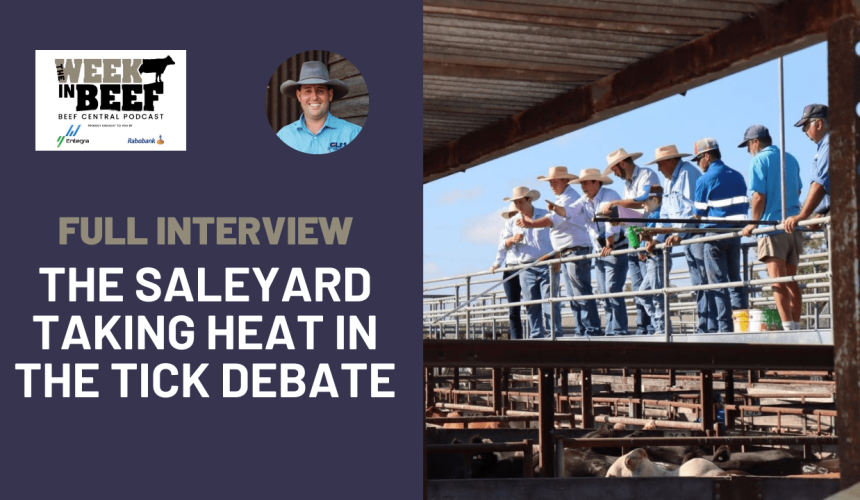
Australia’s second largest saleyard is at risk of losing buyers and vendors due to regular tick infested cattle being presented at the sale, which livestock agents say is the result of a break down in the Government’s biosecurity system.
The president of the Dalby Agents Association, Brendan Gilliland told The Week in Beef podcast he called an emergency meeting this week to discuss measures to stop the spread of cattle ticks through the Dalby saleyards.
“We have to get on top of this issue in the next four months, if we are proactive now going into winter we could get on top of 80 per cent of these outbreaks in the clean country,” Mr Gilliand.
“We can’t afford to let another whole year go by or cattle will die.
“The cattle on the clean side of the tick line have no immunity to infections and disease outbreaks such as red water (tick fever).
“There was a considerable number of heifers, in excess of 30, that died at Jandowae due to red water outbreak at Christmas.
“Now if the ticks get into some of these backgrounding and breeder operations in the clean country, we could see hundreds if not thousands of cattle die very, very quickly.”
Tick infested cattle at Dalby almost weekly
Mr Gilliland said there are tick infested cattle trucked to the selling centre almost on a weekly basis, with the vast majority of the infested cattle coming from Qld’s Tick Free Zone.
“The cattle that are causing the issues are not the cattle coming across the tick line, the problem is the cattle that are in the clean country and have outbreaks nearby but are not being policed or even checked,” Mr Gilliland said.
“They are causing these outbreaks because legislation is not enforcing any quarantine restrictions on cattle that are from first and second removed properties in the clean country, they are the problem.”
Prior to changes to Qld’s cattle tick management system in 2016, if cattle were found to be infested with cattle ticks while in the free zone that property was quarantined by the Government as were all the neighbouring properties, which were referred to as ‘first removed’ properties.
 “First removed properties had the same movement restrictions for store cattle as the infested property and to move cattle that producer would have to have a clean inspection and treatment and that was through a clearing dip rather than on property treatment, like is done now,” former government stock inspector and current third-party scratcher Doug Stuart said.
A reinstatement of strict quarantine and eradication protocols for first and second removed properties is one of the changes Mr Gilliland would like to see in Qld.
“Up until three or four years ago, you very seldomly heard of an outbreak (of cattle ticks in the free zone), but in all honesty, we are seeing infested cattle turn up to Dalby almost on a weekly basis,” Mr Gilliland said.
“We have asked for information from the DPI to be presented to us on a Wednesday morning so that we can inspect cattle from first and second removed properties, but the DPI has said they can’t release that information to us due to the Privacy Act.”
When questioned about why the Government no longer identified an infested property and informed neighbouring properties the DPI issued this statement:
“The Information Privacy Act 2009 provides for the protection of personal information collected and held by Queensland Government agencies and provides rules for what we must do with personal information,” the statement said.
“The community has a right to expect the DPI meets its privacy obligations and protects their personal information.
“It is important for properties on the Restricted Place Register (tick infested properties in the free zone) to maintain communication with all neighbouring properties as working together is key to successfully controlling and eradicating cattle ticks.”
There are calls for the government to change this policy so communities are informed of where an outbreak is so they can respond to stop the spread of cattle ticks.
(To hear more about the debate over tick management see yesterday’s episode of the Week in Beef)
Changes to tick management needed yesterday
Mr Gilliland said changes to cattle tick management were needed ‘yesterday’ as each week the reputation of the Dalby saleyards is being tarnished through no fault of the agents.
“We are under a lot of pressure. We are seeing some considerable resistance from vendors wanting to send cattle to Dalby because they don’t want to get tied up in this,” Mr Gilliland said.
“Buyers are saying to us, if you don’t get this sorted, if you don’t get this right, then we’re going to have to step away, which is horrifying.
“We want to do everything that we can to guarantee to our buyers and to our vendors that they can come here and sell at no biosecurity risk and that everything’s right.
“But the DPI and the governing bodies and the legislation writers in this industry are failing us phenomenally.
“We’re asking for information to try and uphold biosecurity on our end, but we’ve got our hands tied. They’re not releasing any information to us. They’re hiding behind legislation that’s incorrect.”
More DPI inspectors needed on the ground
Like many others in the industry, Mr Gilliland is calling for more biosecurity officers on the ground to manage ticks.
“As livestock agents, we’re more than happy at Dalby to be having these discussions and increasing surveillance.
“We’re trying very hard to be vigilant, but to put all that ownership back onto us, is not fair.
“We need a DPI inspector on the ground on a Tuesday night scratching cattle that are coming in from infested areas or high-risk areas.
“I know our DPI officers are very short on the ground. It’s like going to war with your hands and legs tied behind your back.
“But we need to be able to stand up and sell cattle on a Wednesday and guarantee that those cattle are clean and not a biosecurity risk.”
The Dalby Agent Association is working with the Western Downs Regional Council to investigate the viability of a dip to offer restockers the option to treat cattle as a precaution before sending them to properties in the free zone.
Mr Gilliland said State Government funding would be required to assist with the cost to build such a facility.
One thing that stands out is the difference between detecting ticks and containing them.
Detection shows the system can find outbreaks. Containment is about whether they stop spreading.
If restricted properties are increasing faster than they’re clearing, that’s a containment signal worth watching — regardless of where the initial detection occurred.
Given this is 100 percent the fault of DPI and their contract staff as we heard at the Taroom information session A BIOSECURITY breach that if we carried ot deliberatly we woud be identified and persecuted
I believe the DPI as they are paied by TAX dollars should be responsible for the TOTAL cost of chemicals, mustering, han time loss, loss of cattle
biosecurity breach Fire ants, parthynium ,TICKS,
What is next Foot and Mouth????