
THE uptake of genomic technology in Australian beef cattle has been one of the more remarkable shifts in the industry over the past decade. Nowhere is that more visible than in the Brahman breed.
When single-step BreedPlan was released for the Australian Brahman Breeders Association in 2017, just under 11,000 animals were included in the genomic relationship matrix.
In her presentation to the AAABG Conference in New Zealand, Catriona Millen from the Agricultural Business Research Institute in Armidale highlighted that by the end of 2024, that figure had grown to more than 78,000. This equates to a 7.2-fold increase in seven years.
On-ground impact
Catriona Millen’s paper highlighted the on-ground impact of this uptake using figures from the Rockhampton Brahman Week Sale. She showed the proportion of animals offered with published BreedPlan EBVs went from less than 20 percent in 2016 to more than 90pc in 2024.
While the rapid uptake has offered many producers the opportunity to source new sires with genomic information and EBVs, there is, however, an underlying risk that cannot be discounted.
Genomic breeding values are built on reference populations. These populations provide both genotype and phenotypic records.
The genomic data can be best considered as a DNA snapshot. The phenotype, that is the actual performance record (be it weight, scan, fertility records, sperm morphology and so on) sets the base for understanding the overall genetic merit of an animal. Without that phenotypic anchor, the genomic snapshot has nothing from which to learn.
As genotyping rates in Brahman cattle have increased, it is noticeable that phenotyping rates have not kept pace. In her paper at last year’s AAABG conference, Ms Millen highlighted that by December 2024, 49pc of genotyped Brahman animals had no phenotypes recorded against them at all.
 In 2018 that figure was 14pc. While increasing numbers of bull breeders are now genotyping, this growing proportion that are doing so without collecting any performance data is eroding the overall reliability of genomic breeding values in the long term.
The Brahman breed has been particularly well supported by large industry-funded reference projects. The Beef Information Nucleus and Northern Repronomics, not to mention earlier research conducted by the Beef CRC, have generated substantial linked phenotype and genotype datasets that underpin current EBV accuracy.
However, those datasets were built at a point in time, based on populations that existed then. As cattle populations change there is a risk that reference populations will age out of relevance if they are not continually refreshed with new recording.
In addition, there is also the need to ensure that traits of economic and production importance are fully recorded. As an example, the Northern BIN Steer Project is designed around castrated males specifically to collect carcase and meat quality data, with all male calves castrated as part of that project design.
The impact of this is that traits associated with bulls, such as scrotal size and percent normal sperm, fall completely outside its scope.
These traits are directly relevant to bull buying decisions. However they also have some of the lowest recording rates in the Brahman evaluation and correspondingly low EBV accuracies. A producer buying a Brahman bull and wanting confidence in those fertility genetics is consequently working with less information than the system could theoretically provide.
Producer led project aims to address gaps
At the recent Northern Beef Research Update Conference in Brisbane, delegates were presented with a current producer-led project aimed to address these gaps and strengthen the Brahman reference population.
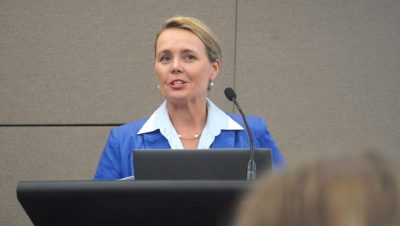
Frontier Genetics’ Rebecca Burnham addresses this month’s NBRUC conference in Brisbane
The project was presented by Rebecca Burnham, one of the members of the Frontier Genetics group, who outlined not only the recording gaps the project is designed to fill, but the significant opportunities it presents for the Brahman breed.
Ms Burnham also noted the interest the project has already attracted from beyond the Brahman seedstock sector, suggesting the producer-led co-operative model is resonating with a broader industry audience looking for practical solutions to the phenotype recording challenge.
Frontier Genetics Inc is a cooperative of ten Brahman seedstock herds operating across Queensland, with member properties spanning a range of environments. The group already operates to a shared minimum recording protocol that includes weights at 200, 400 and 600 days, mature cow weights, days to calving, scrotal size, genomics and DNA sire verification.
That baseline puts them well ahead of typical industry recording rates, before any project work begins.
Working with MLA under a Donor Company-funded project called ‘Beefing Up Genomics,’ Frontier Genetics is now utilising that base to deliver the phenotype and genotype data that has not been fully captured in previous reference populations.
The project is targeting four calf cohorts across about 2720 head, with intensive recording of traits that have historically been difficult to collect at scale in northern seedstock herds.
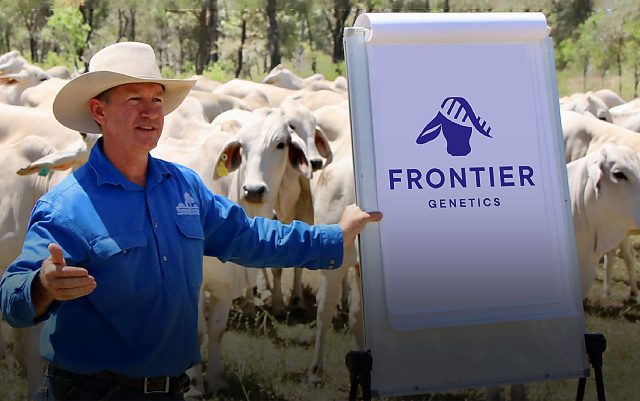
Frontier Genetics member Michael Lyons
Core among these are percent normal sperm (PNS), ovarian scanning for age at puberty and lactation anoestrous interval, birthweight and carcase scanning. The project also extends into emerging trait areas that are of growing interest to northern producers, including cow body composition, tick and fly lesion scoring, coat length and udder measures and scores.
These traits reflect the broader production and adaptation challenges facing northern beef herds and represent areas where improved genetic information could deliver real on-farm value.
The project is also designed explicitly to complement rather than duplicate existing reference work, adding female reproduction phenotypes where Repronomics coverage is thin and filling the male fertility recording gap the BIN structure cannot address, given all male calves in that project are castrated.
Fertility biggest economic lever
Fertility is the biggest economic lever in extensive northern beef production, and it is currently one of the weakest points in the Brahman genomic evaluation.
Low EBV accuracies for traits like days to calving, percent normal sperm and age at puberty mean that the genomic tool a commercial producer relies on when buying bulls offers less reliable information for the traits that most affect production and profitability.
Improving the reference population for those traits directly improves the confidence a buyer can place in those numbers, and more broadly will impact on the selection decisions flowing through to commercial herds across northern Australia.
The breed also carries a structural vulnerability that makes this work more urgent than it might be for other breeds. Brahman breeders have historically recorded performance data at lower rates than most other breeds.
The rapid rise in genotyping is genuine progress, but nearly half of those genotyped animals now carry no phenotypes. If that trend continues unchecked, the reference population underpinning the entire Brahman genomic evaluation will gradually thin-out, and EBV accuracies will stall or decline for exactly the traits producers most need confidence in.
While this producer-led project, with the support of MLA, is focussed on the Brahman breed, the underlying principle applies across the broader industry.
Genomics has changed what is possible in beef cattle selection, and the rate of adoption across the industry reflects that. However, the accuracy of any genomic prediction is a function of the reference population behind it.
Genotyping without phenotyping is effectively a partial investment. And as most producers would recognise, partial investments deliver partial returns. The herds that will get the most from genomic technology over the next decade are the ones that treat recording as the non-negotiable half of the equation.
 Alastair Rayner is the Strategic Account Manager for Southern Australia with Vytelle and Principal of RaynerAg. He has more than 30 years’ experience advising beef producers and graziers across Australia. Alastair can be contacted here or through his website: www.raynerag.com.au
Great work yet again Alastair. Frontier Genetics is well labelled. An inspirational group on the front foot, taking advantage of a great opportunity.
The issue highlighted will escalate as more businesses recognize the usefulness of accurate breeding values for key drivers of business margins – production, values, costs. It is difficult to understand why anyone would use a bull that has not been cleared of dud genes, whether they be the cause of subfertility or other major problems such double muscling. Introducing such genes to the next generation in just one year creates a decade or more of effort to gradually bleed the rubbish out of subsequent generations, all the while experiencing the costs of getting it wrong.
I urge producers to screen their bull herds for dud genetics using simple sampling procedures. Already many are doing so with horn genetics. There is a lot more than just that. However, take care in doing so. It’s not magic. Just part of the bull selection and use process. Use a balanced approach with advice from peers and others who really understand how this stuff works.
Another great article Alister