
MORE cattle from the Northern Territory are beginning to move as one of the most active wet seasons in memory gives way to the northern dry season.
Mustering has started in drier parts of the Victoria River district, with Barkly stations also preparing to begin.
The scale of the season is captured in the NT Government’s latest Pastoral Feed Outlook report, covering January to April 2026.
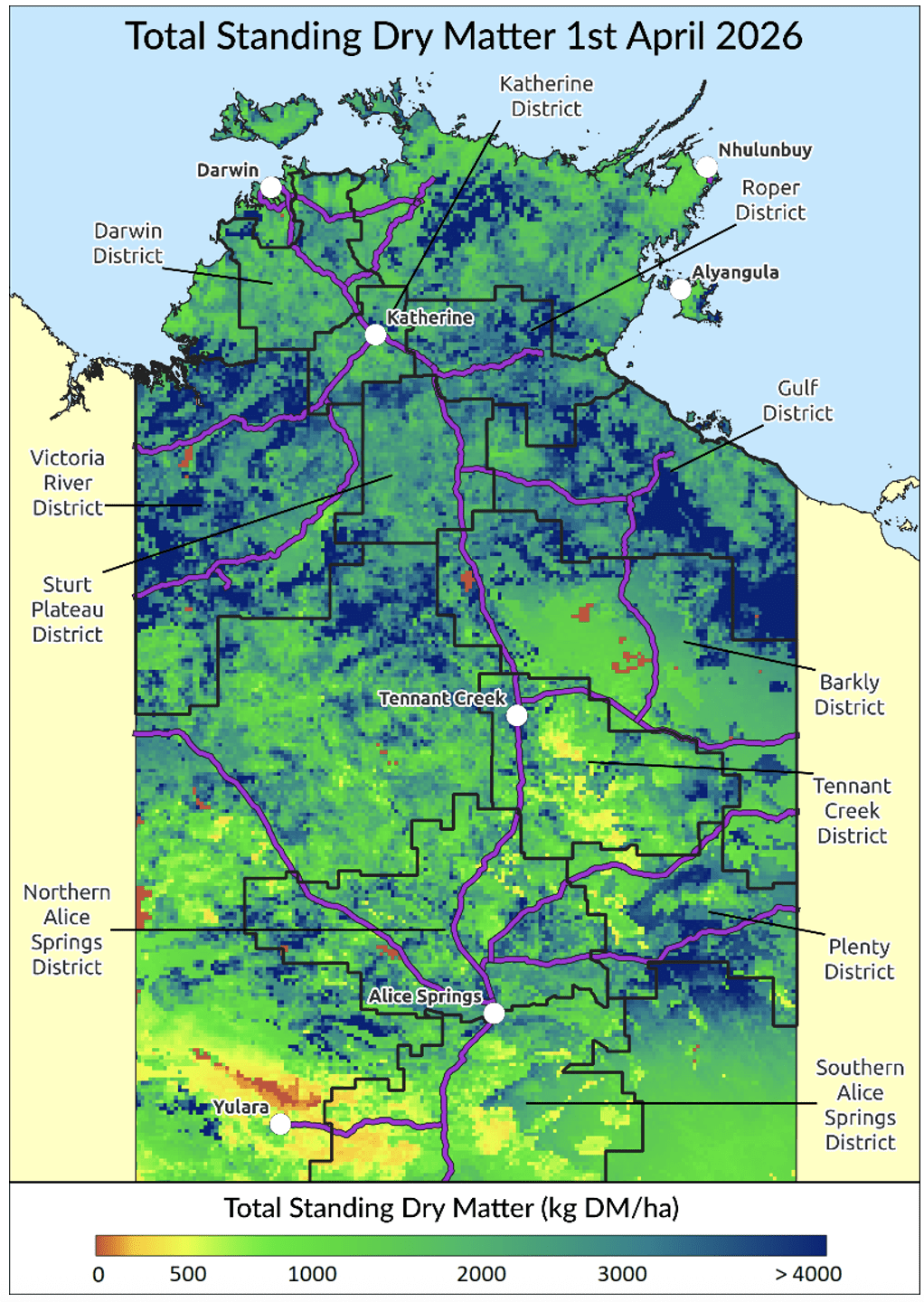
Source: NT Gov Pastoral Feed Outlook Report Jan-April 2026
Severe Tropical Cyclone Fina affected both the Top End and Kimberley in mid-November, followed by inland troughs and lows that delivered exceptional rainfall to central Australia in early to mid-February. Further tropical lows in March caused severe flooding across the Top End, particularly in the Katherine and Daly regions.
Pasture growth is now well above average across all pastoral districts.
NT rural property and livestock agent Andy Gray, a former NT Livestock Exporters Association president, said heavy rainfall over a short period had caused major damage to roads, which was contributing to mustering delays even where areas were drying out.
 “A lot of places that you’d be into well and truly in any wet season by now haven’t been able to start,” he said.
However, that is now changing, with some areas now dry enough for graders to get to work on re-opening roads and mustering to get underway.
The general rule is that sales of cattle from properties ‘on tar’ are now happening, while sales on dirt are yet to get underway.
“Speaking to some of the truck drivers, they can get to those properties that are on the bitumen where they have yards nearby.”
Some export activity has already been happening out of Darwin, most notably via the world’s largest livestock carrier which called into the NT Port two weeks ago to load over 17,000 cattle for Indonesia. (More detail in this ABC article here)
The MV Al Kuwait, formerly known as the Ocean Shearer, would typically be transporting sheep from Western Australia to the Middle East at this time of year.
However, with trade to the region disrupted by the Iran conflict and the vessel idle in Fremantle, northern cattle exporters secured the ship to move a large consignment of cattle sourced mainly from Queensland and Western Australia to Indonesian feedlots eager to replenish empty pens after a busy Ramadan/Lebaran sales period.
Prices ease as supply increases
Northern catle export prices have continued easing in line with the traditional seasonal increase in supply.
Live export steers loaded in Darwin recently have been around $4.20/kg, with current offers closer to $4/kg for high-grade Brahman feeders and $3.70/kg for crossbred cattle, export sources told Beef Central this week.
By comparison, North Queensland, where mustering has been in full swing for some weeks, has seen 300–450kg export steers at $3.45/kg delivered Charters Towers, and heifers at $3.25/kg according to a recent order for delivery April 26-28.
The Northern Territory is running about a month behind its typical seasonal timetable, but with road access improving and mustering underway, more regular shipments from Darwin are expected from around mid-May.
Exporters and importers meet in Jakarta
Meanwhile, Australian exporters and Indonesian importers met in Jakarta earlier this week for their annual talks.
The overall “vibe” was described as positive, with discussions focused on continued investment in animal welfare training and vaccination programs through LiveCorp to protect both Indonesian and Australian cattle.
However, concern remains over Indonesia’s government-imposed “price cap” on finished cattle.
Set at 59,000 Indonesian Rupiah, the cap is below levels needed for feedlots to remain profitable under current global cattle prices.
The meeting heard that lifting the cap to 62,000 IDR would support increased imports, generate jobs in both countries and improve returns for Indonesian cattle producers.