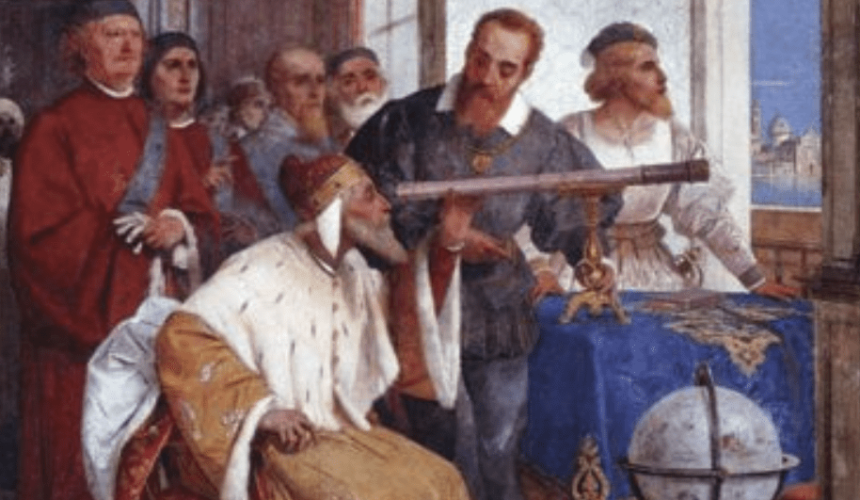
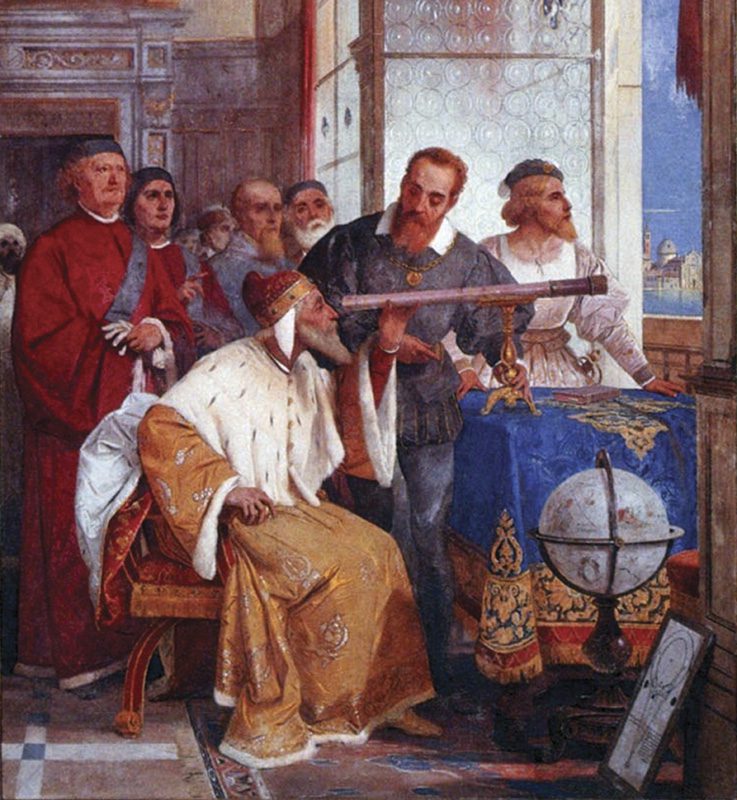
Galileo showing the Doge of Venice how to use the telescope (fresco by Giuseppe Bertini, 1858)
JUST as Galileo’s telescope once revealed hidden truths about the universe that challenged prevailing narratives, a growing group of international scientists and researchers are building a scientific base to help illuminate evidence often overlooked or ignored in public discourse about the role of meat and livestock in modern society.
In a speech to a conference in Perth earlier this year Swiss food systems scientist and economist Professor Peer Ederer drew on the story of how the ancient Italian astronomer Galileo Galilei helped people to see the universe as it truly was.
In the process the story helped to illustrate how Professor Ederer and numerous other scientists around the world are working to present a balanced view on what the science around animal agriculture actually says, in a bid to prevent livestock systems from becoming a victim of over-simplified and reductionist agendas.
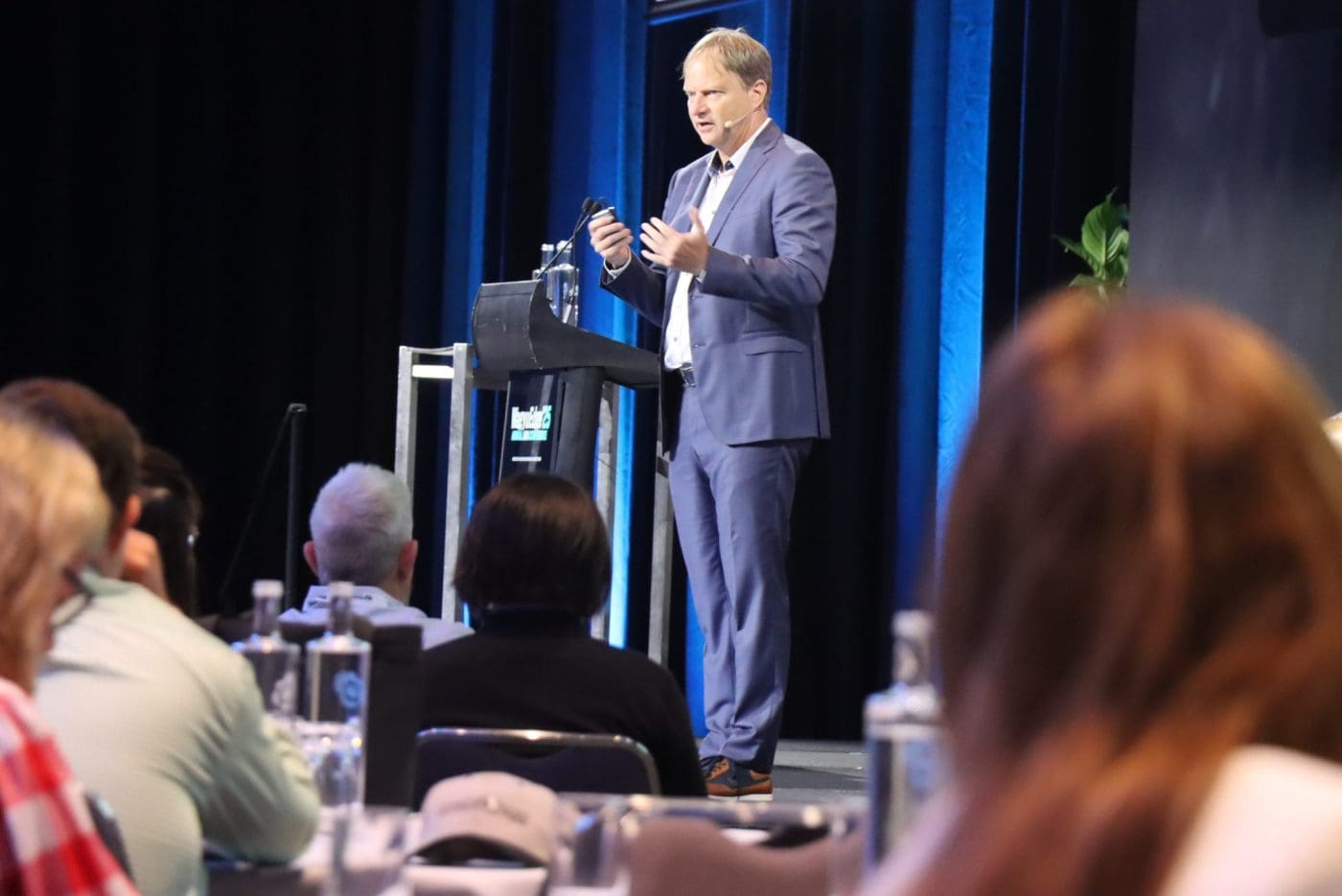
Peer Ederer addressing the 2025 WagyuEdge Conference in Perth.
In 1543, he explained, Polish astronomer and mathematician Nicolaus Copernicus published mathematical proof that the Earth revolves around the Sun. “This had indeed been known already in Greek antiquity, but in those days Gods were more important than science.”
Yet despite that breakhrough it still took centuries for most people to accept that numbers-driven truth.
More than a hundred years after Copernicus’ discovery, many still believed the Sun and stars orbited the Earth.
That was, after all, what they could see with their own eyes when they looked to the night sky. It was also what the dominant religious doctrines of the time declared to be true.
It wasn’t until Italian astronomer and physicist Galileo Galilei built the telescope that the idea that the Earth revolves around the Sun gained broader acceptance. The invention allowed people to observe Jupiter’s moons for themselves, presenting irrefutable evidence that not everything revolved around Earth.
Even then, the definitive proof was slow to penetrate religious orthodoxy. Followers of Copernicus were burned at the stake for teaching “heretical” ideas. Galileo himself was tried for heresy by the Roman Inquisition and placed under house arrest for life.
Illuminating science
But what does this have to do with meat and livestock production?
At the annual Australian Wagyu Association conference in Perth earlier this year Professor Ederer explained how a group of scientists from around the world is collectively working to build a type of Galileo’s telescope of their own.
Instead of lead tubing and glass lenses, their “telescope” is being built with scientific evidence and research data.
Despite starting small their group is growing in number and building in its impact. Their “Dublin Declaration” event held in Ireland in 2022, which brought together scientists from around the world, is now backed by the signatures of 1200+ scientists. Signatories are only accepted if they are verified to be an independent researcher or scientist (see more here www.dublin-declaration.org).
That was followed by a similar large gathering last year in the US which resulted in the Denver Call to Action.
The purpose of their efforts, which are over and above each of their ‘day jobs’ as scientists, researchers and university academics, is to provide a balanced picture of the extensive body of scientific evidence that exists around the role of meat and livestock systems in society, much of which is overlooked in public discourse dominated by activist campaigns aimed at ending meat consumption and animal agriculture.
They express concern that if the distortion and obfuscation of the science surrounding meat and livestock continues unchecked, major problems such as global malnutrition and childhood stunting will only worsen, as will consequences for landscapes which have evolved for eons with herbivores harvesting grass and fertilising soils.
Following ‘where the science leads them’
It’s also worth noting that many of these scientists who have emerged as some of the most prominent public defenders of meat and livestock on scientific grounds had no direct connection to the sector.
Like Copernicus and Galileo, they say they simply followed where the science led them.
A ‘curious’ result
Peer Ederer came to the topic as a food systems scientist when he began researching answers to the question of how the world can feed a rapidly growing population long into the future without destroying the planet.
He began researching the specific topic of the role animals should play in global food systems, from a nutritional, environmental and ethical perspective.
His research led him to an answer he had not anticipated.
“I came to the conclusion we need more animals,” he said.
“That is a curious result,” he says he thought to himself.
“Why does my econometric spreadsheet reach that conclusion, while the consensus seems to be that we need less animals?”
As he continued to research the science surrounding meat and livestock production, he soon discovered many other scientists around the world also coming to similar conclusions as his from their own analysis.
Dr Frederic Leroy was one.
He came to the topic through salami.
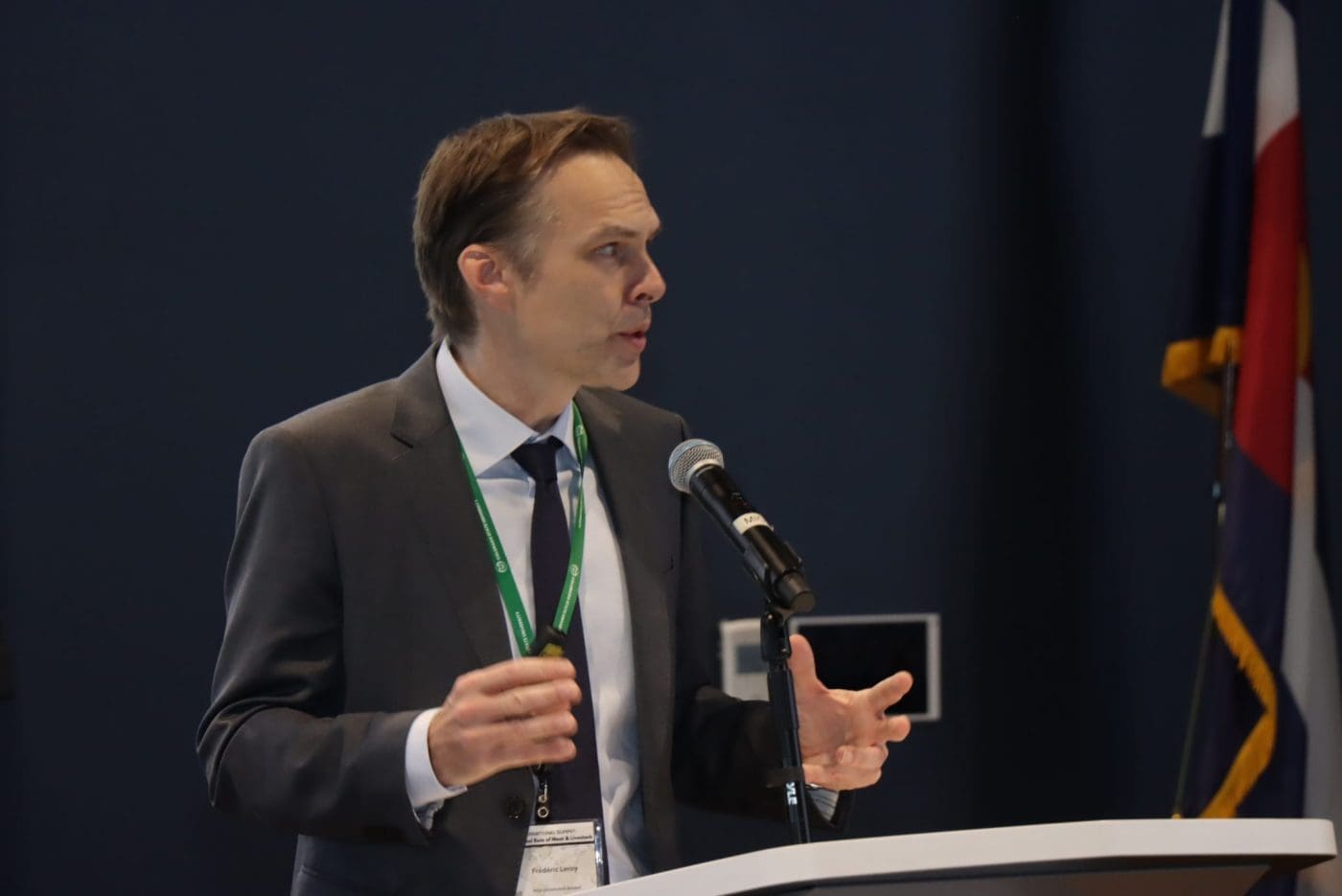
Dr Frederic Leroy
The professor of food science and technology at the Vrije Universiteit Brussels studied meat fermentation for his PhD.
As he delved into that subject he became increasingly aware of the existence of a powerful movement against meat – people connected to high level institutes and organisations who were actively disseminating the message that animal-sourced foods were bad in almost every conceivable way, yet were failing to deliver evidence that went against what he could see the science was actually saying.
“Through different angles we all arrived at this issue,” Peer told Beef Central in Perth.
“That is, there is a deliberate multi-layered obfuscation going on, with the aim to push certain narratives that do not correspond to what the actual scientific evidence is.”
The small but growing group of scientists began to publicly challenge some of the scientific misinformation about meat and livestock they were seeing.
Early on, their work caught the attention of the World Farmers Organisation which created a scientific counsel incorporating their expertise to help bring important balance to global policy forums which were being dominated by anti-meat activists. (More in this earlier story https://dev.beefcentral.com/news/how-a-late-wake-up-call-restored-balance-to-the-un-food-system-summit/)
What started as a small group has grown considerably in recent years. A defining moment was the “Dublin Declaration” in 2022, followed by the Denver Call to Action last year.
Under attack
The scientists also caught the attention of those who believe animal agriculture must end and have since become subject to attacks on their credibility via social media and media articles.
A common criticism raised against them is that some of the scientists involved have received funding from the livestock sector. The criticism overlooks the academic principle that scientific validity derives from adherence to established methods and peer scrutiny, not from the source of funding. And nor do the critics raise the same argument against scientists producing research papers directly funded by groups opposed to meat consumption and animal agriculture.
However despite being singled out for ad hominin attacks supported by groups such as Greenpeace and media organisations The Guardian and New York Times, they remained undeterred, and say they are happy to let the science to the talking.
The attacks have indeed have had an impact on one level.
Peer conceded in his interview with Beef Central in Perth that there are many more scientists who support the scientific position of the Dublin Declaration, but have been reluctant to sign due to the ‘chilling effect’ of being publicly targeted and harassed by anti-meat groups or losing the support of the institutions they rely on for work.
“Some have told us that their children in high school are getting death threats and emails, and that is crossing the line, that is not acceptable,” he said.
A NATO-like community strength
But, as more join and the community grows in strength, more are now feeling more confident to publicly declare their support.
A key message now is “you are not alone”.
“We have also had scientists who said their voice had already been silenced, but that through the Dublin Declaration and the Denver Call to Action, they feel now emboldened again to be speaking.
“That is of course the function of these instruments, that you are not alone anymore.
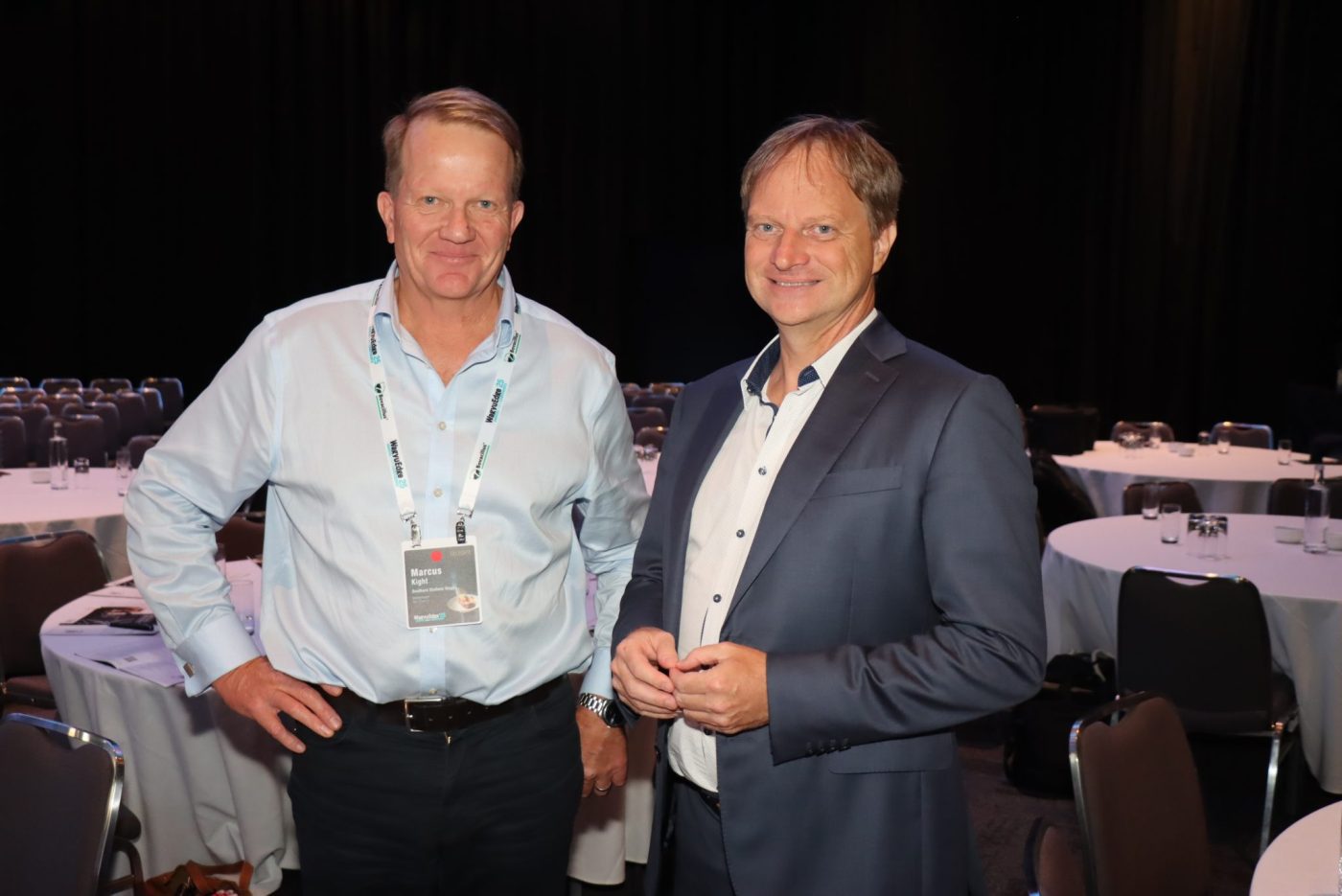
Chatting at the 2025 Australian Wagyu Association Conference in Perth – Marcus Knight from Southern Stations Wagyu, Christchurch, NZ and Professor Peer Ederer.
“NATO works with Article 5 and the Denver Call to Action is a bit like that, it gives every individual scientist more protection if any one of us gets attacked, then we know there are colleagues who are willing to stand up.”
Asked why he had decided to dig in and defend the livestock industry when he could have chosen any number of scientific questions or issues to turn his intellectual attention to – after all, he has no background in the meat or farming industry – he said it was a combination of two things.
“It is really fascinating, it is an important question, if I can make a meaningful contribution to solving this issue that we need to feed the global population properly without ruining the planet, then I think this is all that you can hope for as a scientist, that you make a meaningful contribution to an important subject.
“What also helps of course is that we’re having a portion of success.
“It is inspiring to have a great group of scientists where we can work together as a team, with respect, professonialism and trust.
“And with the Dublin Declaration, the Denver Call to Action, all these things that we’re doing, we actually see a difference being made on the ground. We are having a good run of success, so why stop.”
‘Let the better argument win’
Peer said he was not personally deterred by the public hostility directed at scientists by anti-meat activists.
“Philosophically I am a libertarian person, I think we need to allow people to have their opinions and voice their opinions and I am very much in favour of freedom of press, freedom of sciences.
“This is absolutely necessary, so the activists must be free to spread their version of the truth, I don’t want to ban them, that would be against my philosophy.
“Let the better argument win.”
Frederic Leroy on Dublin Declaration 12 months on
New global livestock information hub to launch
A new international initiative, the Real Food Research Hub, is set to launch in late 2025 as an online global science platform to support evidence on animal agriculture and its role in human health, community wellbeing and planetary sustainability.
“The rise of mis-information and dis-information around animal agriculture including the food it produces has been identified by leading scientists internationally as an urgent issue,” said Dr Rod Polkinghorne OAM, co-Founder of not-for-profit International Meat Research 3G Foundation which is developing the Real Food Research Hub.
“There is a need to return to the use of rigorous, evidence-based scientific research as the basis for decision-making by all stakeholders – including government, industry and consumers – rather than simplification, reductionism or zealotry.”
Topic summaries will span health, nutrition, climate, environmental impact, ethics, economics and other societal issues around animal agriculture, and address the big questions that need answering. From “Should we eat meat?”; “What is the impact of meat on cardiovascular health?”; “Is the farming of animals for food ruining our environment?”; “What is the impact of synthetic and ultra-processed foods?” to “How do we deal with the ethics of eating animals?”. Each Topic summary will draw together the key components of a topic, and breaks down the science behind it.
It will house thousands of credible references from scientists and subject matter experts around the world.
In the Reference Library users will be able to browse by topic area or conduct a detailed search by multiple criteria to find references on their area of interest. Each item in the Reference Library will provides summaries and key information about the work, plus a link to the authors’ source location of the full reference – to go on the free mailing list for updates when they occur click here
Readers might be interested in this paper: Nutritional, environmental and social profiles of natural meat and food derived from cultured muscle cells: An overview. Authors Angela Salzano, Michael D'Occhio, Anna Balestrieri, Giovanna Bifulco, Antonio Limone, and Giuseppe Campanile. Published in the scientific journal Meat Science 2025; web site doi:10.1016/j.meatsci.2025.109868
As an anthropologist who researched paleo diets for ten years and a regular contributor to a science symposium on paleodiets it is good to see these initiatives. I was also a vegetarian for 14 years till I did my research and my daughter was a vegan for a few years so I have no bias against people who don’t eat meat. My research convinced me it was necessary for optimal human health so I look forward to seeing more of the research that you are all contributing to. Thanks
Why is it that anti-animal farming activists resort to such lengths of death threats of students to defend their position? They can be heard without such actions. Everyone can have an opinion-just because it isn't the same as yours, should not invoke violence. The farmers have to take good care of their animals or else their product would not make any money for them to live on. Kudos to the scientists for doing the research that has resulted in the understanding that animal production supports and does not hinder the environment that we all need to survive.
Congratulations to the Beef Central team for continuing to present balanced, well researched journalism on these topics. There are serious challenges for robust scientific thinking that must be defended against the rising tide of well-funded activist extremism.
The great challenge for Agriculture and rural Australia is generating cut-through into mainstream media with credible journalism like we are used to here. We have so many great storytellers, advocates and initiatives within agriculture trying to educate the urban majority, but rarely breakthrough the rural-urban divide. Why are rural media, and rural stories, so often ignored (and disrespected) by mainstream media? Urban consumers are interested, but they just get spoon-fed recycled crap...