
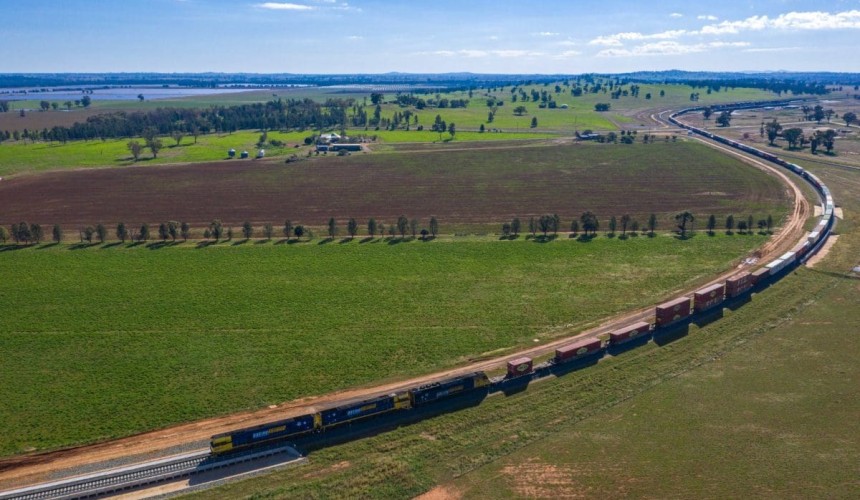
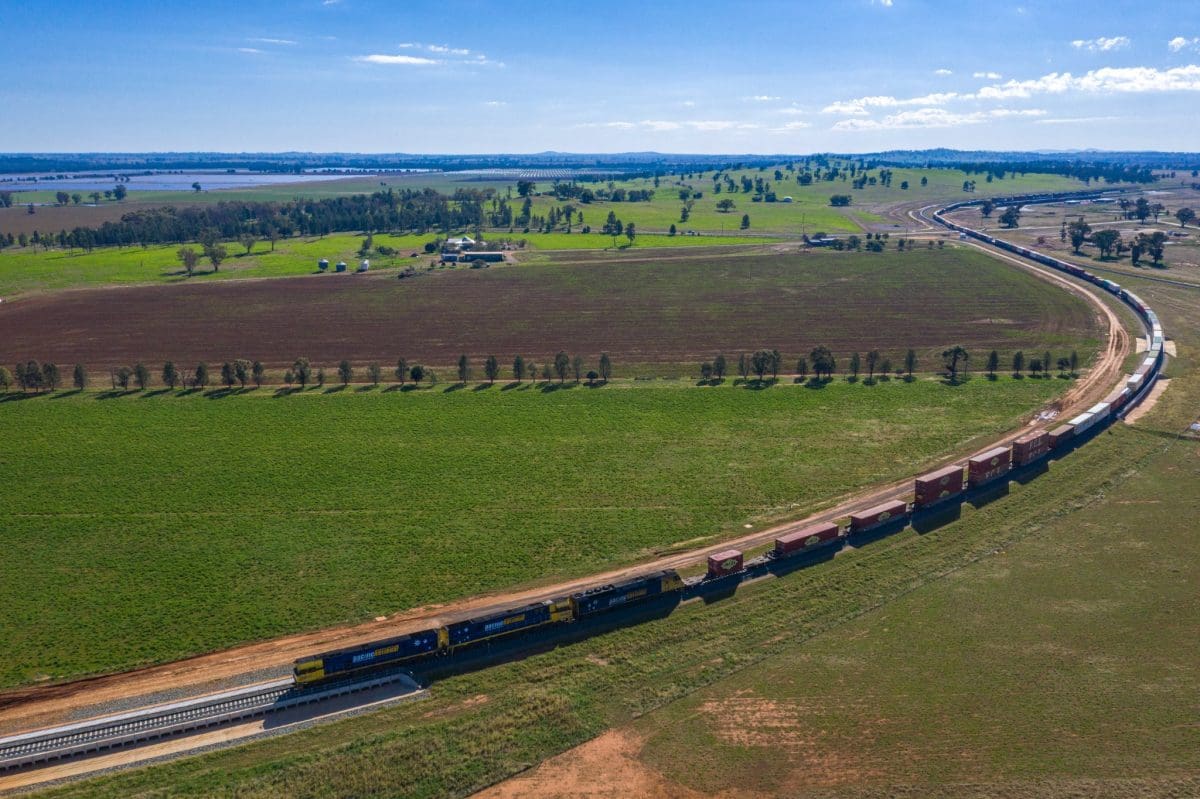
THE FEDERAL Government has placed an indefinite hold on all Inland Rail projects north of Parkes after an independent review found completing the full Brisbane to Melbourne line would cost at least $45 billion and take a decade.
The estimate is about $15B higher than the roughly $31B figure outlined in Kerry Schott AO’s 2023 independent review, and nearly three times the $16.4B estimate in 2020.
To date, $14.5B in equity funding has been committed, leaving a roughly $30B shortfall.
The government will target finishing projects from Beveridge in Victoria and Parkes by the end of 2027.
Inland Rail works north of Parkes will focus on preservation of the rail corridor, as well as protecting sites for future Inland Rail intermodal terminals in Gowrie and Ebenezer in Queensland.
No major construction has begun on these sections, aside from part of the Narrabri to North Star line, which was upgraded and completed in late 2023.
Grain trains have been using these lines independent of the Inland Rail since operations resumed.
Minister for Infrastructure, Transport, Regional Development and Local Government Catherine King said this outcome could be traced back to governance issues from the LNP governments.
 “The 2023 independent review found major deficiencies in the governance and delivery of Inland Rail by the Liberals and Nationals,” Ms King said.
“We are taking sensible decisions to realign the future of Inland Rail and build a safe, efficient and reliable network for the future.”
Speaking on ABC AM this morning, Ms King said there were calls from the industry to shore-up the existing freight network as well as get the Inland Rail to Parkes.
“What freight operators are telling us is that where we want to put investment at the moment is actually in the existing freight network, to get Inland Rail to Parkes, which is what we’ve been doing.
“So basically this project, from the start, from when we came into office, we’ve been having to manage, frankly, what has been a bit of a mess.
We’re now making the decision to prioritise getting it to Parkes, preserving the corridor beyond that, and the intermodal terminals beyond that, and really delivering better resilience.”
Funding reallocation
Following the move, the government has announced a reallocation of $1.75B in funding originally set to go to Inland Rail works into other freight rail projects, alongside a $55 million incentive scheme to get more freight moving by rail and sea.
The works will involve upgrades to improve the efficiency of the East Coast network, including track renewal works, passing loop extensions, improved signalling to remove key speed restrictions, improve transit times, support larger trains and enhance service reliability and safety.
Works will also include resilience upgrades in high-risk flood-prone sections particularly along the East-West Corridor, which has faced many multi-week closures over the last decade following downpours in central Australia.
The Commonwealth, state and territory infrastructure and transport Ministers agreed in November 2025 to identify opportunities to move more freight by rail.
The Transport Resilience And Capacity Kickstart (TRACK) pilot program will support more fuel-efficient freight movements across Australia, which is especially relevant while the conflict in the Middle East continues to affect global fuel supply.
This work will also include the establishment of a coordinator within the Australian Rail Track Corporation’s (ARTC) to identify and implement improvements to rail operations in conjunction with other rail infrastructure managers.
LNP response
Shadow Minister for Infrastructure and Transport, Senator Bridget McKenzie has come out against the decision, blaming the Labor Government for the project budget issues.
“Labor inherited a project 100 years in the making – a project that was intended to build resilience to the north-south freight network linking Melbourne and Brisbane,” Senator McKenzie said.
“History will record that this Labor Government pulled up the tracks half-way without any warning.
“This decision means no long-term project is safe, undermining sovereign risk for Australia’s national $270 billion infrastructure build.”
Federal Member for Riverina Michael McCormack said regional communities would suffer from this move.
“The Inland Rail is nation-building infrastructure…” Mr McCormack said.
“The vision was there for all to see, but apparently this Labor Government lacks the foresight to deliver anything in the infrastructure space.
“The Minister for Infrastructure is showing complete disdain for those in the infrastructure industry and those in the regions.
“This will come at the cost of regional jobs.
“Regional economies will suffer further from this neglectful decision.
“No doubt we should hear from country mayors angry at the continued neglect Labor has inflicted on regional Australians.
“This Government does not care about the regions or the hard-working people who live, work and raise families there.”
NSW Farmers calls for answers
NSW Farmers president Xavier Martin said the decision has left questions for farmers and communities along the northern part of the corridor who were still facing significant challenges in getting produce to market.
“NSW Farmers policy supported Inland Rail because moving freight more efficiently matters to farm businesses, regional communities, and the prosperity of the nation,” Mr Martin said.
“Certainty matters, and if the funding is stopping at Parkes then the government must be upfront about what happens next, because real people and real businesses have already paid a price,” Mr Martin said.
“We need the Minister to tell us what this means north of Parkes, for those easements already acquired, and the already-constructed assets that are now stranded.
“How does the government plan to genuinely invest in the future of rural and regional businesses without this major linkage, and will they work with the states to deliver this funding into improving the existing regional rail freight network, rather than a wasteful redistribution of taxpayers’ money?”
Mr Martin said the priority must be reinvesting funds back into the regional network and not diverting off into other projects.
“What regional Australia cannot afford is an even more expensive high-speed passenger rail project that does nothing for freight, nothing for farm productivity, and nothing for the communities already affected by Inland Rail,” Mr Martin said.
“A Newcastle to Sydney very fast train has been reported as costing between $90 billion and $114 billion, that’s way more expensive than Inland Rail.
“The federal government must not shortchange practical freight upgrades that keep regional businesses competitive for the nation’s future.”