
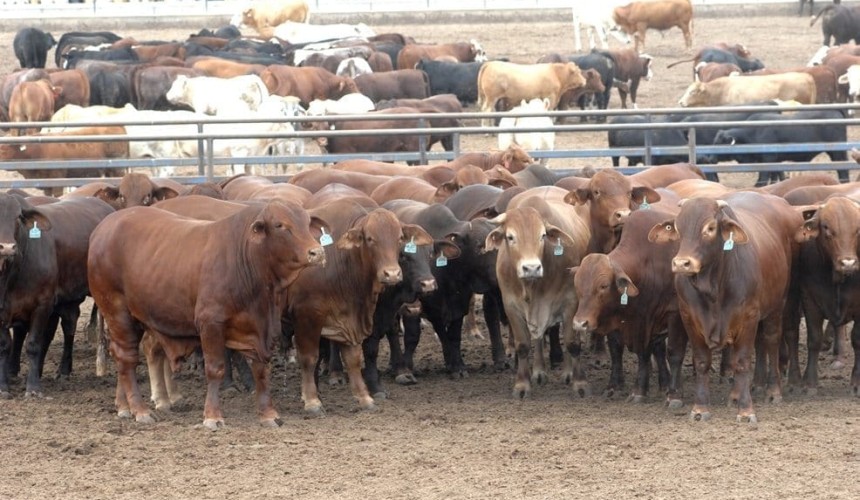
LOTFEEDERS who have targeted the China export beef market have some tough decisions to make in coming weeks over the use, or non-use, of hormonal growth promotants.
Beef Central has spoken to a range of southern Queensland and northern NSW yards this week to get an impression of what’s happening.
Two of those yards have already shut-down some no-HGP programs on 120-day and 200-day midfed cattle – in one case a customer program numbering around 600 head per week. That’s based on the uncertainly around what happens with those cattle once Australia’s 2026 China quota is filled some time around mid-year.
Cattle in 120-day programs entering the feedyard this week, for example, would close-out for slaughter during the week starting May 18. That’s about the time Australia is likely to fill its 2026 China quota of 206,000t, some suggest, after which a mammoth 55pc tariff will apply, effectively rendering trade prohibitive.
Another large Queensland lotfeeder said his business was yet to sit down to make decisions, but was ‘acutely aware’ of the looming issue. At the very least, he said some midfed Angus that would otherwise have gone through a no-HGP program in order to be eligible for China will now receive an implant.
“These decisions need to be made by lotfeeders before the end of January,” he said.
“But in truth, nobody really knows what the right decision is, with so much uncertainty over things like the development of an internal China quota management system, progress in EU Free Trade Agreements and access conditions for our HGP-free beef into the UK.”
“The other danger is, the industry comes up a with quota management system in the next two or three months, and there are no eligible (HGP-free) cattle on feed to supply it, because people have reverted to using implants,” he said.
There were no other export homes that could take large volumes of HGP-free beef at a premium like China does, a supply chain contact said.
“Those HGP-free cattle will go somewhere, even if the China door does close, but it comes back at 40c/kg dressed weight price difference between free and not free,” he said.
HGP-free grainfed beef has been a major growth segment for the Australian beef industry since the rapid expansion in beef trade into China over the past ten years. China is by far Australia’s largest no-HGP market (dictated by market access terms), with the EU and UK running a distant second and third.
Last year, DAFF records show Australia’s exports to Greater China (including Hong Kong) reached 280,000t, second only to trade into the US.
The UK took just 16,800t, and the EU, 7600t, but both (currently) require EUCAS producer accreditation to participate. Neither currently represent any sort of serious default market for Australian HGP-free beef diverted out of the China market.
This leaves lotfeeders in a dilemma, with short and midfed feeder cattle being inducted in coming weeks.
Trenbolone acetate implanted feedlot cattle typically gain at 12-15pc faster than non-treated cattle, so finished cattle price incentives need to be substantial to offet the production sacrifice. Additionally, implanted cattle produce saleable meat yields up to 1.5pc higher than non-treated cattle.
The total production sacrifice on HGP-free export weight cattle could reach $300 a head, through the combination of lower performance in the feedlot and boning room yield, a prominent export processor said yesterday. On top of that, higher weightgain also delivered greater annual stock turnover through a feedyard, by hitting target weights earlier.
Beef Central has also heard this week of some mid-fed cattle already part way through their HGP-free feeding programs, that are now being given a ‘pill’ to maximise production for the remainder of their programs. They will now clearly be sold into markets other than China.
Of course, there is no reason why HGP-free beef cannot be diverted into other mainstream export markets like the US, Japan or South Korea, one trade soruce said, but it was not highly sought-after in these markets and would not attract the same premium it could in China.
Processor uncertainty
Large China-eligible export processors with HGP-free programs are asking similar questions, and talking with their feedot suppliers and overseas customers, Beef Central was told.
“Maybe some will take a bath with HGP-free beef and sell it into a HGP-treated market, but there is a lot of uncertainly about which way to move,” one Queensland processor contact said yesterday.
“We think the hard decisions about future HGP programs will come within the next couple of weeks,” he said.
The main impact was likely to be seen in Queensland and northern NSW feedyards where HGPs are mostly widely used on shortfed and midfed cattle, he said. Further south, there were more yards feeding for marbling that did not routinely use implants. Longfed Wagyu programs avoided HGP use entirely, because of its impact on marbling.
Background
On 1 January China announced a new quota/tariff system on imported beef, that will see Australia limited to 206,000t tariff-free this year. Anything above that figure will accrue a 55pc tariff, making trade unviable, exporters say.
If Australia does not develop its own China quota management system, under a first in, best dressed system we could hit our 2026 quota as soon as May, trade analysts suggest.
In that event, any HGP-free beef is going to struggle to find a home, at anything like the China price premiums that justify the production sacrifice, Beef Central was told.
In other news China has overnight re-admitted a reported 20 Canadian beef plants for supply, following a 2021 case of atypical BSE in Canada.
Bindaree Beef chief executive Andrew McDonald said that could spell the death-knell for any possibility of Australian grainfed exports under a 55pc tariff later in the year.
“We were all hoping that there might be some form of quota exemption for Australia’s higher quality chilled or grainfed beef, for example, but now that Canada has regained access to China, that looks even less likely,” Mr McDonald said.
“Without China, I just don’t see many Australian lotfeeders being able to justify HGP-free programs,” he said.
“Export processors will be having these conversations with their feedlot suppliers now – assessing the current situation.”
China is a different marketplace. Their legal system is unlike any other and their citizens can be imprisoned if they act against the interests of China.
China through their government departments give strong signals of their future intentions. In our case, they seek to increase their imports of beef products from South America. Given their processing cost advantages (John Berry explained Australia processes for $350 a body, USA $250 and South America $150), and understanding China is a price market, clearly, they seek to source meat protein for their nation from suppliers with the lowest costs.
Taking Peter White’s advice and speaking with Chinese officials and customers, we may discover they have restricted our tonnage because they do not see fat and frozen quarter beef from cutter cows and spent bulls coming from Australia. They were an important market for Australia during the last prolonged drought when these products were imported by China in large tonnages. However, perhaps not for the future.
When I worked with Peter at AMH, we always acted on his advice on quota arrangements. He worked closely with the Blue House in South Korea when they were constructing their tender arrangements. On one occasion, I was called to a meeting of the Cattlemen’s Union in Inverell to explain our actions in dropping the price into a South Korea tender to capture 100% of the tender. Fortunately, Angliss dropped the price again in the next tender and this underwrote AMH’s profits from this trade.
Again, Peter is correct suggesting it is inappropriate to allocate quota on past year shipments. If we are correct and China sees a change in the mix of product supplied in the future, then this quota should go to those exporters capable of meeting their product specifications.
So perhaps Australia needs a system where exporters bid for the quota. It could be administered by MLA in like manner to AMLC. As with the EU HQB quota, there could be a price determined by a market in the quota. It would need to be transferable as an annual amount or permanent of course at different pricing. The quota would need to be for defined product such as applied in the HQB. Again, this would require consultation with the Chinese government officials and customers to work out what they seek from our supply chain.
It was interesting to see that the states with the higher share of their beef exports going to China are NSW and WA. I suspect these figures will change considerably if China are seeking differing beef products from Australia. MSA may be able to underwrite the product definition for supplying into this quota.
Australian Cattle Industry Council