
FOR about three million years humans ate red meat as part of their overall diet and seemed to get along very well.

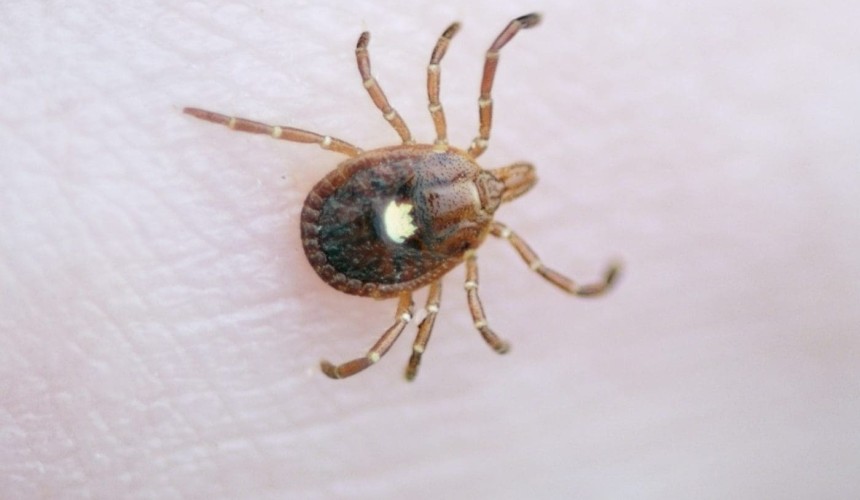
The Lone Star tick. For millions of years red meat has fed human beings, yet modern “anti-meat” studies increasingly dismiss its proven nutritional value and instead focus on ways to force people to give it up – from retail nudges to extreme proposals that involve engineering ticks to spread meat allergies.
Then somewhere around the turn of the 21st century, scientific studies began warning that red meat was in fact harmful to human health and should be reduced or preferably removed from human diets altogether.
At the same time, other research pushed back, showing that red meat is in fact a nutrient-dense and healthy food that provides important amounts of protein, essential amino acids, vitamins, and minerals in balanced human diets.
Some might argue those previous three million years had already proved that quite conclusively.
But studies suggesting red meat is good for you don’t tend to get the same airplay as those warning it will send you to an early grave.
 Good science usually acknowledges what came before, weighing competing findings as part of the scientific method’s self-correcting nature.
Increasingly, that’s not happening.
Many recent anti-meat studies don’t appear to be too bothered with nuance.
Instead, they open with the unchallenged assertion that “meat negatively impacts human health” and then dive straight into answering one question: what is the best way to stop people from eating it?
And judging by some of the examples that have lobbed into our inboxes in recent weeks, some of the suggested tactics sound more like social psychology experiments rather than actual nutrition research.
Among the more benign examples is one such study which examines the effectiveness of “default nudging” – a strategy which involves convincing retailers to position vegetarian or vegan options as the first and most convenient choice for consumers, with meat options requiring an extra step, in the hope consumers will just give up and take the easier selection.
Another explores how forcing people to watch animal suffering via Virtual Reality can influence their attitudes toward meat consumption.
A further study examines the use of “meat-shaming” stickers on meat labels to alter consumer purchase intentions.
But none of these efforts at coercion even come close to the lengths the authors of other so-called academic papers advocate in order to prevent people from eating meat.
In a paper titled “Beneficial Bloodsucking” published in the medical journal “Bioethics” earlier this year, two professors of medical ethics argue that ticks could be engineered to spread alpha-gal syndrome (AGS) — a natural condition that causes a debilitating red meat allergy.
They argue that eating meat is ethically wrong, and contend that actively promoting this tickborne disease to force people to give up meat is not just permissible but “morally mandatory”.
Our attention was first drawn to this issue in this recent linkedin article from EP3’s Andrew Whitelaw, who argues the idea is not only scientifically absurd but also ethically bankrupt, violating personal freedom and bodily autonomy.
The idea of using bio-engineering to stop people from eating meat was also given a platform by TED talks back in 2013, when another “bioethicist” S. Matthew Liao suggested people could not be trusted to stop eating meat on their own.
Bioethicist S. Matthew Liao: In order to fight “climate change”, we should genetically modify humans to be intolerant to meat.
“If we eat less meat, we could significantly reduce our greenhouse gas emissions.”
“Now, some people would be willing to eat less meat, but they lack… pic.twitter.com/9uQS9XmqEx
— Wide Awake Media (@wideawake_media) October 8, 2024
“If we eat less meat, we could significantly reduce our greenhouse-gas emissions,” he says in the video.
“Now, some people would be willing to eat less meat, but they lack the willpower.
“Human engineering could help. Just as some people are naturally intolerant to milk or crayfish, like myself, we could artificially induce mild intolerance to meat by stimulating our immune system against common bovine proteins. And in this way, we can create an aversion to eating eco-unfriendly food.”
Andrew Whitelaw hit the nail on the head with this description: “This proposed scheme isn’t persuasion. It’s coercion. It says: “If you won’t change willingly, we’ll take your freedom away with a bite.” That’s not bioethics, and it’s certainly not ethical. It’s body politics. No one should be forcibly altered to fit someone else’s moral agenda.”
Bioethicists now brand the consumption of something that has sustained human kind for more than three million years, and which evidence shows continues to play a vitally important role in maintaining human nutrition across the globe, as a crime.
When “bioethics” becomes a vehicle for enforcing ideology, it ceases to be ethical itself.
The world's education systems have let themselves become hijacked by many exteme ideologies, instead of providing evidence based information and ethical guidance to permit people to sensibly manage their lives. There is too much wealth and not enough genuine hardship to keep these extremist promoters focused on truly important matters. Derek Newton, Towoomba, Qld., Australia.
again another diversion as to would it actually reduce emissions as we still need to eat and it is proven grazing in rhe grasslands is an necessity to maintain this biome. examples by the buffalo if we stopped being brain wàshed and focused on landfills the garbage we are forced to buy and the 25% if the co2t early output into the air is from products that wind up in landfills and now 60% of new landfills have no capture of methane and CO2 that emit from landfills and this alone is more than the ghg from meat eating by making consumer goods fixable and last longer turning things into collector pieces reducing waste by 50% would actually reduce CO2 by billion tons per year more than what would be reduced by total EV adoption and home heating combined
Absolutely criminal to infect a basic food source.
there is a lot of opinions being treated as facts going on..and almost always they cannot be proven correct at all..intolerance masking itsef as zero tolerance does not change what it is: an attempt to control what people think and believe by every unethical means possible..
only by insisting on correct terminology and fact checking can this be met. understanding that such attempts to influence us are based on ideologies,not science or sense
Hi
I love read meat and see nothing wrong with that.
I understand the way of vegans and respect it.
I understand the way of vegetarians and respect that.
That said why are they protesting and forcing their opinion down my throat?
I dont understand why 2 people on this planet think their opinion not even facts carry the weight of billions of people and are so entitled that they will bioengineer ticks to make me meat intolerant.
We need to stand up now and weed out the crazy people.
Thanx for your hard work showing this to the people.
thank you for reporting this.beef industry needs to push back on this negative rubbish.
And keep eating meat
This is nothing short of perverted and prosperous. What sick minds are behind all this?? They are who we need to track down and call out. These are the people that are dangerous to humanity.
Thankyou for reporting on this.
Whilst it seems like outlandish nonsense to us ... our industry really needs to wake up & realise just how big, committed, effective & influential anti-meat idealogy has been in our societies.
Please do a investigative journalism deep-dive into the 7 Day Adventist Church "health" (anti-meat) activism & the origins of the Dietitians Association ... & the outcomes of upon our health & medical industries, education, politics ... & impact upon our industry.
We need to sit up & start taking this stuff seriously. Red meat consumption per person has dropped dramatically, this is largely why. We have sat out of this public convention & let the crazies run it too long.
Thankyou for your efforts in this.
Keep up the good work! Because of health issues I can only eat meat for majority of my diet and beef is the primary source. I always wondered why the beef industry doesn't push back harder on these false claims.