
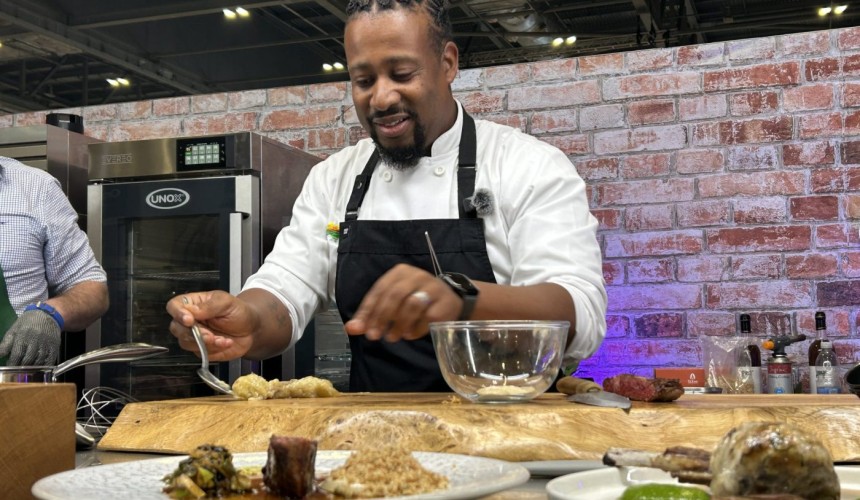
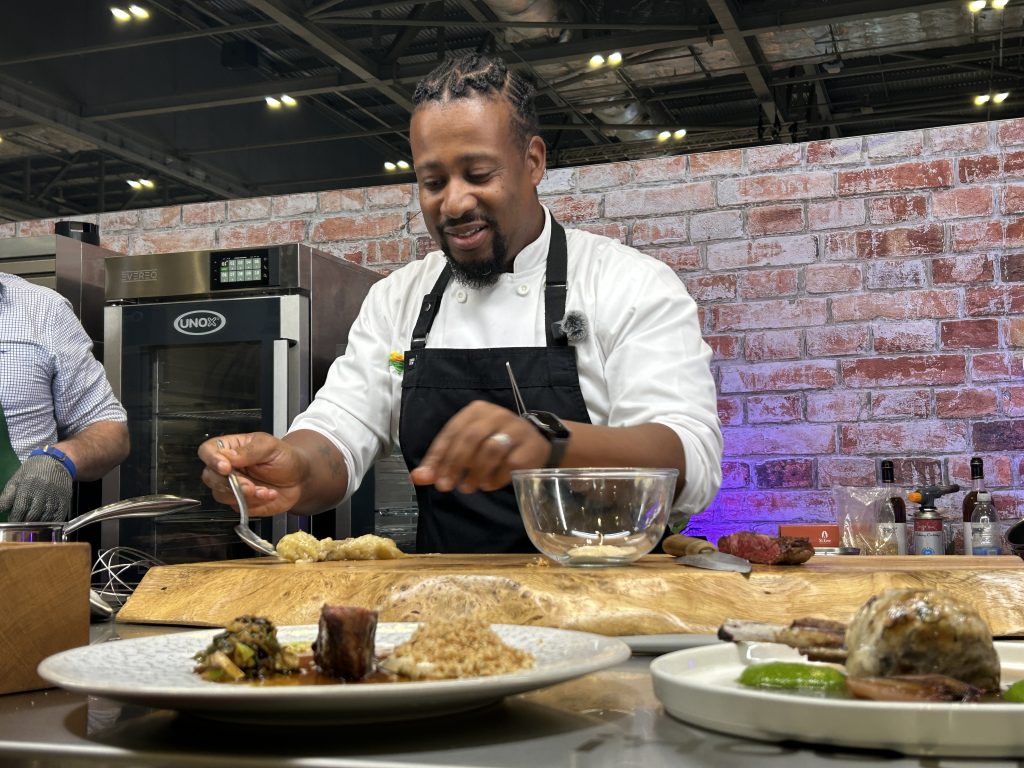
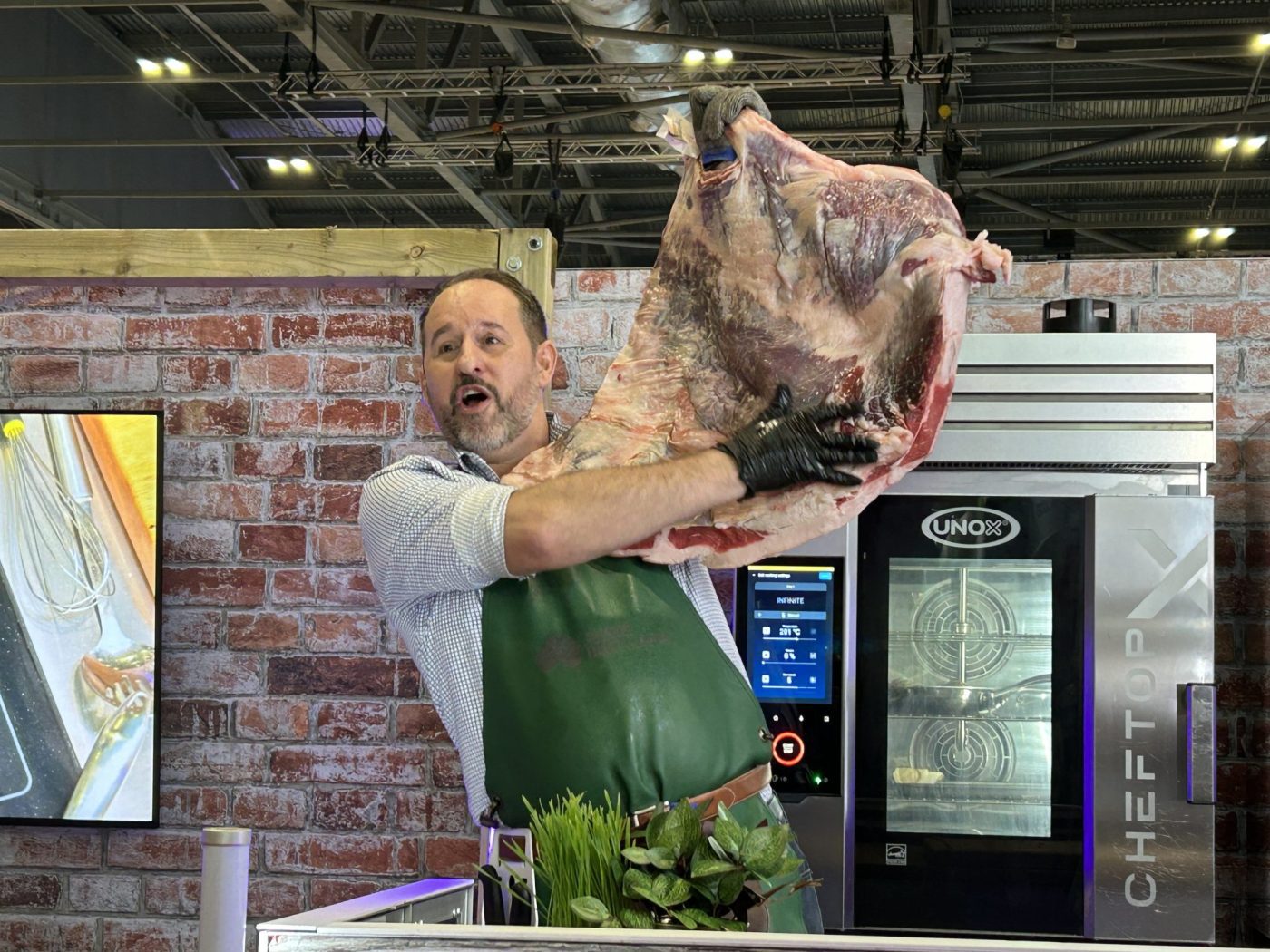
Celebrity chef Mike Reid created magic with inside skirt served with a bone marrow sauce and beef-fat-fried crumb sprinkle.
PUSHBACK from United Kingdom meat producers against Australian red meat imports is misguided and prevents mutual benefits, according to a gathering of industry stakeholders in London this week.
A top chef, a meat trader, a vet and Meat & Livestock Australia’s UK country manager told a packed audience that Australian imports are vital to address Britons’ future red meat needs.
MLA’s Richard Saunders told the gathering that among British beef and lamb farmers, production volumes were going down each year, to a deficit of 150,000 tonnes.
“So we need to get it from somewhere,” he said. “Is it going to be America, Australia or South America? It’s going to be one of those three. The US has the lowest cattle numbers in 70 years.
“Which of those countries aligns with animal welfare and ethics and also supplies well? That’s Australia,” he told the gathering.
The dialogue came during the three-day Hotel Restaurant and Catering Expo under MLA’s Aussie Beef, Lamb and Goat campaign. The expo, drawing more than 25,000 attendees under the banner of Food, Drink and Hospitality Week was held in the sprawling 44,000sq m Excel pavilion space in east London.
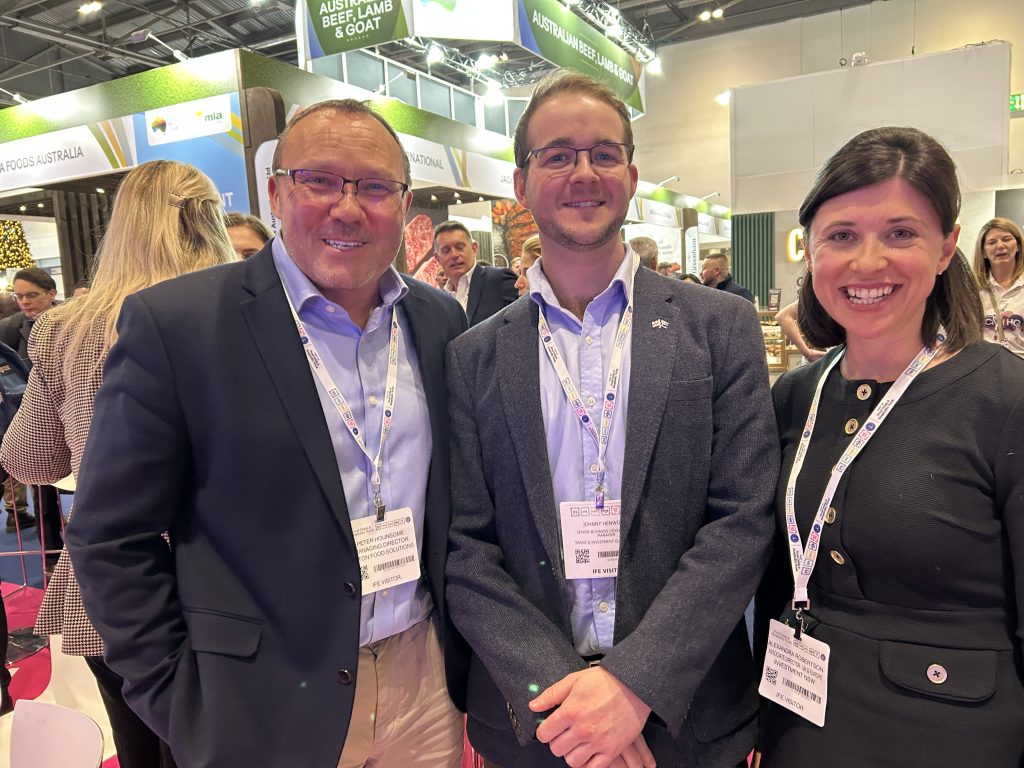
Peter Hounsome, MD of Hilton Foods, Johnny Henwood TIQ and Alexandra Robertson Investment NSW at the London event.
UK demand defies fuel challenges
Head of sales for the UK and Europe for prominent Australian Wagyu and Angus beef brands, Jack’s Creek, Kaine Allan said that despite container delays and diesel issues, UK demand was still present, especially in central London through high-end restaurants and end-users, plus butcheries.
The money is still there, combined with the lack of Irish and UK beef which is helping Australia’s imports,” he said.
How should Australia handle opposition from UK producers? “Education,” was his answer.
“Companies like MLA are doing a lot of chef’s forums, panels, Q and As. It’s not that people don’t want to learn, it’s just that they don’t know,” he said.
“The taste of Australian beef is good, but it’s the consistency that they love. In Australia, meat is all independently graded. The UK does not have a similar grading system, and sirloins on two different days from the same supplier can be completely different. When it comes to Australia, they know what they’re getting.”
He said Jack’s Creek pre-sells 80-90pc of product before it gets to the UK and the company overwhelmingly supplies repeat wholesale clients.
Jack’s Creek was among 13 beef, sheepmeat and goatmeat exporters attending the three-day Hotel Restaurant and Catering expo under MLA’s Aussie Beef, Lamb and Goat campaign in east London (see list of participants at base of page).
The combined MLA platform comprised a commanding display stand in the vast expo complex and the team took over the central cooking demonstration site for most of the expo’s second day.
The presentation drew crowds for most of the session which saw two full cooking demonstrations, food sampling and a discussion panel examining the role Aussie beef and lamb in the UK.
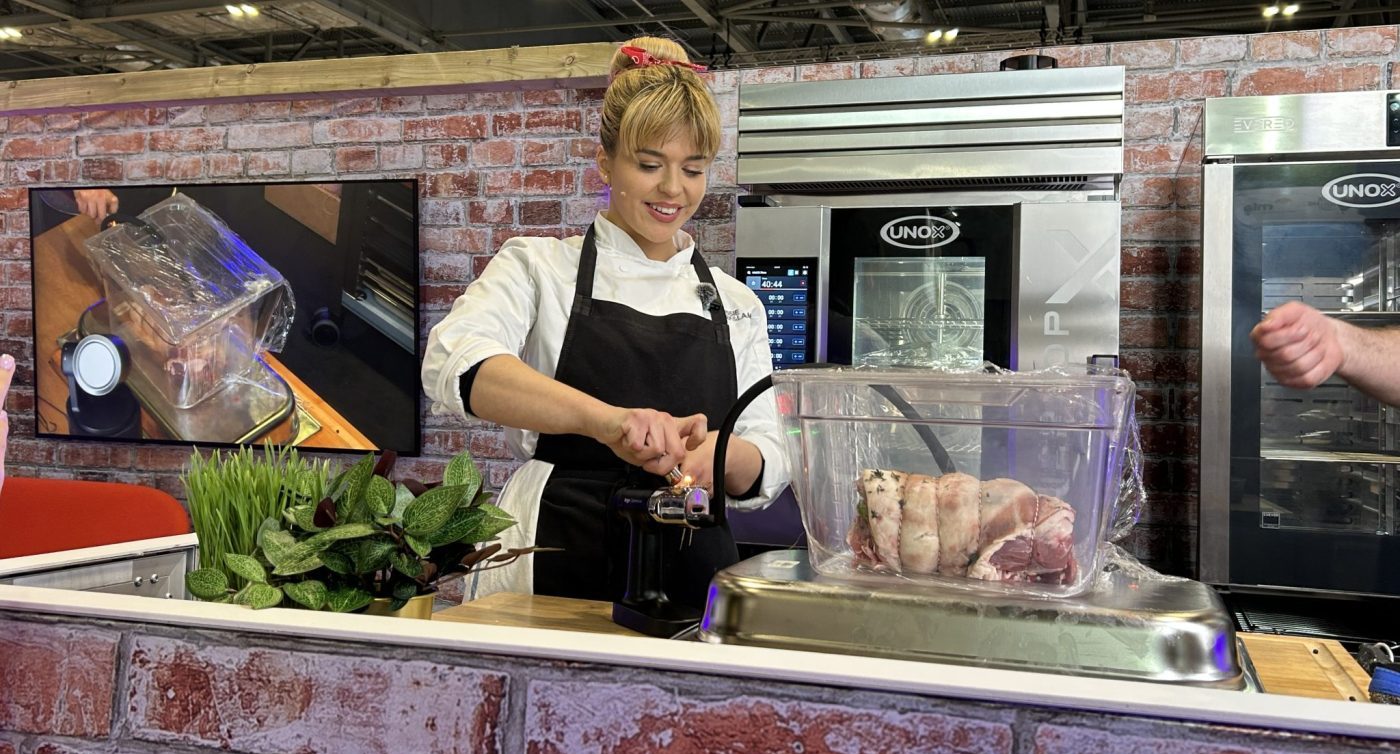
Chef Lara Norman hooks up the smoker for the rolled lamb shoulder.
The cooking demonstration featured chefs, Lara Norman and Aussie Beef, Goat and Lamb brand ambassador Mike Reid who operates two – soon to be three – restaurants. He features across TV and other media in the UK and Australia.
Mike has been using Australian beef since 2014 and was the first UK chef to import Blackmore Wagyu. “I was very much ahead of the curve,” he said.
The panel session included the MD of Hilton Food Solutions Peter Hounsome who said: “Over the past 20 years or so, people have travelled the world more and become more inquisitive about what they eat. They want new tastes, and Australian beef and lamb does offer that. And it does offer quantity,” he said.
“British lamb and beef is great, but in Australia, there’s great British breeds out there. The way they care about animal welfare it’s top-notch and the feed is top-notch, so the quality is great.”
“The two (UK beef production and Australian) complement each other. There’s room for everybody at the table,” Mr Hounsome said.
“Give the consumer the choice. What does the consumer demand? We lose sight of the consumer – we have to provide what they will buy.”
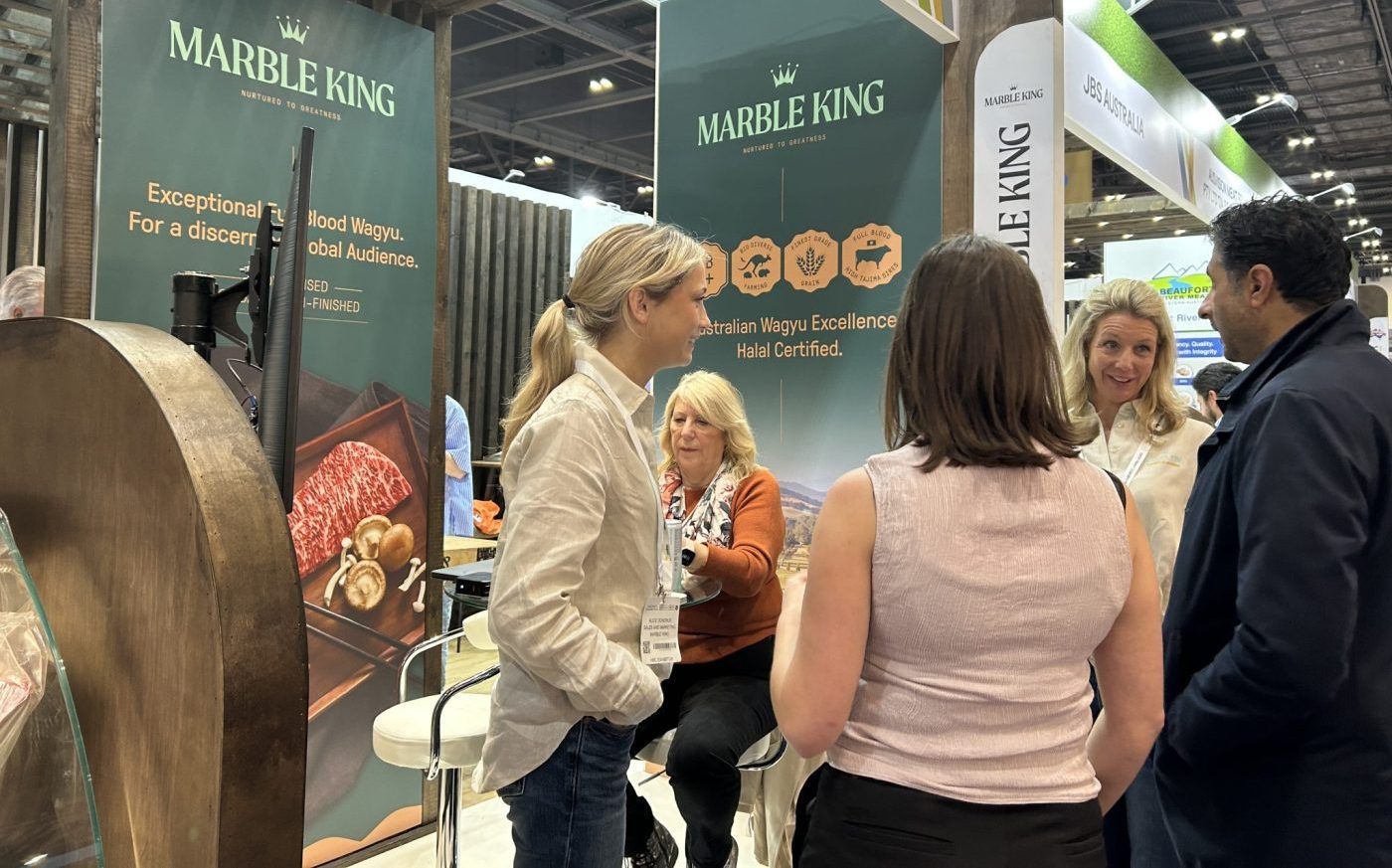
Alice and Martine Donohue of Queensland’s Marble King Wagyu chat with visitors on their stand.
Animal welfare parallels
DAFF’s agricultural counsellor to the UK, Amy Little, said the UK and Australia were very aligned when it came to animal welfare and traceability.
“Both countries have a layer of industry standards that manages the details of animal welfare as well,” she said.
 The UK has its Red Tractor program (a successful and widely used UK form of voluntary farm assurance, covering animal welfare, food safety and environmental protection, tracing products back to UK assured farms). In Australia, those features are covered by laws and other similar programs, including NFAS, Livestock Production Assurance, AAWCS, and programs managed by the Integrity Systems Company.
“So we’re very, very similar, and where there’s differences that’s due to the fact that they are vastly different countries. Australia is enormous. We’ve got properties up north where you don’t have seasons – only wet season and dry season and then you’ve got Tasmania where it snows.”
“The way animal welfare is managed for a cow standing in knee-deep snow in Scotland is very different to how you manage welfare for a cow standing in 35-degree heat in northern Australia.”
Mr Hounsome agreed. “Animal welfare is a must. If the animal is not treated correctly, not bought up correctly, it’s not happy. If it’s not calm the meat is going to be terrible eating – and I’m yet to try a bad bit of Aussie lamb or beef. So that says it all.”
In terms of UK customer inquiries, he said animal welfare was “right up there along with the environmental side of things for sure.”
“But the way I look at it it’s like a drawbridge, either get off it or be encouraged to raise those standards. The Australian standards are right up there, for sure. Is there areas to improve? yes. Is there areas that the UK farmers could improve? yes.
“So let’s all work together for a common goal here. Shutting doors is not going to encourage it.”
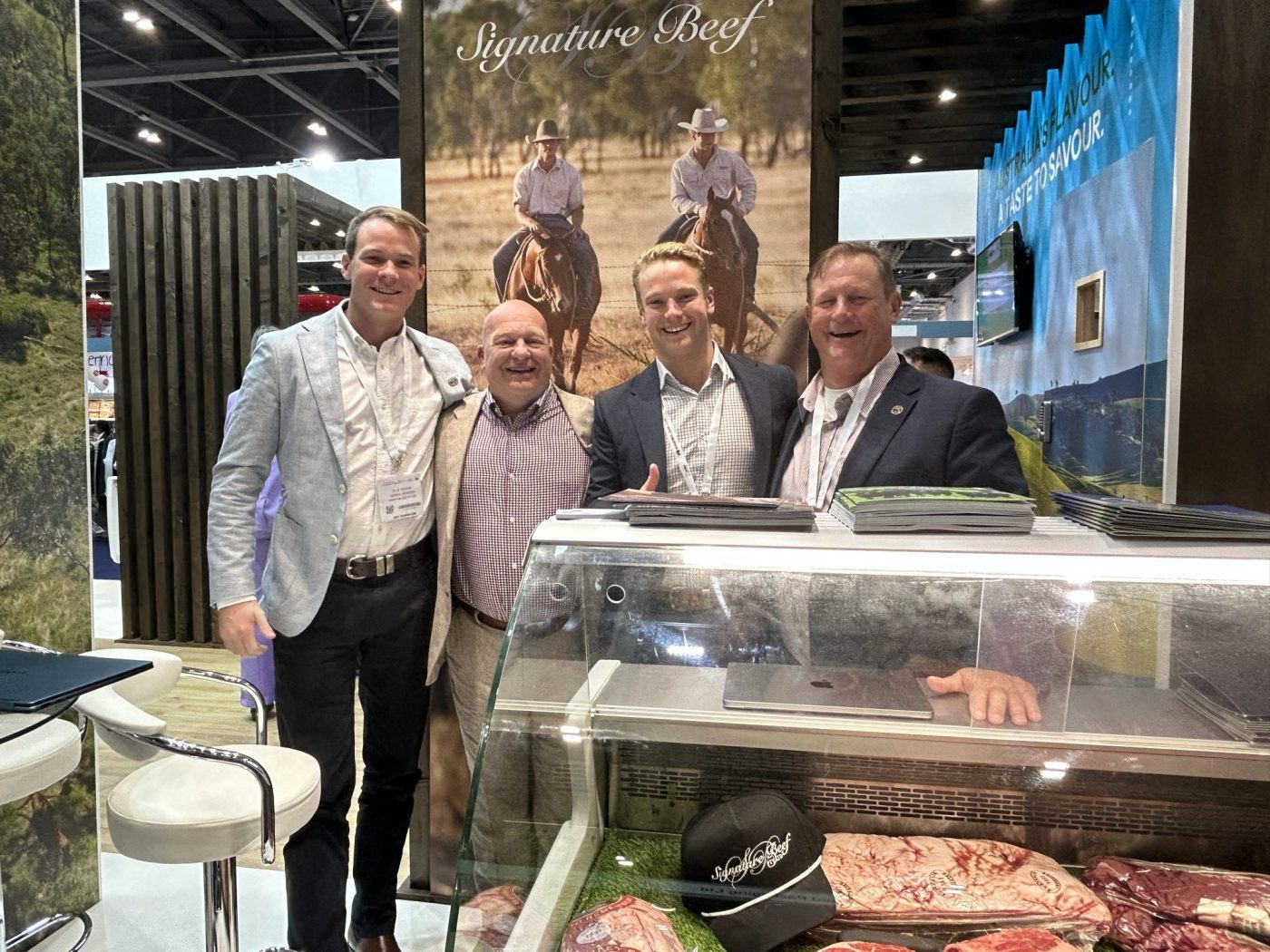
The Signature Beef team (L to R) Ollie Thorne, general manager, Jason Marshall, from PTG Smithfield, David Angus MD and Blair Angus “just call me the gardener”manager.
Pressure on to ‘buy local’
Chef Mike Reid was also on the panel. He discussed the tension between local beef producers opposing Australian imports.
“From a chef’s perspective the pressure is on, buying local. And I understand that pressure, I feel the same pressure,” he said. “But ultimately I would rather give my guests the best experience. So having access to incredible beef, consistent in quality all year round with the attention to detail, for me that’s the most important thing.
“Aussie beef is second to none. We’ve got some incredible British producers in this country, but what Australian beef does is – you’ve got the land mass, you’ve got the terrain, you’ve got this incredible pool of fifth-generation, sixth-generation, seventh-generation farmers.”
“The quality and the consistency of Aussie meat is probably what I love the most. It’s so consistent like – all year round – which is so important for me as a chef to be able to trust what I’m getting. Whether it’s in February, whether it’s in April or December, you can always count on Aussie meat, basically.”
“Once you start to scale-up in this business having more than one restaurant with the same offerings – it becomes very hard to get the level of British beef and British lamb consistently that you need to do those numbers” Mike said.
“And that is where Aussie meat can be really helpful. You can do four, five restaurants with consistency. There’s such a place for it.”
He also took time to address criticisms about the food miles of Australian imports by comparing it to beef coming from South America. “That’s not close. That’s not around the corner, that’s not my local. I think we need to be real sometimes,” he said.
“People say how can that be environmentally friendly? It’s coming from the other side of the world. How can that be fresh? There’s an educational piece to be done there. But bringing meat across on a boat is probably the lowest carbon footprint for any beef in the UK.”
DAFF’s ag counsellor Amy Little said, “We know from the carbon footprint that the proportion of that coming from shipping is very, very small.”
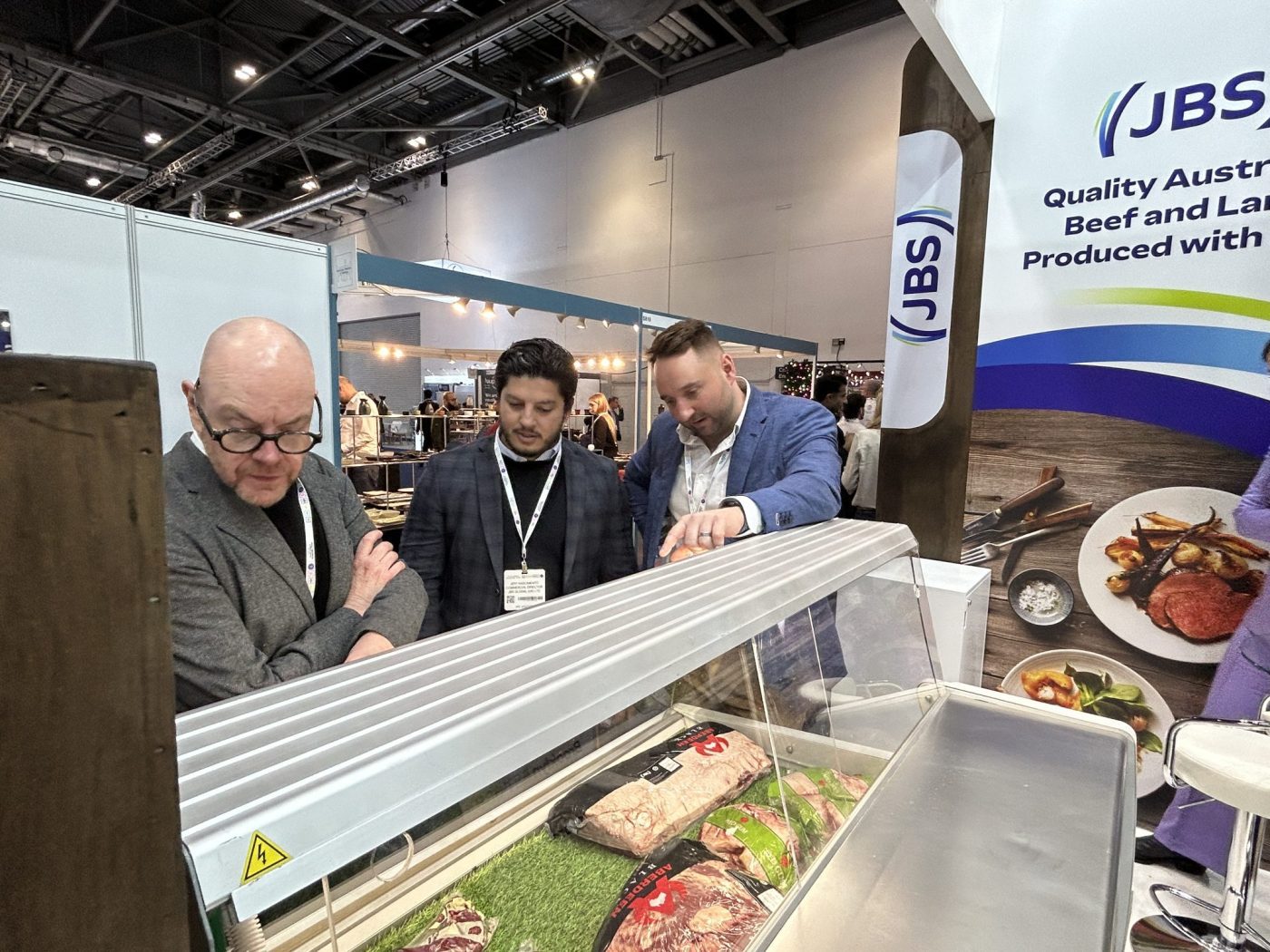
JBS’ Oliver Coulman chats with Jeff Nascimento, commercial director JBS Global (UK) and Anthony Wellington, Pilgrims Europe.
What does Australia’s FTA with the EU mean for the UK?
In the evening, the Australian Trade Commission hosted around 300 guests at Australia House.
Australian Trade and investment Commissioner James Fairley praised the UK-FTA “that has made Australian products more accessible and made Australian products more competitive in the UK market, enabling Australian suppliers to diversify the goods they can send and helping British companies to diversify their sources more.”
He praised South Australia’s Vili’s pies which is now the official supplier of pies to the London Broncos.
He also highlighted the recently inked FTA with the EU, a deal that he described as “once-in-a-generation with the world’s second-largest economy (that) will open up access to 27 member countries and about 450m consumers.
“But it’s not all about the FTA and tariffs,” he said. “Australian and UK industry, processors and consumers, are relying on high-quality, sustainable products.”
“Australia and the UK should work together to drive solutions for key global challenges facing our agricultural producers. Together we can work to diversify the products available on our shelves, collectively promote sustainability and health benefits and continue to supply high-quality, premium products.
“We are pleased to see the initial benefits of the FTA continue. It’s a win for industry and consumers, there’s no doubt about that. It’s a great deal for the UK and for Australia. There are countless opportunities for us to explore, resulting in significant benefits to both economies.”
- Australian beef and lamb exhibitors participating in the MLA-supported display in London included Teys Australia, Thomas Foods International, JBS Foods Australia, Endeavour Meats, Fletcher International Exports, Greenham Australia, Jack’s Creek, Marble King, Mulwarra Export, Providore Global, Signature Beef, Stella Foods Australia and Ausvision Meat Producers (trading as Beaufort River Meats).
Here’s some images from around the Australian displays at London’s Hotel Restaurant & Catering Expo
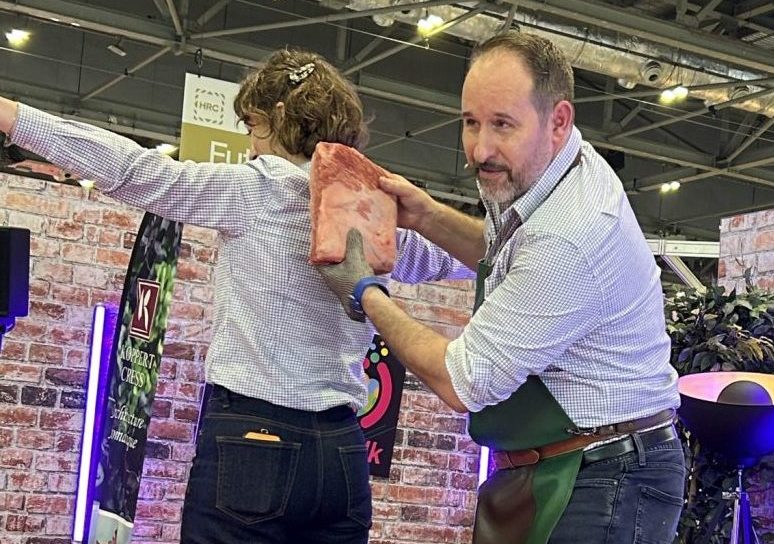
MLA’s Richard Sanders uses colleague Emma Broughen to explain the origin of short ribs…
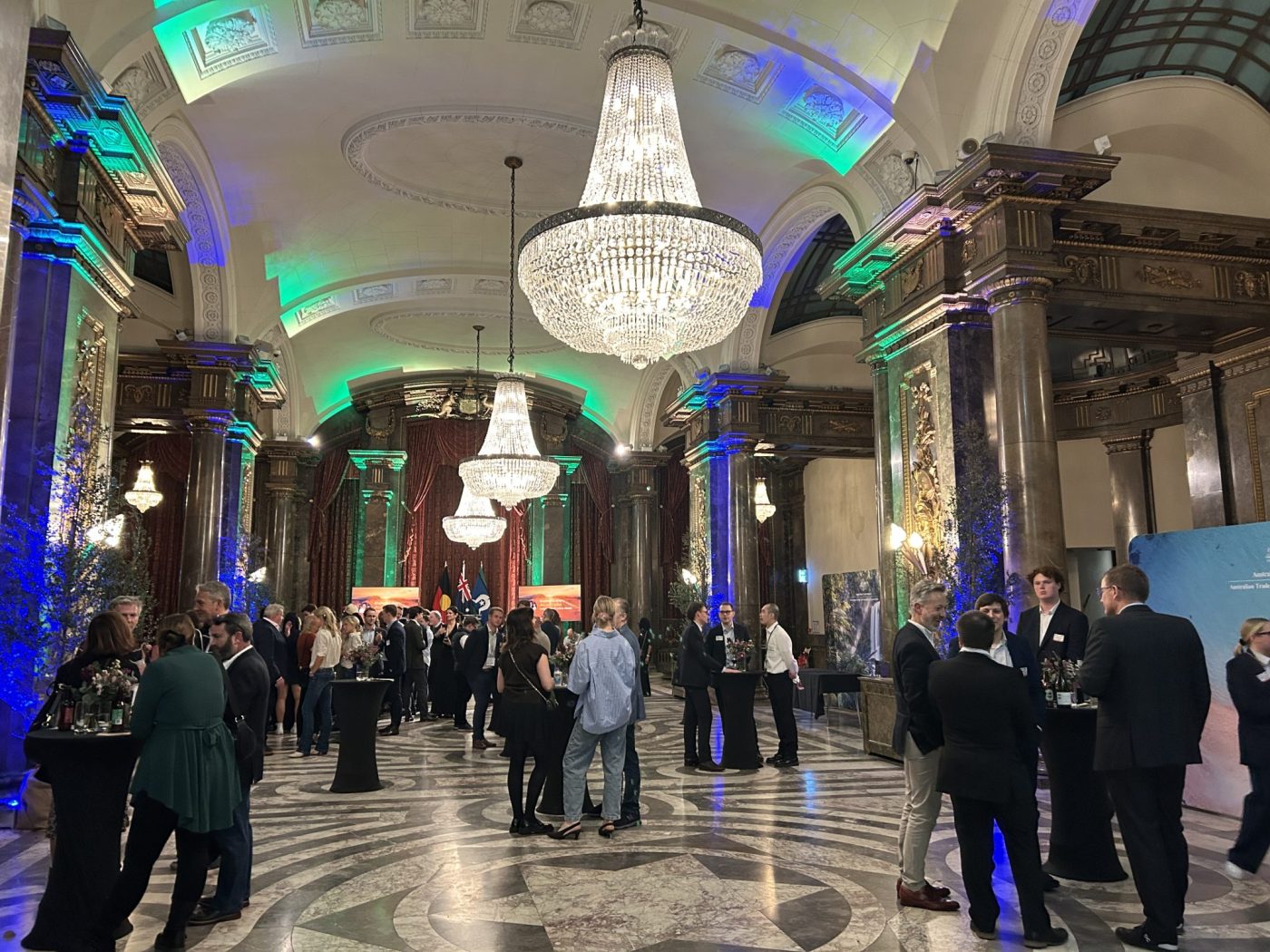
The expo was followed by a welcome at Australia House in London.
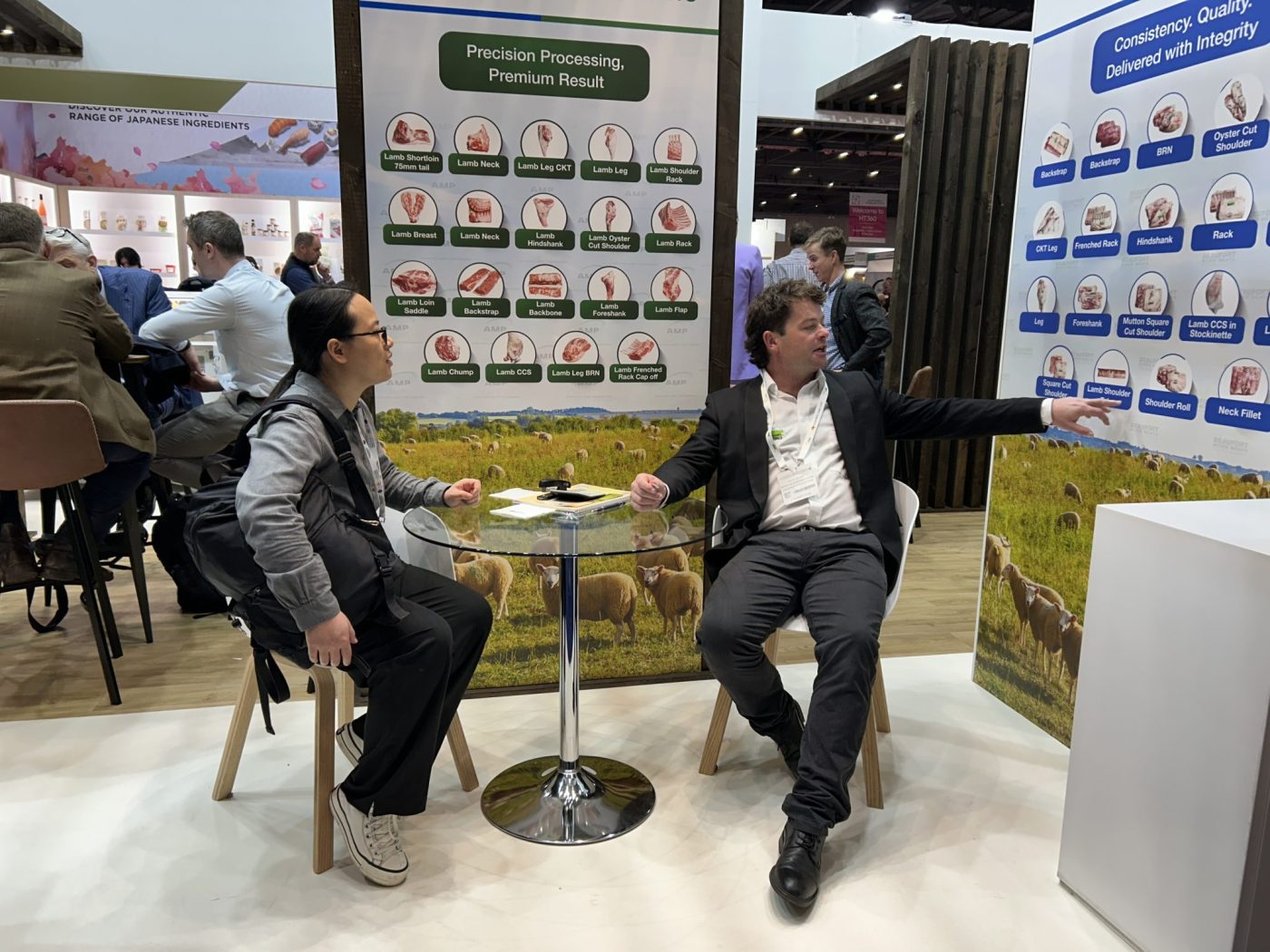
Jack Dryer of WA’s AMP/ Beauford River Meats with a potential customer …
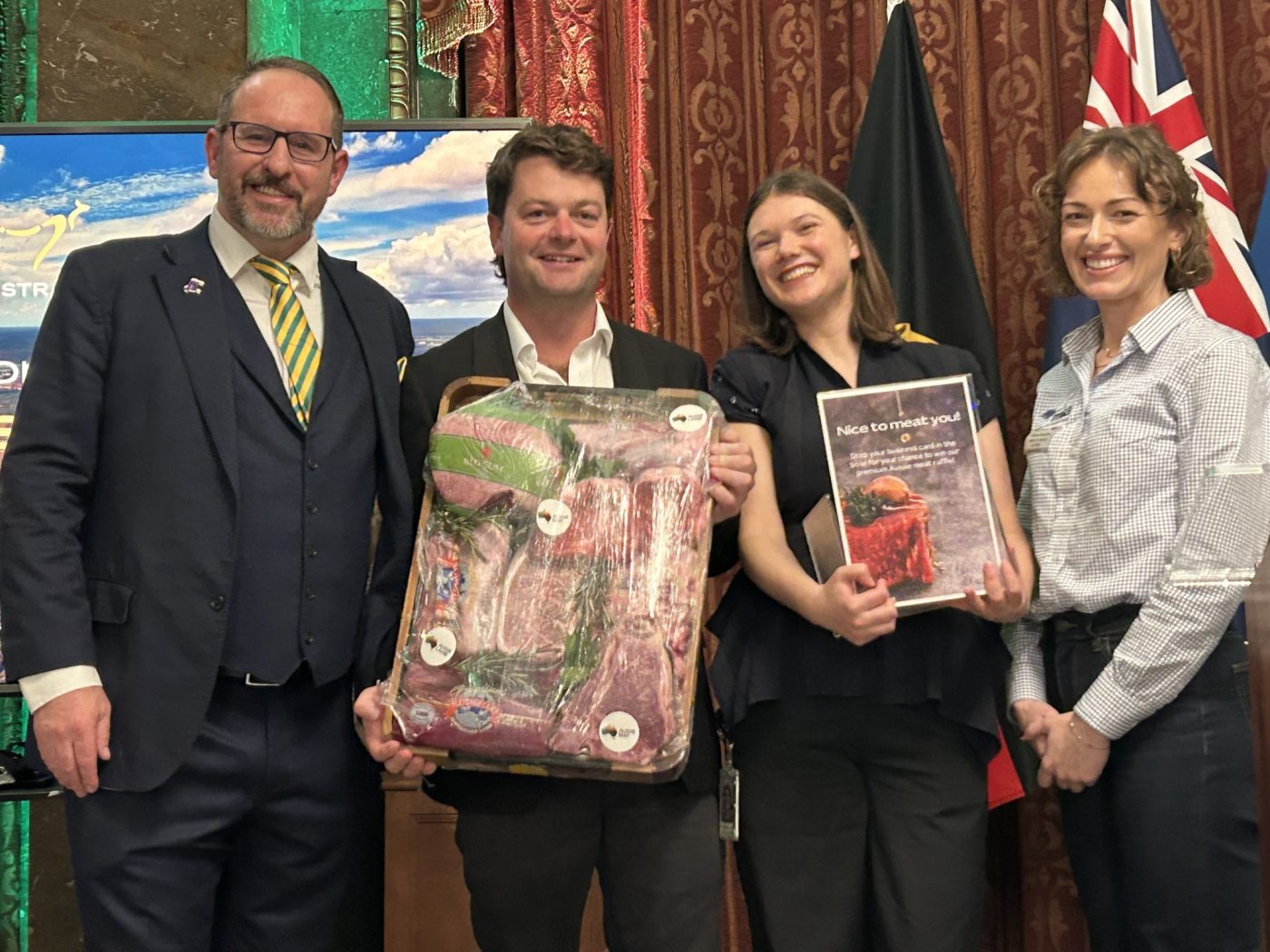
Jack Dryer of WA’s AMP/ Beauford River Meats later won the meat tray visitor’s prize at Australia House.
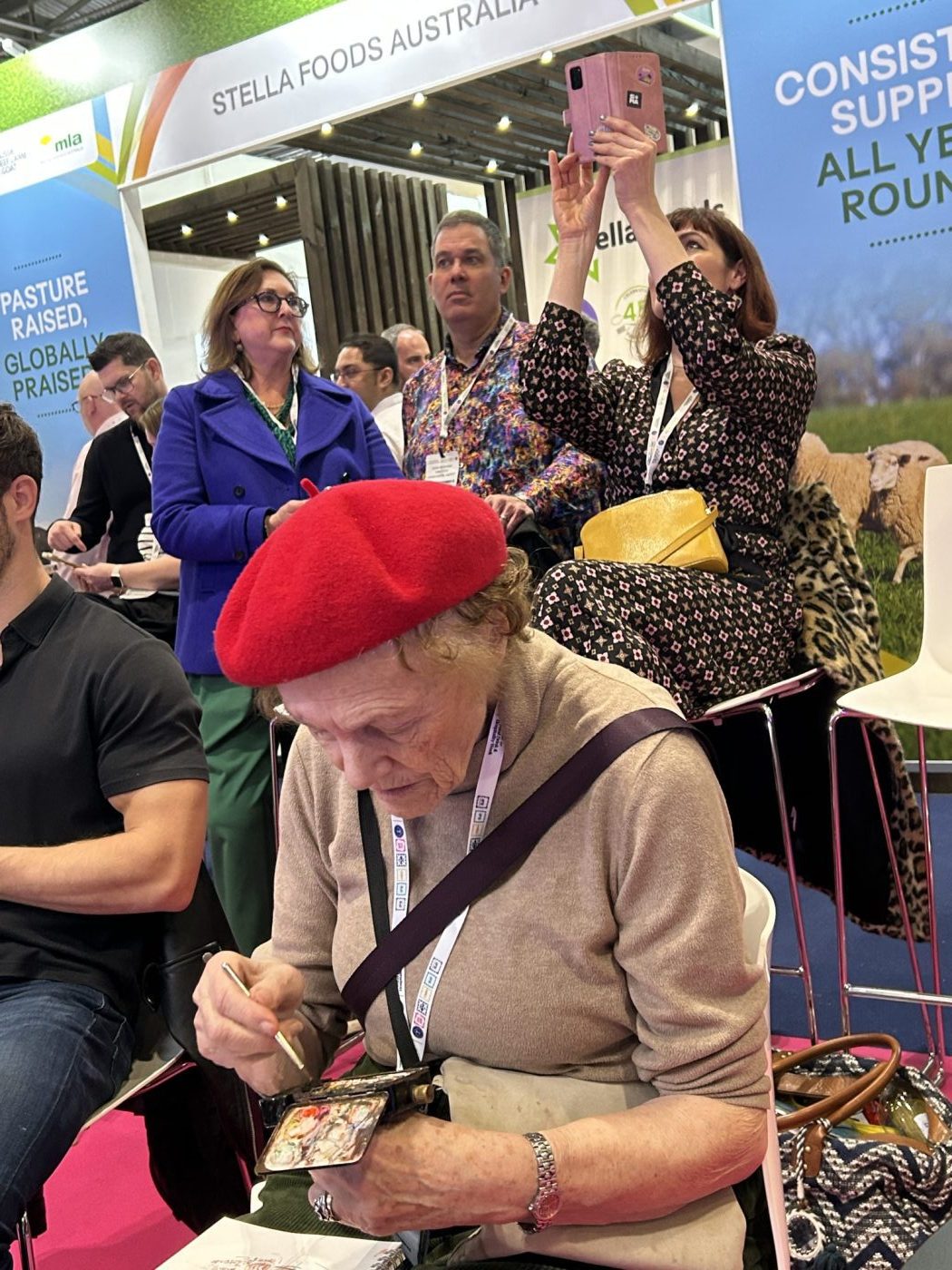
While some reached for their mobiles, veteran food columnist and illustrator Elisabeth Luard used her watercolours to capture the scene.
Pommy farmers lived the life of Riley with the EU for decades. Dairy, beef etc..
Welcome to the real world of competition!