
A PROPOSAL to develop and implement a self-imposed quota management system for Australia’s beef exports into China for the next three years is gaining traction in industry circles.
The plan, devised by industry analyst and former beef exporter Simon Quilty, follows China’s announcement last week that Australia (along with all significant beef exporters supplying the market) will face a steep tariff for out-of-quota product shipped this year, and through to at least 2028.
 The quota/tariff measure is part of a new Safeguard mechanism, designed to protect Chinese domestic cattle producers from rising imported beef competition.
In Australia’s case, a quota of 205,000 tonnes will apply this calendar year for shipments. Once that figure is reached, a tariff of 55pc will apply – however trade sources say a tariff at that level would make business into China prohibitive.
Without some form of self-imposed quota management system, some anticipate that Australia could fill its entire 2026 China quota allocation as soon as May, as exporters and importers rush to land product ahead of a 55pc tariff imposition, under a ‘first-come, first served’ basis. Last year, our exports to China reached 272,000t.
Australian beef exporters have operated previously under similar self-imposed quota management systems – most recently into the US market in the early 2000s and before that into South Korea in the 1990s, and the US from 1968.
In past examples, the Federal Government administered the quota management schemes.

Simon Quilty
Simon Quilty’s solution to ensure that Australia’s quality China market is not compromised is to introduce a self-managed quota scheme overseen by the Australian Government, under which exporters are allocated fixed quantities for China based on their past shipments to the market.
However nobody in the industry should under-estimate how complex devising and establishing such a scheme will be – especially given the tight time-frames discussed below.
The Australian Meat Industry Council has confirmed to Beef Central that it is consulting with its processor members on options to manage the new access arrangements.
AMIC was formally engaged in the Chinese Ministry of Finance Safeguard investigation process that unfolded last year, advocating on behalf of the Australian industry.
“We are continuing to do this now the measures have been announced to support our members and best respond to these new restrictions,” chief executive Tim Ryan said.
“In this respect, AMIC is consulting with our members on options to manage the new access arrangements, including possible quota management. We will work constructively with our members and government to explore the feasibility of any such arrangements, to inform a position and approach that is supported by our members and benefits the Australian beef industry,” Mr Ryan said.
Concern over impact on livestock prices
Simon Quilty said the key concern for Australian beef exports and livestock prices in our limited access to China for the next three years was the erosion of Australia’s chilled and frozen grassfed and grainfed markets into China.
“The second important aspect of protecting Australia’s China access is ensuring that higher-value products enter China, and that the quota is not wasted on low-quality products like 50CL trimmings or bones,” he said.
“By implementing a self-imposed scheme, Australia protects both beef and cattle prices, ensuring that the quality end of the market quota is used all year round in a sensible manner.”
How would a quota management scheme look?
Here’s a brief outline of Mr Quilty’s preliminary model for a self-imposed quota scheme for China:
- Year One (2026) quota would be allocated on the last 12 months of China entries – this would ensure the seven meatworks that lost their licenses before 2025 would not be disadvantaged in the allocation. For example, if an export establishment shipped 30,000t to China out of a national total of 300,000t in 2025, (10pc), its allocation in 2026 would be 20,500t out of the 205,000 allocation (10pc). Quota would be allocated on a pro-rata basis.
- Year 2 of the scheme in 2027 would be based on a two-year average of shipments (based on 2025 & 2026).
- Year 3 of the scheme in 2028 would be based on a three-year average of shipments (based on 2025, 2026 & 2027).
- Should Chinese authorities decide to continue the current scheme beyond 2028, then later allocations would be based on a rolling three-year average.
By gradually moving to a three-year average allocation system, exporters of low-value product who sell their allocation would receive benefits each year (diminishing) as compensation over the three-year period, Mr Quilty said.
Quota allocation would be based on establishment number and/or shipper-of-record – not export number, he suggested.
The mechanics of this would depend on what software DAFF had in place that can easily identify shipments to China, which in turn can determine performance of each exporter. Any toll operator’s allocation would be a commercial arrangement between the meat processor establishment and the toll operator.
“The quota would be tradeable between establishment numbers. Such arrangements have existed in the past, particularly in exports to the US market,” Mr Quilty said.
“This would ensure that the China quota would be allocated to where it is most needed, enabling the historical low-quality quota exports/performance to be transferred to high-quality users.”
Under the model, at least 80pc of the quota would need to be used by October 1, with any unutilised quota redistributed into the general export pool. This would ensure that the quota was not ‘sat on’ by quota-holders, but used in a timely manner and flows to where it is most needed, he said.
There would be no provision for new entrants under the current model.
“China decides which establishments receive a Chinese export license and which do not; the Australian government lacks this authority. With quota being tradable, any player seeking to enter the market could purchase quota to do so,” Mr Quilty said.
Need for industry to act quickly
The proposed quota scheme would be retrospective for 2026 shipments.
“It should take no more than six weeks for Australia’s meat industry to agree on the details of such a scheme, then any entries into China during that period would be accounted for in the 2026 allocation of 205,000t,” Mr Quilty said.
However if the Australian industry was to embrace such a self-managed China quota scheme, it would need to act quickly, he said.
“The beef export industry does not have the luxury of time to debate how a scheme would or should look. The further we progress into the shipment calendar year, the more difficult it will be to implement a quota scheme, and the damage will be done to China’s quality beef market.”
Why is such a scheme needed?
Mr Quilty suggests there were three reasons why a self-managed quota scheme is needed.
“The first is to stop the ‘rush to the door effect’, whereby Australia fills China’s safeguard quota early (possibly by late April or early May), which stops shipments, particularly quality grassfed and grainfed products. This would result in an absence of Australian high-value products for the remainder of the calendar year,” he said.
The second was the potential for misuse of China quota.
“In the past, low-grade commodity products have been shipped to China; a self-imposed China quota would ensure that quota flows to where it is most needed, which is likely to be the quality end of the market. Those lower-grade commodity exporters under this proposed scheme would be compensated,” he said.
The third factor was that a self-imposed quota scheme could turn a negative into a positive for Australia, as most other export countries were likely to fill their quotas early, and then cease shipping to China, seeking to diversify elsewhere.
This would lead to higher Chinese domestic prices by the end of the year, Mr Quilty said.
Under a managed scheme, Australia could maintain continuous exports into a potentially rising Chinese domestic market later in the 2026 year. This could result in higher returns and, most importantly, help avoid the need to re-divert beef products to other countries, which may charge lower prices.
Background to the impact of an unchecked approach
There were plenty of examples of an ‘unchecked approach’ in market behaviour in markets impacted by quotas.
A good illustration of this ‘rush to the door effect’ was Brazil’s shipments to the United States each year, whereby a 65,000t quota is allocated to ‘other countries’ (which includes Brazil) at 0pc tariff. In 2025, the ‘other countries’ (dominated by trade out of Brazil) filled this annual quota by 17 January, as exporters sought to gain a market advantage. Once filled, tariffs to the US rise to 26.4pc, affecting shipments from Brazil, Japan, Ireland and Lithuania until the end of the calendar year.
“A similar approach is likely to occur in Australia, given the 55pc ad valorem tariff that applies into China once the safeguard is triggered this year at 205,000t,” Mr Quilty said.
Risk of misuse of Australia’s China quota
There was some risk of Australian exporters ‘misusing’ our 2026 quota of 205,000t, because Australia exports both high and low-quality beef to China, he said.
The use of tonnage-based quotas on low-quality beef would result in poor returns for the industry, given that these low-value commodity items can be sold in alternative markets at parity with China or at a slight discount.
“The chilled (and frozen) quality end of the market would be lost under a ‘free-for-all’ approach like this, given that 55pc is cost-prohibitive and that limited shelf-life would mean long-term customers might be served in the first five months, and receive nothing for the balance of the year,” Mr Quilty said.
This situation would likely be repeated in 2027 and 2028.
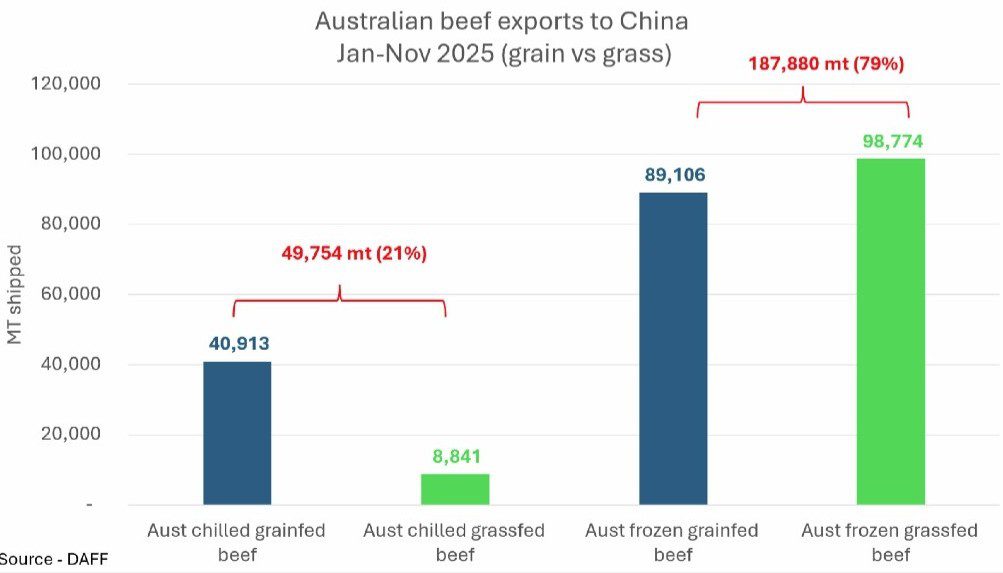
Some key points worth noting from Australia’s trade into China in 2025:
- As seen in the graph above, Australia’s chilled exports, both grainfed and grassfed, made up 21pc of all our beef exports to China last year. Under a quota scheme, it would be assumed that these chilled programs would continue.
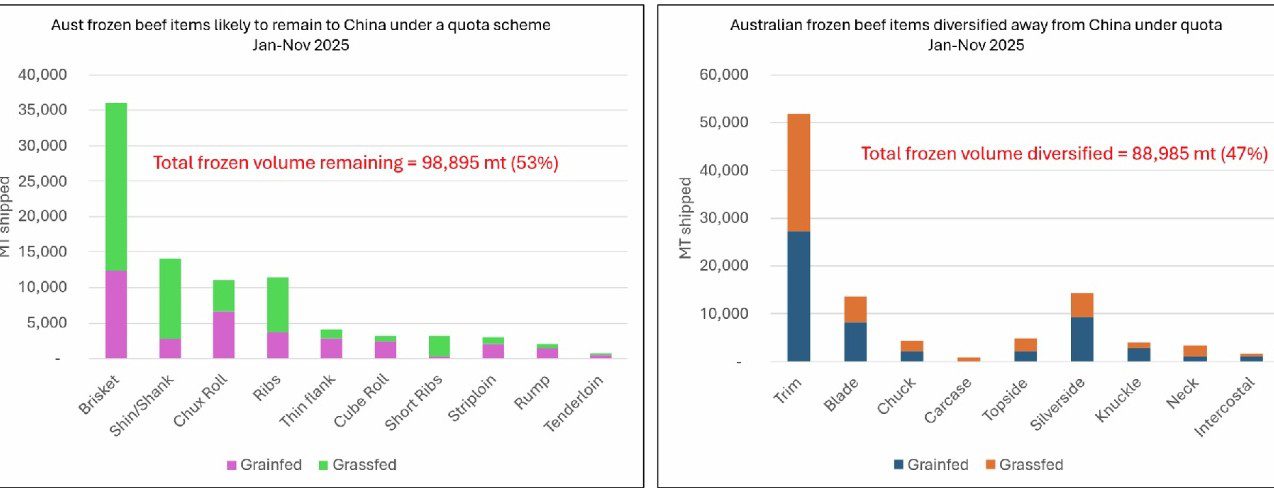
- Within the frozen exports are valuable items such as loin cuts, as well as low-grade products like trimmings. It would be important to identify within the frozen shipments which items would continue to go to China and which low-grade items would be sold.
- When assessing frozen items that would remain going to China under a quota scheme and those that would be diversified away, Mr Quilty estimated that all grassfed and grainfed chilled products would continue, accounting for 49,754t, or 21pc of beef exports.
- Of the frozen items, 53pc would likely remain, and 47pc would be diverted into other markets, as they are the lower-grade items.
Estimated frozen beef export items from Australia to China that would remain in China and those exported away under a quota scheme
“If a quota scheme was put in place and lower-grade beef were sold away, then the re-allocation to higher-quality beef would mean that Chinese customers would not miss out on any exports in 2026,” Mr Quilty said.
The total 12-month estimate for Australia’s high-quality beef exports (chilled and frozen) to China in 2025 was 165,000t.
“With 205,000t of access in 2026, Chinese customers’ needs could be met without disruption or volume reduction,” he said.
Low-value export quota would be sold away to other markets, but under a tradeable quota scheme, low-value exporters would be rewarded for doing so, based on their 2025 export performance, thereby reallocating the quota to where it is most needed.
Importance cannot be over-stated
“The importance of establishing a self-managed quota scheme quickly for Australian beef exports to China cannot be overstated,” Mr Quilty said.
“There is an urgent need to minimise market damage – this will also ensure that Australian high-quality beef producers do not experience a price downturn; instead, they may see higher returns toward the end of 2026, as other countries quickly fill their quotas and cease shipments (due to the 55pc tariff), while Australia maintains consistent shipments throughout the year at 0pc tariff.”
“When Australia exported to the US market in the 1990s under a quota management scheme, it was overseen by the Australian Government and ensured that beef markets behaved in an orderly way, preserving market access and bringing stability to livestock prices. This proposal is no different,” he said.
“There are no winners for Australia in the new safeguard arrangement put in place by China. Australian farmers, feedlot operators and processors are all worse off. There is a real need to make the most of a negative situation and, ideally, turn it into a positive one or at least minimise any damage.”
“With a well-managed China quota scheme, this might create an opportunity in the last half of the calendar year. By this time, most other supply countries will have filled their allocations, resulting in higher domestic beef prices in China. Australia can capitalise on this potentially higher-priced market through a well-managed scheme.”
“I only hope that, as an industry, we can make the most of this challenging situation by better managing access to a significant market. To do so, a quota scheme needs to be implemented as quickly as possible.”
Industry response
So how is the industry reacting to this, or a similar self-managed quota management process?
While it’s still early times, a majority of beef processors at this stage appear to be in support of the principle behind the program, if not this exact model itself. Beef Central understands that other beef industry sectors are viewing the initial concept favourably.
A smaller number of export processors are evidently opposed, but as previous quota management episodes have shown, the question of dividing up quota within competing export processors has always been divisive, potentially creating ‘haves’ and ‘have nots’, based on location, product type and other factors.
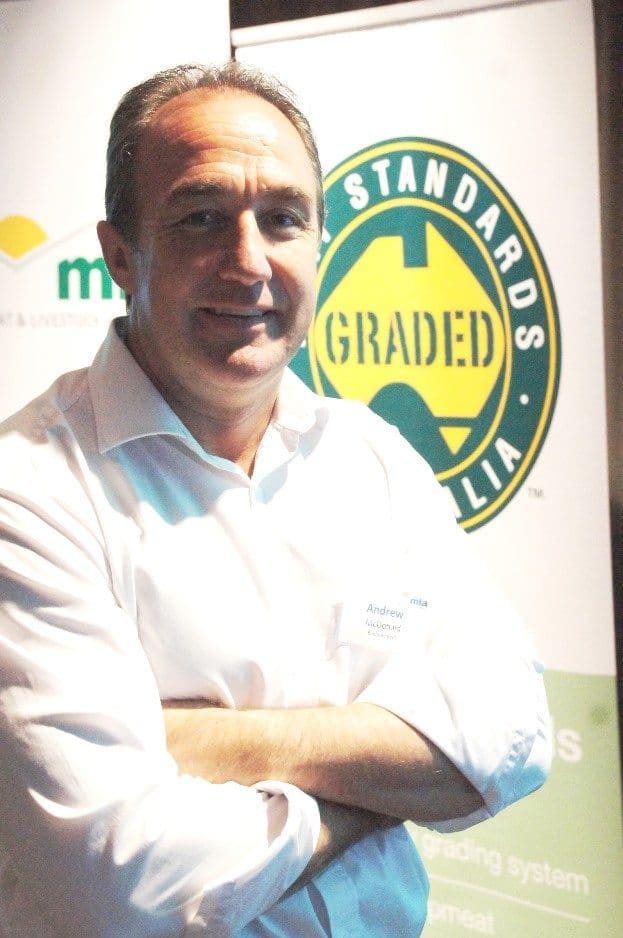
Andrew McDonald
Among those who have declared support for the principle behind a China quota management model is Bindaree Beef managing director Andrew McDonald.
He told Beef Central such a management system was “the only thing Australia can do,” given the quota and tariff terms imposed by China last week.
“If we, as an industry, do not manage the quota system appropriately, and with control, it could cost the Australian beef industry a billion dollars,” he said.
“If we fill our China quota this year by, let’s say, June or July, every person sending meat into China is going to dump meat into every other market for the rest of the year. That would inevitably impact price in those markets as well.”
“It’s not only trade into China that has potential repercussions from this. And it will happen even before then, because customers like Japan, by about March, will know the quota is looming, and will start to slow down their purchasing of Australian beef, knowing that from 1 July, exporters are going to be ringing, trying to sell them meat that has diverted out of China.”
“And if Brazil has to displace 500,000t of beef that would otherwise have been sold into China into other markets, there’s additional pressure applied.”
Mr McDonald said he liked the general basis of the ‘Quilty’ model, because it meant the processors that lost their China licenses would get to participate at full production, under the 12-month model; and the two-year and three-year averages for years two and three covered the requirements well.
“The terms would allow the industry to manage things to best advantage. Without it, it could get very ugly, once the quota is filled,” he said.
“Will there be a little bit of trading in quota going on among eligible exporters? Maybe. A Wagyu exporter might buy some quota from an exporter of low-value product, like cow-beef or bones, for example. They might be prepared to pay a dollar a kilo to access some quota for high-value beef like this.”
History of division over quota management
Similar quota management systems have been applied in the Australian beef industry for close to 60 years.
According to Steve Martyn’s beef export industry history, World on a Plate, in 1968, Australia enacted a US quota management system, following the earlier passing by US Congress of the Meat Import Law. Initially, exporters were allocated 1.5lb of US quota for every 1lb sold into other export markets. However the formula was changed 16 times over the next eight years.
Northern Australian plants (Katherine, Darwin and Alice Springs in the NT and Wyndham, Derby and Broome in the Kimberley) were particularly harshly treated at the time, because they produced mostly manufacturing meat, and were heavily reliant on the US market. It was not until 1975 that they finally got a share under the US quota scheme, and it drove some of those plants to the brink of failure – made only worse by the arrival of the 1974-78 Beef Slump.
No surprisingly, larger southern processors vigorously resisted the northern lobby, because it meant giving up some of their own existing quota to others.
Dear editor
Would it be possible to have graphs of Chinese beef production and prices over the last say 20 years?
And would it also be possible to have graphs of Chinese imports of beef and prices over the same last 20 years so that we can actually see what the Chinese are talking about and whether it is correct?
I suspect it may be a diversion tactic away from actually trying to manipulate the market down, in which case it would be breaking ITO rules and FTA rules .
Simon Quiltys proposal gives Australia control of a bad situation,
Improvements can be made along the way.
<strong>All the growth in imported beef into China has happened in the past ten years, Dugald. Prior to 2015, imports never exceeded 250,000t, but were around 2.6 million tonnes last year. Domestic Chinese beef production is harder to track. Editor</strong>
What a terrible idea
You can’t do a good deal with a bad person as buffet says
Why would we bow down to china once again ?
Get the product in there as soon as possible and let the market be the market .
By the time the Aus industry pansies around and plays with the market for three years they will have changed their mind again and use against us
AGAIN
I have dealt with these Chinese many a times, they can’t be trusted .
I sat in a endless meetings about exporting excess of a million cattle, buying in excess of 5 billion of country
And they do nothing
They continue to manipulate the market
Put a tax on iron ore equivalent of the tariffs they impose
See how hungry they get
When the prices finally get good, there is always something that just so happens to come along to talk those prices down.
This event is being way overblown for obvious reasons.
Simon Quilty for our ag minister, when Andrew Hastie and Jacinta Nampijinpa Price finally represent our country. I wonder if JBS have the same view point as a Bindaree given how they might possibly win either way in this global beef nonsense? cheers Matthew Della Gola
<strong>Worth remembering, Matthew, that ALL exporters to China - Brazil included -are encumbered by China's new quota/tariff regime. Australia is the first and only one, that we're aware of, that is trying to come up with a solution. Editor</strong>
Thanks Jon, great analysis. Given previous self-managed quota programs relied on Government oversight, what has been the Federal Government's response to the Quilty plan?
<strong>Too early to tell, Ken. Hoping to learn more next week, when we (and the government departments) return from holidays.
Happy new year to you and Maree.</strong>
Proactive is better than reactive in any supply chain.
Lets not let " greed and fear" enter into this, the question is going to be answered by our China import customers who need product year round. This pushback plus Processor margins will rationlise our
market for the better "high quality clean beef" as opposed to low quality imported beef which China domestic product is running with .
Lets Show how good a team players we can be, and go back to China with year-round quota, which gets the ball back in our hands.
"Happy Hamburgers" for 2026 and beyond.
It would be sensible to discuss the issue with the Chinese authorities and customers.
Diving the bus out of the rear vision mirror may be a mistake.
<strong>For younger readers' benefit, Peter White is a former chief executive officer with Australia Meat Holdings, later to become JBS. Editor </strong>