
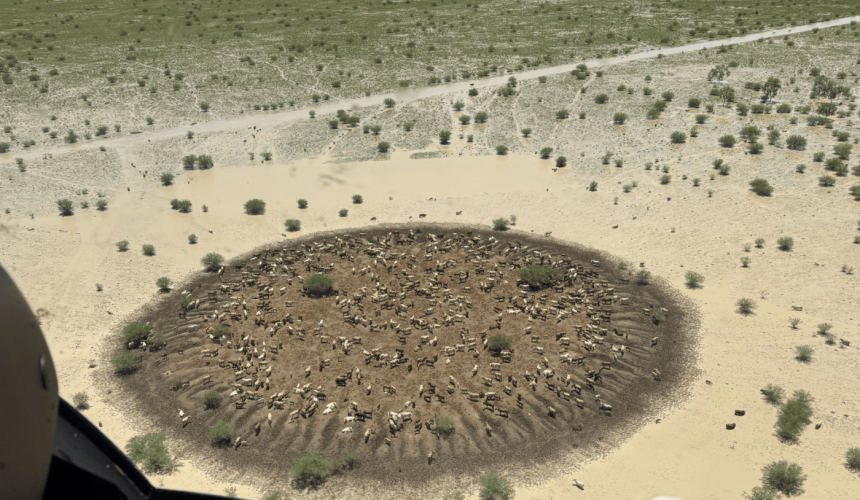
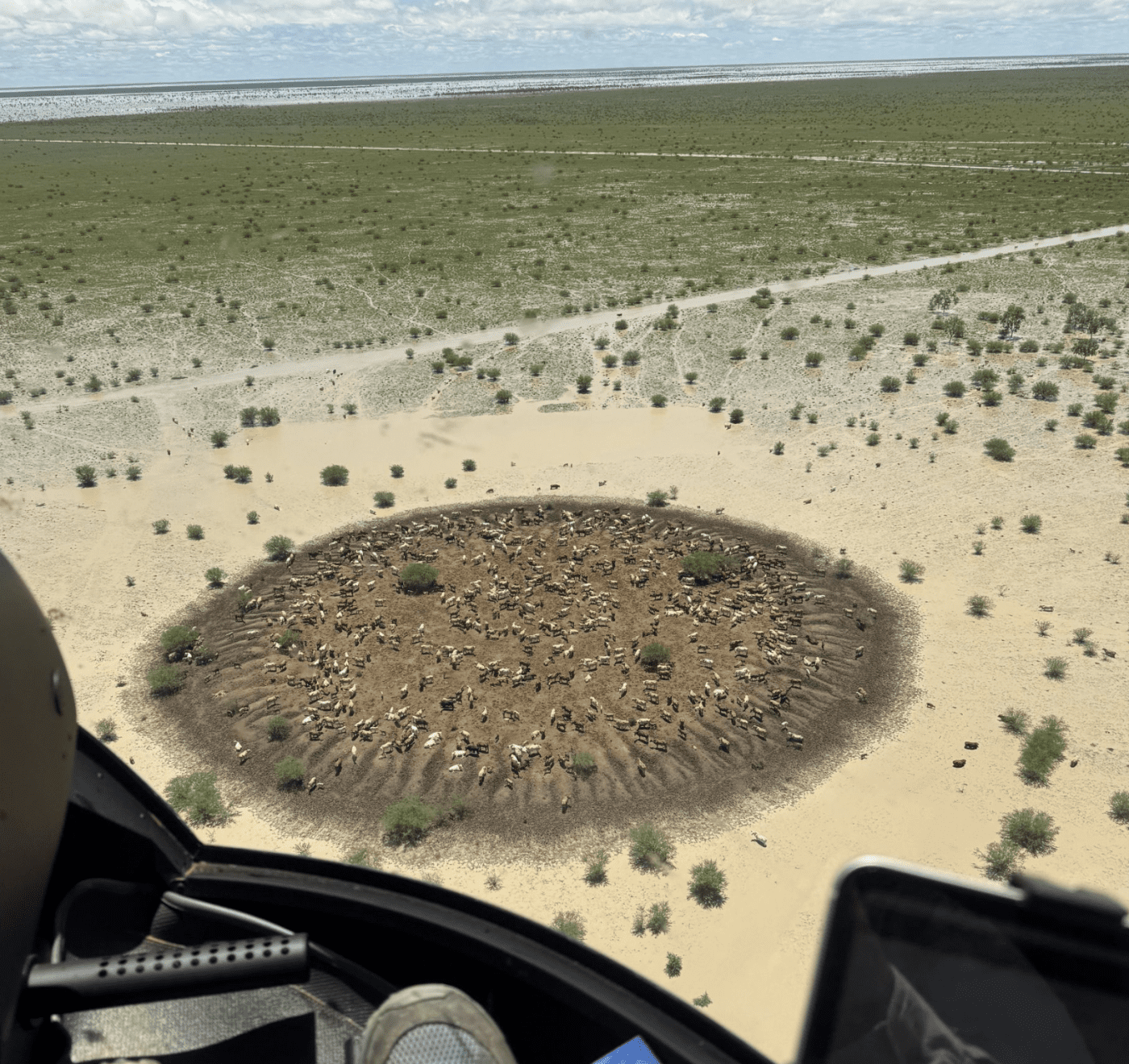
Flood refuge in use during January’s Northwest Queensland floods. Click on image for a larger view, click twice to expand further. Photo: Scott Elliott from Blue Hills Helicopters in the Carpentaria Shire.
THIS year’s wet season has tested the Flood Refuge Mounds (FRMs) that were built following the devastating floods in North-West Queensland in 2019.
The current estimate of livestock deceased or missing as a result of floods earlier this year has risen close to 100,000 head. But in 2019 that number was over 500,000 head of cattle, sheep, goats and horses.
While not all of those animals died from drowning, the lack of high ground to escape the floodwaters is thought to have contributed enormously.
That prompted Bob Shepherd, Principal Extension Officer with the Department of Agriculture and Fisheries to write a guide for the design, construction and management of FRMs in 2023, to provide somewhere for stock to escape the flood water when an event like 2019 occurred again.
Mr Shepherd said 80 to 100 FRMs were built across four corporate pastoral properties on the Lower Flinders River floodplain.
“From the photos I have seen and reports I have been hearing the FRMs are working how they were designed to,” Mr Shepherd said.
“The photo above by Scott Elliott has approximately 750 head on it, which is very encouraging to see.
“However, it is too early to say how effective the FRMs have been across the whole of the lower Gulf floodplain, but we will have a better idea once first round musters are completed.”
Mr Shepherd said there is a lot of interest in the FRMs following this year’s flood event in North-West Qld, however there are changes being investigated, having seen the mounds in action this year.
“I would recommend using more topsoil when constructing the mounds to achieve better and more rapid revegetation to increase stability of the mounds,” Mr Shepherd said.
“The circular shape seems to be the most efficient to build with the least cubic metres of soil moved per head of cattle carried.
“I would also recommend producers build a slight crown on the top of mounds so that water will not pond on the top and to feed supplements to cattle in dry times on the mounds so that the cattle are familiar with their location and are comfortable using them before the wet season.”
Beef Central has heard reports of cattle rushing and trampling to get to the hay during fodder drops to the FRMs.
Mr Shepherd advised producers to start fodder drops when there are only a few head of cattle on the mound, rather than waiting for large numbers.
Flood Refuge Mounds are a topic of discussion at this week’s Northern Beef Research Update Conference in Brisbane.