
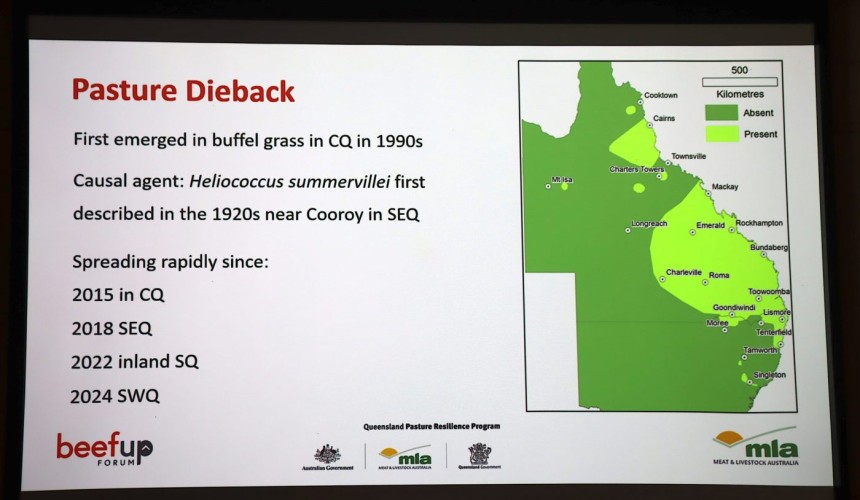
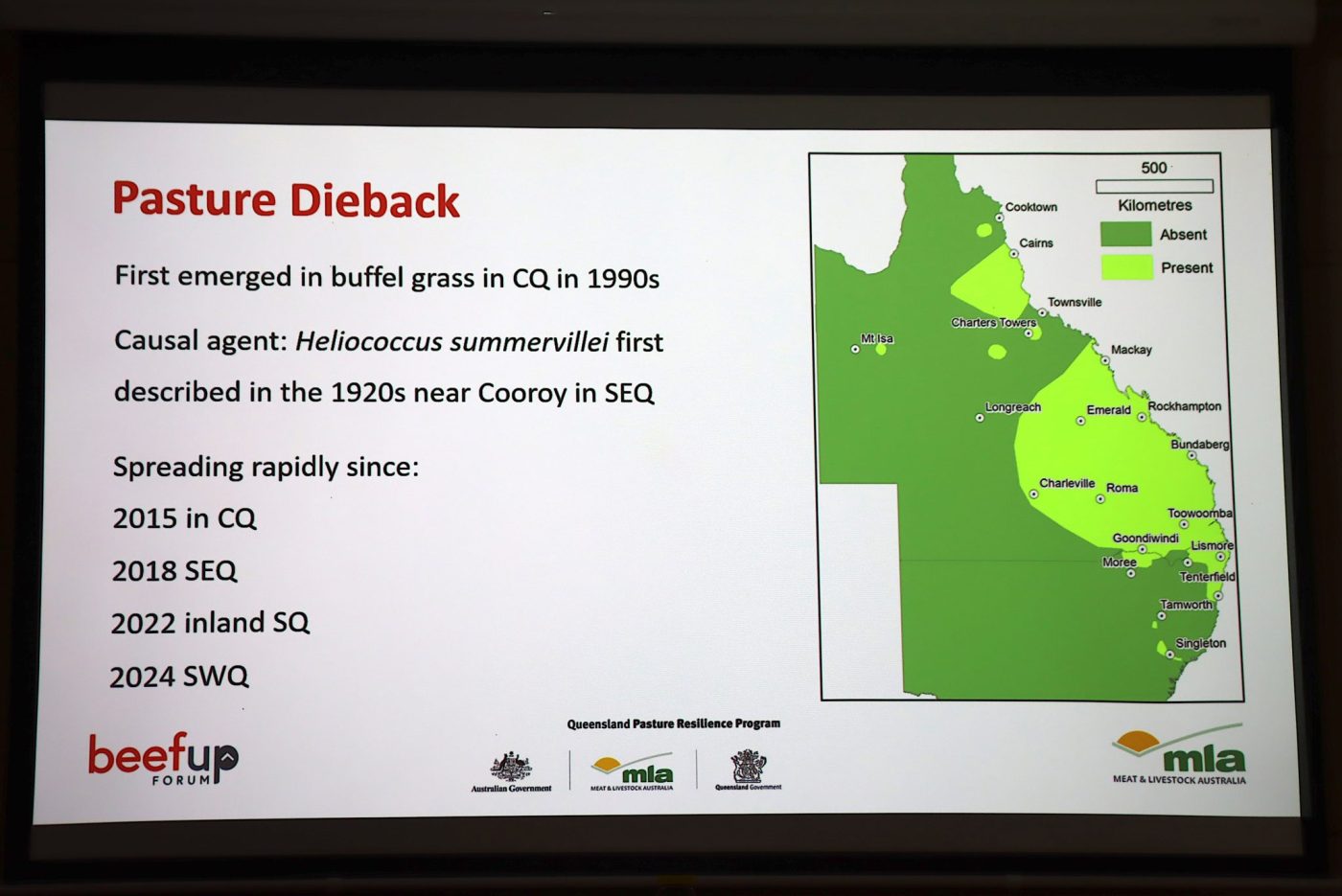
This map presented at last week’s Morven BeefUp forum was produced last year, with expanded spread expected to be confirmed when it is updated for 2026.
PASTURE dieback has now spread across most sown pasture regions of Queensland, with impacts being recorded in north-eastern New South Wales to as far south as west of Sydney.
From buffel grass pastures in Central Queensland in the 1990s the spread of dieback has accelerated significantly since 2015, affecting sown pastures of South East Queensland by 2018 and into inland and south-west regions of the State in recent years.
It has also killed tropical/subtropical grasses along the NSW coast and towards central latitudes of the State.
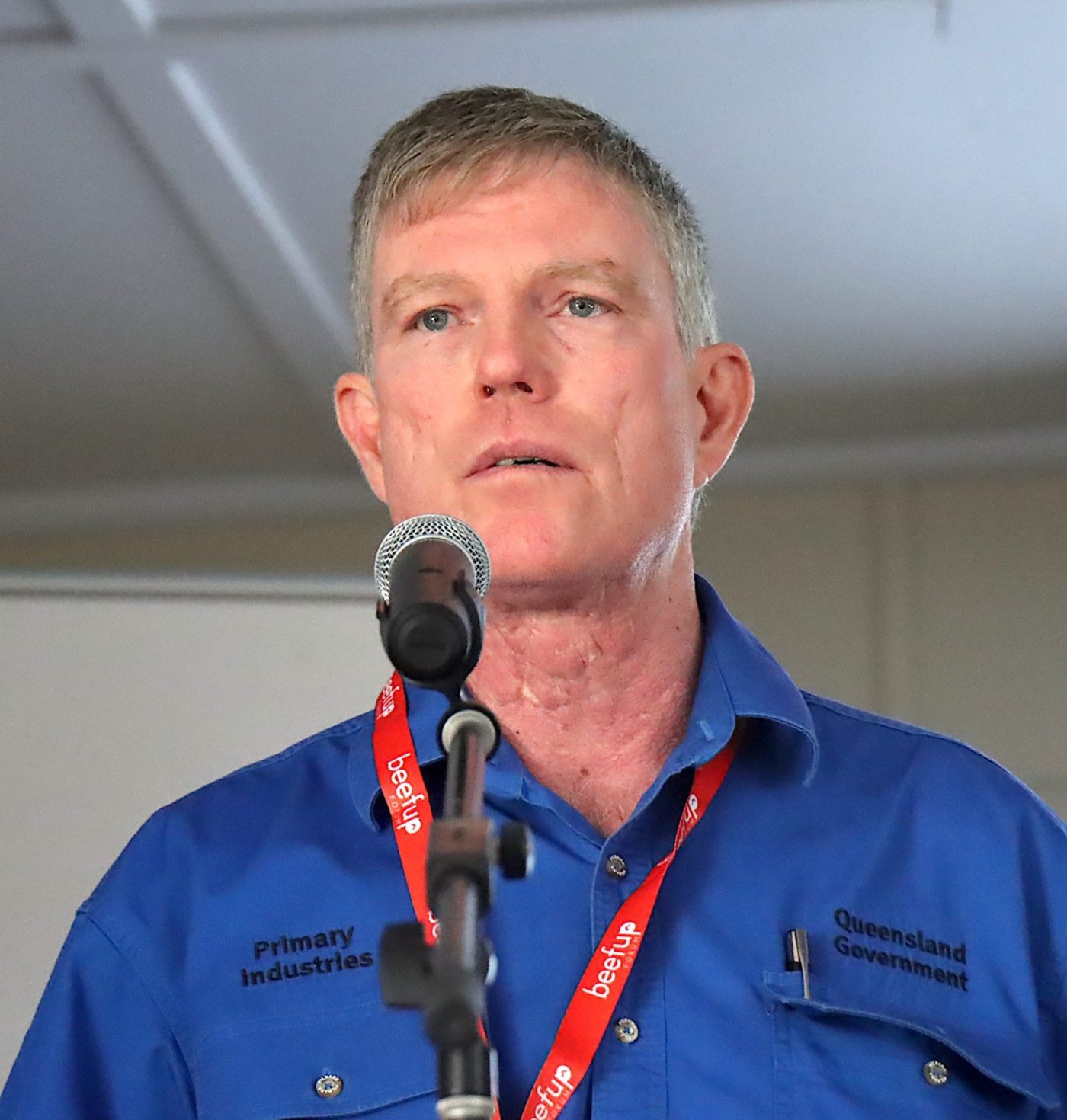 Queensland DPI pasture specialist Ted Callanan (right) told producers at last week’s BeefUp forum in Morven in western Queensland that the spread has largely followed sown pasture systems and rainfall patterns, with native pastures so far mostly unaffected.
Complex problem with no simple solution
While Mr Callanan said pasture dieback is strongly associated with the native sap-sucking mealy bug Heliococcus summervillei, the exact cause of plant death remains unclear.
He said the mealy bug weakens grasses by feeding on plant sap, leaving them vulnerable to additional stresses such as disease or seasonal conditions.
“Whilst this bug is always found with pasture dieback, whether it actually causes the death of the plant may or may not come true, but it certainly weakens the plant to where another fungal disease or another stress might attack and kill that plant.”
Mealy bugs were believed to be spread primarily by wind, helping to explain the rapid expansion across large geographic areas.
US research boost
He said knowledge around mealy bugs remained fairly limited, but the recent spread of mealy bugs in several states of America meant it was now being studied by experts from the USDA and the Smithsonian Institute, which could help to expand combined knowledge.
“While we don’t have a silver bullet here in Queensland or Australia just yet, fingers crossed with some extra experts around the world we might be able to move forward and come up with some sort of control for this little bug, trying to stop the spread.”
Susceptible pasture species
What is now known includes the varying susceptibility of different types of tropical sown pasture species.
Short-growing buffel varieties such as American and Gayndah, the most commonly planted sown pasture species, were highly susceptible, while taller Biloela buffel grasses have demonstrated greater tolerance.
“We have seen areas of Biloela buffel in pasture trial sites north of Talwood where an entire paddock has been wiped out with pasture dieback, so absolutely no grass species left at all in that paddock, except for weeds.
“The only plots left in that entire paddock are little squares where that Biloela buffel was originally planted some years ago.”
Practical strategies
Current best practice focuses on reducing risk and maintaining productivity, he said, with strategies including:
Managing the biomass of grass through grazing was one way to limit potential damage. “If you can reduce the food source for those bugs, you reduce the damage, you reduce the population.
 “If you have an area of susceptible grass that has bugs in it, and you’re starting to see serious damage, the call at the moment is to use that grass before you lose it.
“Those little bugs will take it if you don’t.
“So try and get some grazing out of that pasture before it’s too late, and then rest that grass going into the next season.
“Don’t graze yourself into a drought. Don’t do anything completely silly, but there’s a chance there with high density grazing with bigger animals for a shorter period of time, you can use some of that grass before it is too late.
“We’ve seen some really good examples of where that’s been done, in various places at a fairly large scale.”
Improving pasture diversity by introducing more tolerant species and legumes such as Desmanthus has also proven successful in making pasture more resilient.
Sowing a break crop was also a really good way of getting rid of susceptible grass. “If you’ve got a susceptible grass in your paddock that is just keeps getting re-infected, putting in a break crop, replacing that grass if you can, is a great way of controlling that risk.”
Managing for recovery was the recommended practice at scale, Mr Callanan said, but he also warned that pastures that recover naturally can remain vulnerable to reinfestation.
“Buffel grass, Rhodes grass, panic grass is very good at re-establishing from their own seed set, which is a good thing, so if it does get taken out in one growing season, it can recover.
“The bad news with that is that it doesn’t remove your risk. So in the next season, it could be the season after that, it could be a cycle of every three years, for example, because you’ve still got that susceptible grass and that risk there, the bugs can still come back.”
Controlling the bug itself has also proven challenging. Chemical control has not worked, because it is difficult to achieve a widespread kill of the bug, there is no legally-registered product for controlling the bug at scale and the high cost of chemical control is also prohibitive.
Nor has burning proven successful. While it may kill surface insects, it will not kill those bugs underground, protected by litter or in neighbouring blocks.
Case studies highlight challenges, but also pathways forward
One South East Queensland case study highlighted both the potential and the limitations of “management for recovery” as a response to pasture dieback.
In the example, Mr Callanan said a Rhodes grass paddock was completely decimated by dieback in 2019, with pasture replaced by less desirable species such as broadleaf weeds and love grass.
However, following a weed control program, by 2021 the paddock had recovered strongly with natural regeneration from existing seed reserves.
Within two to three seasons, the pasture had returned to full productivity.
“So two to three seasons later, it’s back and looking great.
“But without controlling that risk factor, the bugs come back.
“So by 2024 that pasture is sick again.
“By 2026, talking to those guys this month, they’re in what we are calling dieback induced drought. That pasture has collapsed again.”
As a result the producers are reducing cattle numbers again.
“So it comes back to managing the risk. Managing for recovery is low cost. It’s very easy to do.”
Another case study at Roma highlighted the value of reducing susceptible pasture species and introducing legumes which aren’t affected by dieback.
In 2024 on the Frith family’s Glen Arden property, paddocks with American and Gayndah buffel, recently seeded to Desmanthus, had significant dieback appear.
The Desmanthus increased in plant population per square metre and completely counteracted the dieback, with the affected country producing increased stock days per hectare above average carrying capacity.
Nearby paddocks with more tolerant Biloela buffel also retained productivity, demonstrating how species selection and diversity can significantly influence outcomes.
“We all know that legumes are good for increasing the carrying capacity, increasing the weight gain and improving the soil, so it’s just a win, win, win, win, win getting that legume in there,” Mr Callanan said.
“We’ve gone from a lot of bad news with dieback where it can come in and really effect your business, and have some really significant impacts, to potentially where there are some really good news stories to come out of dieback.”
Looking ahead
Despite the scale of the challenge, Mr Callanan said dieback was an opportunity to look at the broader pasture management picture.
“Don’t see dieback as the death of all things. Take a step back. Look at your paddock and go, what else is going on? What else can I do? Look for the opportunities.
“It’s an opportunity to go in and renovate that paddock, restore your productivity, restore your weight gain.”